Swinger Lifestyle for Beginners: Communication & Consent

Sex-positive spaces run on clear communication. Swinging adds more people, more variables, and less room for assumptions. This section gives you beginner-level communication skills you can use before, during, and after play.
You will learn how to state rules and boundaries in plain language, ask for consent without killing the mood, check in without pressure, and stop fast when something feels off. You will also learn how to do a short debrief after, so you and your partner stay aligned and avoid repeat mistakes.
This sub-chapter fits inside the larger guide, Rules, Boundaries, and Consent: The Foundation of the Swingers Lifestyle - What Is the Swingers Lifestyle? A Beginner-Friendly Guide. Use it as your script template, then adjust it to your own limits.
Good swinging runs on clear communication. You need it before play, during play, and after play. This section gives you practical scripts and checkpoints to avoid confusion, protect your boundaries, and keep consent clear in real time.
This is a sub-chapter of Rules, Boundaries, and Consent: The Foundation of the Swingers Lifestyle - What Is the Swingers Lifestyle? A Beginner-Friendly Guide. You will learn how to set rules with your partner, share boundaries with other couples, and use simple words for consent. You will also learn how to pause or stop without drama, and how to debrief after to prevent repeat mistakes.
What Is the Swingers Lifestyle? A Beginner-Friendly Overview
Definition and Core Idea
The swingers lifestyle is consensual non-monogamy in a social and sexual setting. You and your partner agree that you can have sexual contact with other people. You set rules first. You follow them every time.
This lifestyle focuses on consent, communication, and respect. You choose what you do. You choose what you do not do. You can stop at any moment.
Swinging usually involves couples. It can also include solo men or solo women, based on the event rules. It differs from cheating because you act with permission and clear limits.
Common Formats You Will See
Most beginners start with simple formats. You can scale up only if you both want it.
- Soft swap, sexual play without penetrative sex. Examples include kissing, touching, oral, and mutual masturbation, based on your rules.
- Full swap, sex that includes penetrative sex, if you both agree.
- Same-room, you play in the same space as your partner. Some couples prefer this for comfort and visibility.
- Separate-room, you play in different spaces. This needs tighter rules, clear check-ins, and strong trust.
- Play parties, events where social time comes first, then play areas open later. Rules vary by host.
- Clubs, venues with staff, house rules, and set nights. Many require consent checks and dress codes.
- Private meets, meetups with one couple or a small group in a home or hotel. You control the environment, but you carry all the responsibility.
Who Participates and Why
People in the lifestyle come from many age groups, orientations, and relationship styles. Some are married. Some date long term. Some are ethically non-monogamous outside swinging.
Common motivations include sexual variety, shared excitement, social connection with like-minded adults, and exploring fantasies with structure.
This lifestyle does not fix relationship problems. If you already struggle with trust, resentment, coercion, or poor communication, swinging can amplify it. You need stability first. You need mutual desire, not pressure.
Key Terms Beginners Hear
- Swap, trading partners for sexual play. Couples define what “swap” includes.
- Play, any agreed sexual activity. People use it as a flexible term.
- Veto, a pre-agreed stop signal or rule that ends an interaction. Use it sparingly and define how it works before you attend any event.
- Unicorn, a single person, often a bisexual woman, sought by a couple. Treat people as people, not roles.
- Compersion, feeling positive when your partner enjoys a consensual experience with someone else. Not everyone feels it. You can still swing with clear limits.
- Boundaries, your non-negotiables. Examples include safer sex rules, activities you avoid, and who you will not play with.
What Is the Swingers Lifestyle? A Beginner-Friendly Overview
Definition
The swingers lifestyle is a form of consensual non-monogamy. You and your partner agree to have social and sexual experiences with other people. Consent drives every step. Communication, rules, and boundaries keep it stable.
Most swingers join for shared experiences as a couple. Some spaces allow singles. Many do not.
Common formats
- House parties: Invite-only events hosted in a private home. Rules vary by host.
- Clubs: Paid entry, staff, and posted rules. Some clubs run beginner orientations.
- Private meets: One couple meets another couple, sometimes in a hotel or home.
- Resorts and cruises: Lifestyle-friendly vacations with planned social events and play spaces.
- Online communities: Apps, forums, and event pages used to screen, chat, and plan.
Key terms you will hear
- LS: Lifestyle. A common shorthand for swinging.
- Play: Any agreed sexual activity. It can mean kissing or intercourse. Always ask what someone means.
- Swap: Two couples exchange partners for play.
- Soft swap: Sexual play without intercourse, based on the couple’s rule set.
- Full swap: Intercourse is on the table, based on consent and agreed limits.
- Unicorn: A single person, often a bisexual woman, sought by a couple. Many communities flag this term because some couples treat unicorns as disposable. Use respect and clear expectations.
- Couples vs. singles policies: Many clubs and parties prioritize couples. Some allow single women, fewer allow single men. This shapes pricing, screening, and access.
What it is not
- Cheating: Cheating hides actions. Swinging requires prior agreement and ongoing consent.
- Coercion: If you pressure your partner, you break the core rule. Consent must be free and reversible.
- A fix for a failing relationship: Swinging can expose weak communication fast. It does not repair distrust on its own.
- One-size-fits-all: Couples set different rules. Some only watch. Some only soft swap. Some only play together. Some never repeat partners.
Benefits and realities
You can get novelty, shared excitement, and a stronger sense of teamwork. Many people also find community and social connection.
You also face real complexity. Jealousy can show up. So can mismatched desire, unclear boundaries, and post-event emotional swings. Alcohol can blur judgment and increase risk. Poor screening can create safety problems.
You get better outcomes when you plan, talk, and debrief. You set rules that match your values. You keep consent specific and current. You treat other people as people, not props.
Rules, Boundaries, and Consent: The Foundation (and How They Differ)
Rules, Boundaries, and Agreements, How They Differ
Rules control your partner. They try to manage someone else’s choices. They often create conflict if they feel restrictive or vague.
- Rule example, “You cannot kiss anyone.”
- Rule example, “You must text me every 30 minutes.”
Boundaries protect you. They state what you will do, what you will not do, and what you will do if a limit gets crossed.
- Boundary example, “I only have sex with condoms. If a condom comes off, I stop.”
- Boundary example, “I will not play with coworkers or close friends.”
- Boundary example, “If I feel overwhelmed, I take a break and leave the room.”
Agreements are shared commitments. You and your partner choose them together. They work best when you make them specific and easy to follow.
- Agreement example, “We tell each other before any new sexual contact happens.”
- Agreement example, “We only play when we both feel sober and clear.”
- Agreement example, “We keep phones on silent and check in at set times.”
| Type | What it does | Who controls it | Simple example |
|---|---|---|---|
| Rules | Limits partner behavior | One partner | No kissing |
| Boundaries | Protects your body and mind | You | I stop if condoms are not used |
| Agreements | Sets shared expectations | Both partners | We check in before escalating |
Consent Basics You Can Use Every Time
Enthusiastic means you get an active yes. No guessing. No reading between lines.
Informed means you share key facts. Safer sex expectations. Relationship status. What you want to do.
Specific means you ask for the act, not a general pass. Kissing is not consent for sex. Oral is not consent for penetration.
Reversible means anyone can change their mind at any moment. You stop fast. You do not punish them for stopping.
Ongoing means you check in as things change. New person, new act, more intensity, different room, different pace.
- Use clear asks, “Kiss?” “Hands here?” “Condom on?” “Do you want to keep going?”
- Listen for clear answers, “Yes,” “Stop,” “Slower,” “No oral,” “Not today.”
- Match actions to words. If you get anything less than clear consent, pause.
What “No” and “Not Yet” Look Like in Practice
No means stop. You do not negotiate. You do not ask why. You do not try again in five minutes.
Not yet means pause and reassess. The person may want more time, more trust, or different conditions.
- Good response to no, “Got it.” Then create space.
- Good response to not yet, “Thanks for telling me.” Then slow down or change activities.
- Use a simple exit plan. Step back. Get water. Leave the room. Rejoin later if you both want.
Pressure-free culture keeps people safe. It also keeps your reputation clean. People remember how you handled no.
Common Beginner Boundaries to Set Early
- Condoms and barriers, condoms for penetration, dental dams for oral, gloves for fingers. Decide what acts require barriers.
- Kissing, no kissing, kissing allowed, or kissing only with your partner.
- Oral sex, oral allowed only with barriers, oral with testing and trust, or no oral at all.
- Penetration, penetration only with your partner present, or only in the same room, or not at all.
- Emotional limits, no dating, no overnights, no one-on-one meetups, or no repeat partners.
- Alcohol and drugs, sober-only play, limit to one drink, or no substances that blur consent.
- Privacy, no photos, no real names, no sharing details with friends, no social media contact.
- Who is off-limits, coworkers, neighbors, close friends, family connections, or anyone tied to your daily life.
State your boundaries before clothes come off. Repeat them when a new person joins. Keep them short and direct.
Red Flags and Dealbreakers
- Coercion, pushing after a no, guilt, sulking, anger, or “come on, everyone does it.”
- Secrecy, hiding a spouse, lying about relationship status, or refusing basic transparency that affects consent.
- Ignoring boundaries, “accidentally” crossing limits, stealthing, removing barriers without consent, or trying to escalate without asking.
- Intoxication issues, pressuring you to drink, using substances to lower resistance, or engaging when someone cannot consent.
- Isolation tactics, blocking your exit, separating you from your partner without agreement, or discouraging check-ins.
- Disrespect, mocking limits, treating people like roles, or talking about “unicorns” as objects.
If you see a dealbreaker, you leave. You do not debate. You do not stay to be polite.
Rules, Boundaries, and Consent: The Foundation of the Swingers Lifestyle
Rules, Boundaries, and Agreements
You need structure before you play. Use three tools. Rules, boundaries, and agreements. They sound similar, but they work differently.
- Rules control what happens inside your relationship. Example, “We use condoms every time.” “We do not play when we are angry.”
- Boundaries protect your body and your emotional safety. They describe what you will and will not do. Example, “No anal.” “No being filmed.” “I leave if I feel pressured.”
- Agreements set expectations with your partner and with other people. They must stay realistic. Example, “We tell each other before we kiss someone.” “We only play in the same room.”
Keep rules and boundaries short. Write them down. Use plain words. Share agreements with others before clothes come off.
Consent Basics
Consent is the core skill. You must give it, ask for it, and respect it every time.
- Enthusiastic. You look for an eager “yes,” not a reluctant “fine.”
- Informed. You share key facts. STI status, condom use, what acts you want, and what you will not do.
- Specific. Consent for kissing does not mean consent for groping, oral, or penetration.
- Reversible. A yes can turn into a no at any moment. You stop fast, without punishment or debate.
- Sober enough to decide. If alcohol or drugs impair judgment, consent fails. Set limits before you drink.
Use direct language. “Can I touch your chest?” “Do you want oral?” “Condom required?” Ask again when you change the activity.
Common Beginner Boundaries
Beginners do best with a few clear boundaries. You can loosen them later. You will not fix confusion in the heat of the moment.
- Safer sex practices. Condoms for penetration. No condom switching between partners. New condom when changing holes. Barriers for oral if you want them. No play with visible sores.
- Touch permissions. No grabbing without asking. No face slapping, choking, or hair pulling unless you name it first.
- Rooms and visibility. Same room only. Door open only. No locked rooms. Or private room allowed with a check-in schedule.
- Alcohol limits. Two drink max. No shots. Water breaks. Stop play if anyone gets sloppy.
- Overnights. No sleepovers at first. Or overnights only if both of you agree in advance.
- No solo play. No meeting others alone. No private messaging. Or messaging allowed, but no plans without a shared chat.
Privacy and Discretion
Privacy protects your job, your family, and your mental health. Decide your discretion level before you attend events or message strangers.
- Photos and video. Default to no recording. If a venue allows cameras, ask the host rules. If you allow photos, require faces out of frame.
- Names. Use first names only. Use lifestyle names if you want. Do not share last names early.
- Workplace overlap. Avoid coworkers, clients, and people tied to your workplace. If you meet one, you leave.
- Social media. No tagging. No following personal accounts. Use separate profiles if you need them.
- Location sharing. Do not post real-time location updates. Do not share your home address until trust builds.
If you want a deeper privacy checklist, use the same mindset you would use for online adult spaces. See Camgirls Daten: Sicher und Anonym for practical data and anonymity habits you can adapt.
Red Flags You Should Treat as Stop Signs
- Pressure. They push for “just this once.” They mock your limits. They sulk when you say no.
- Pushy negotiation. They keep re-asking after your answer. They try to wear you down with compliments or guilt.
- Ignoring a no. They touch again after you stop them. They “accidentally” cross the line.
- Covert rule-breaking. They remove condoms without consent. They hide messages from their partner. They lie about testing.
You do not owe anyone access to your body. If a red flag shows up, you end the interaction. You leave. You block. You tell staff if you are at a venue.
For a broader safety and etiquette framework, use Safety and Etiquette: Health, Privacy, and Respect in Lifestyle Spaces.
Communication Skills for Beginners: Before Play (Planning, Screening, and Setting Expectations)
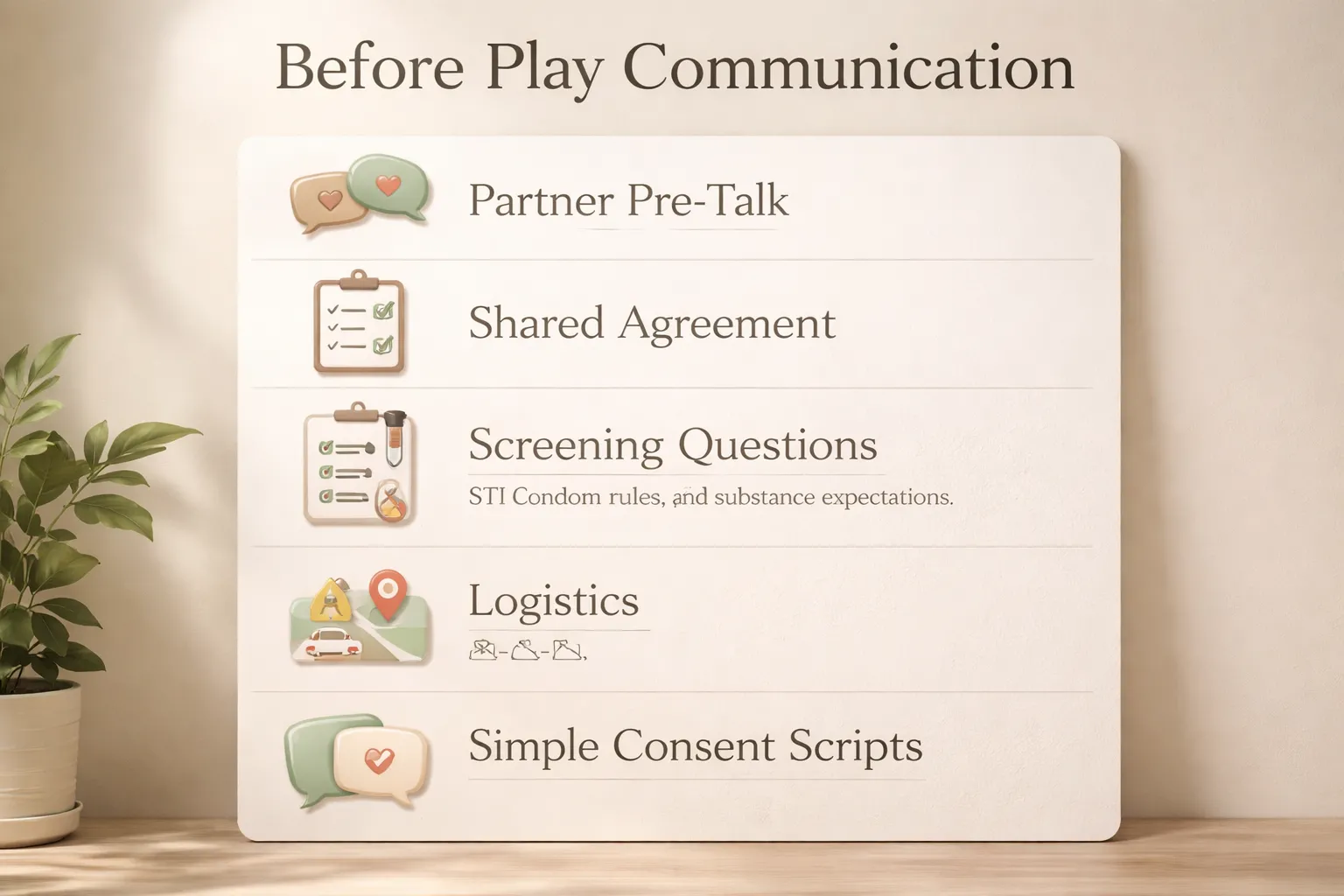
Pre-talk With Your Partner: Goals, Fears, Limits, and “Why Now?”
Start with a private talk. No phones. No alcohol. Set a time limit and take notes.
- Your goal: What do you want from this night, and what do you not want.
- Your “why now”: Curiosity, rebuilding intimacy, a shared fantasy, or exploring bisexuality. Say it out loud so you do not guess later.
- Your fears: Jealousy, feeling replaced, performance pressure, body insecurity, or losing control of the situation.
- Hard limits: Clear “no” items. No debate. Examples, no anal, no kissing, no fluid exchange, no separate rooms.
- Soft limits: “Maybe” items with conditions. Examples, kissing only with condoms for oral, no rough play, no multiple partners in one night.
- Aftercare needs: Quiet time, reassurance, shower, food, or a full debrief the next day.
Agree that either of you can stop the night at any time. No penalty. No blame.
Create a Shared Agreement
Turn your talk into rules you can follow in real time. Keep it short.
- What is allowed: Touching, kissing, oral, intercourse, toys, photos, dirty talk, lingerie, group play.
- What is not allowed: Your hard limits, plus anything that risks consent, privacy, or safety.
- What needs a check-in: Separate rooms, switching partners, removing a condom, BDSM, intoxication changes, adding a third person.
- Stop words and signals: Use simple terms. “Red” means stop now. “Yellow” means slow down and check in. Add a nonverbal signal for loud rooms.
- Phone policy: No photos or video. Phones away unless you need a ride or emergency help.
Decide how you will check in. Examples, every 15 minutes, after any new act, or when someone asks.
How to Communicate With Other People or Couples
Use direct language. State boundaries before you meet. Do not imply. Do not hint.
- Lead with facts: “We are new, we play together, condoms always, no separate rooms.”
- Ask respectful questions: Focus on safety and fit, not graphic detail.
- Confirm consent by action: Ask before each change. “Can I kiss you.” “Can I touch your chest.” “Do you want to keep going.”
- Respect a no: A no ends that topic. Do not push. Do not negotiate.
- Do not overshare: Share what they need to know for consent and safety. Keep private details private.
Screen for Compatibility and Safety
Screening saves time and reduces risk. Do it before you meet.
- Values and style: Do they play as a couple, swap, same room only, or separate rooms.
- Consent culture: Do they talk about boundaries without getting defensive.
- STI testing cadence: Ask when they last tested, what panel, and how often they test. Many experienced people test every 3 to 6 months. Match your risk tolerance.
- Condom norms: Condoms for intercourse. Decide your rules for oral. Ask their rules for condom changes between partners.
- Fluid and barrier rules: Condoms, dental dams, gloves, and lube. Bring your own supplies.
- Substance expectations: Agree on sober, light drinking, or no drugs. If they push substances, you leave.
Ask for proof if you need it. Respect privacy. A clear “no” to sharing results means you choose a different partner.
Practical Prep: Logistics, Privacy, Transport, Exit Plans, Sobriety
Plan the basics before you get turned on. Planning reduces mistakes.
- Location: Decide whose place, or a hotel. Avoid hosting if you cannot control privacy.
- Privacy: No real names if you prefer. No identifying photos. Keep cars, mail, and social media off limits.
- Time box: Set start and end times. Set a hard stop for leaving.
- Transportation: Drive yourself, or use rideshare you control. Do not rely on the other couple.
- Exit plan: Agree on a phrase that means “we leave now.” Example, “We have an early morning.” Leave together.
- Money and essentials: Bring cash, ID, charger, condoms, lube, wipes, and your own toys if you use them.
- Sobriety: Set a max drinks rule, or stay sober. Intoxication increases consent errors and conflict.
Scripts Beginners Can Use
Use simple lines you can say under pressure. Practice them with your partner.
- Disclose you are new: “We are new. We move slow and we check in a lot.”
- State your core rules: “We play together. Condoms always. No separate rooms.”
- Ask for boundaries: “What are your hard limits, and what needs a check-in for you.”
- Ask for consent: “Can I kiss you.” “Can I touch you here.” “Do you want to stop or keep going.”
- Say yes: “Yes, I want that. Keep going.”
- Say no: “No. I am not into that.”
- Say maybe: “Maybe later. Not right now.”
- Pause to check in: “Pause. I need to check in with my partner.”
- Enforce a boundary: “We said no to that. Do not ask again.”
- End the meet: “This is not a match for us. We are leaving now. Take care.”
- Handle pressure: “No. Pressure makes it a no.”
When you feel rushed, you stop and reset. When you feel unsafe, you leave.
Communication Skills for Beginners: Before Play (Preparation and Alignment)
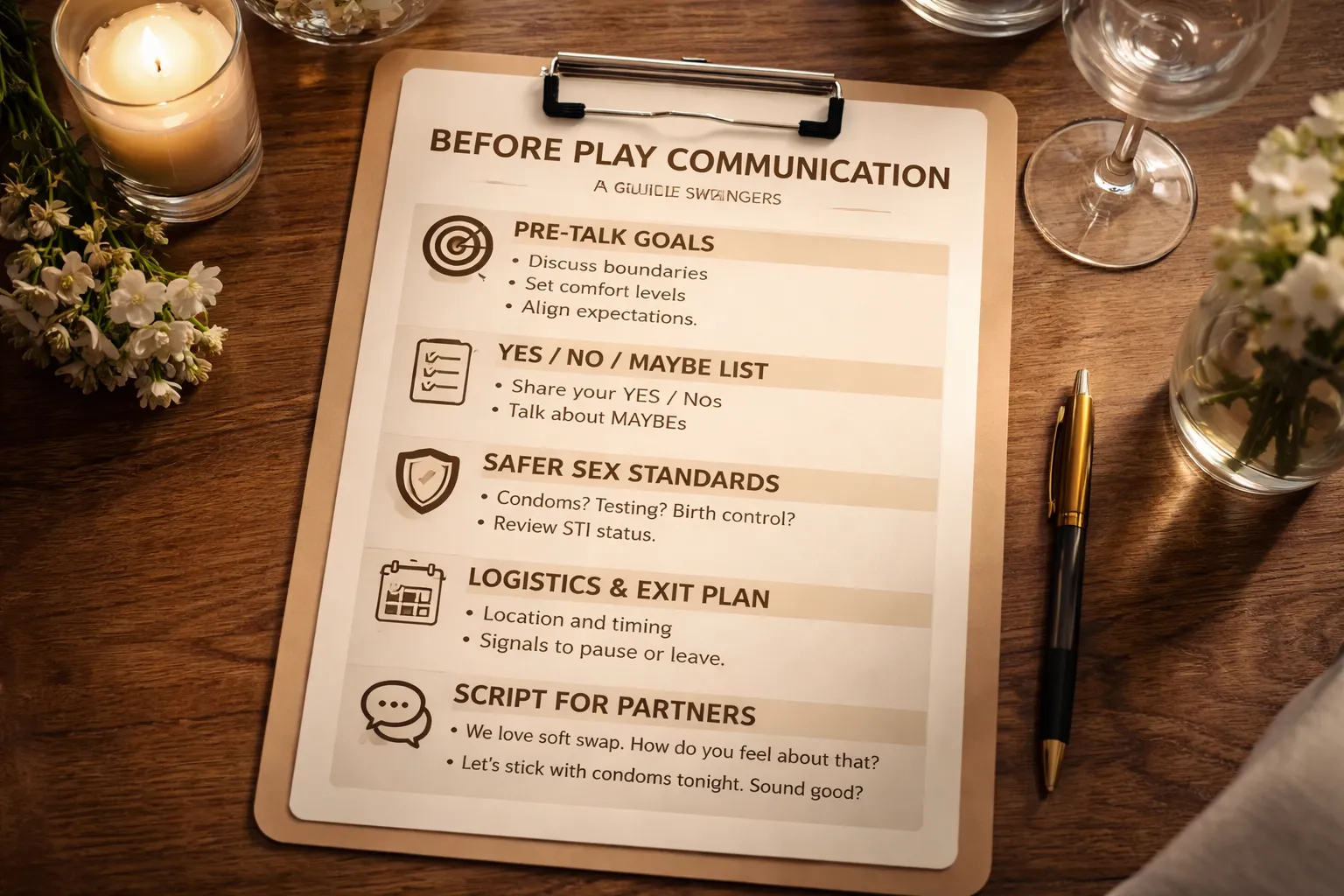
Pre-talk goals, align before you go
Start with a private talk with your partner. Do it before you pick a venue or message anyone. Keep it short. Keep it specific.
- Motivation: name what you want, novelty, group energy, new connections, or shared play.
- Curiosities: list 1 to 3 things you want to explore.
- Fears: name the top risks for you, jealousy, feeling ignored, performance pressure, or regret.
- Non-negotiables: set limits you will not cross.
- Success criteria: define what a good night looks like, even if you do not play.
Agree on one priority. Examples, stay together, keep it soft and slow, or leave early if either of you feels off.
Create a simple Yes, No, Maybe list
Use a three column list. Write it down. Update it after each experience.
- Activities: kissing, oral, penetrative sex, toys, BDSM elements, group play, voyeurism, photos.
- Partner types: couples only, singles, same room only, same bed only, same gender only, specific age ranges.
- Settings: club play areas, private rooms, house parties, hotels, same room with partner present.
Define what “maybe” means. Example, “Maybe with condoms only, with our partner in the room, after a clear verbal check-in.”
Set safer sex standards before you meet anyone
Decide your baseline rules. Then follow them every time. Do not negotiate in the moment.
- Barrier rules: condoms for penetration, condoms or dental dams for oral if you require it, gloves for manual play if you want it.
- Testing cadence: pick an interval you can sustain. Many people choose every 3 months if they have ongoing new partners.
- Disclosure expectations: what you will share, last test date, any known STI status, and barrier preferences.
- Fluid bonding: define what it means for you. Set prerequisites, mutual agreement, recent tests, and exclusivity rules if any.
- Alcohol and substances: set a maximum. Example, two drinks, no drugs, and no play if either of you feels impaired.
Logistics and exit plans, protect your ability to leave
Plan the night like you plan safety. Small details reduce pressure.
- Arrival and departure: set a time window. Agree on a hard stop.
- Transport: keep your own way home. Do not rely on new people for rides.
- Phones: keep them charged. Agree on where you store them.
- Code words: one word for pause, one word for leave now.
- Check-in schedule: set a rhythm. Example, every 30 minutes, and after any new escalation.
- Separation rules: define if you ever split up, and what conditions must be met.
Agree on a no-fault exit. If either of you says the leave word, you leave. No debate.
How to talk to potential partners, honest, brief, respectful
Share what affects consent and expectations. Keep the rest private until trust builds.
- Disclose early: relationship status, your boundaries that matter for them, and your safer sex rules.
- Disclose before play: specific acts you want, specific acts you do not want, and who needs to be present.
- Disclose only if relevant: personal history, detailed jealousy triggers, and private relationship problems.
- Ask direct questions: “What are your hard no’s?”, “What barriers do you use?”, “When was your last test?”
- Use clear language: say the act. Do not rely on hints.
- Respect a no: accept it once. Stop the topic.
Use short scripts you can repeat.
- “We play together, we do condoms for any penetration, and we do not do photos.”
- “Kissing is a no for me. Everything else we discuss case by case.”
- “We need verbal check-ins before anything escalates.”
Communication Skills for Beginners: During Play (Check-Ins, Nonverbal Cues, and Consent in Real Time)
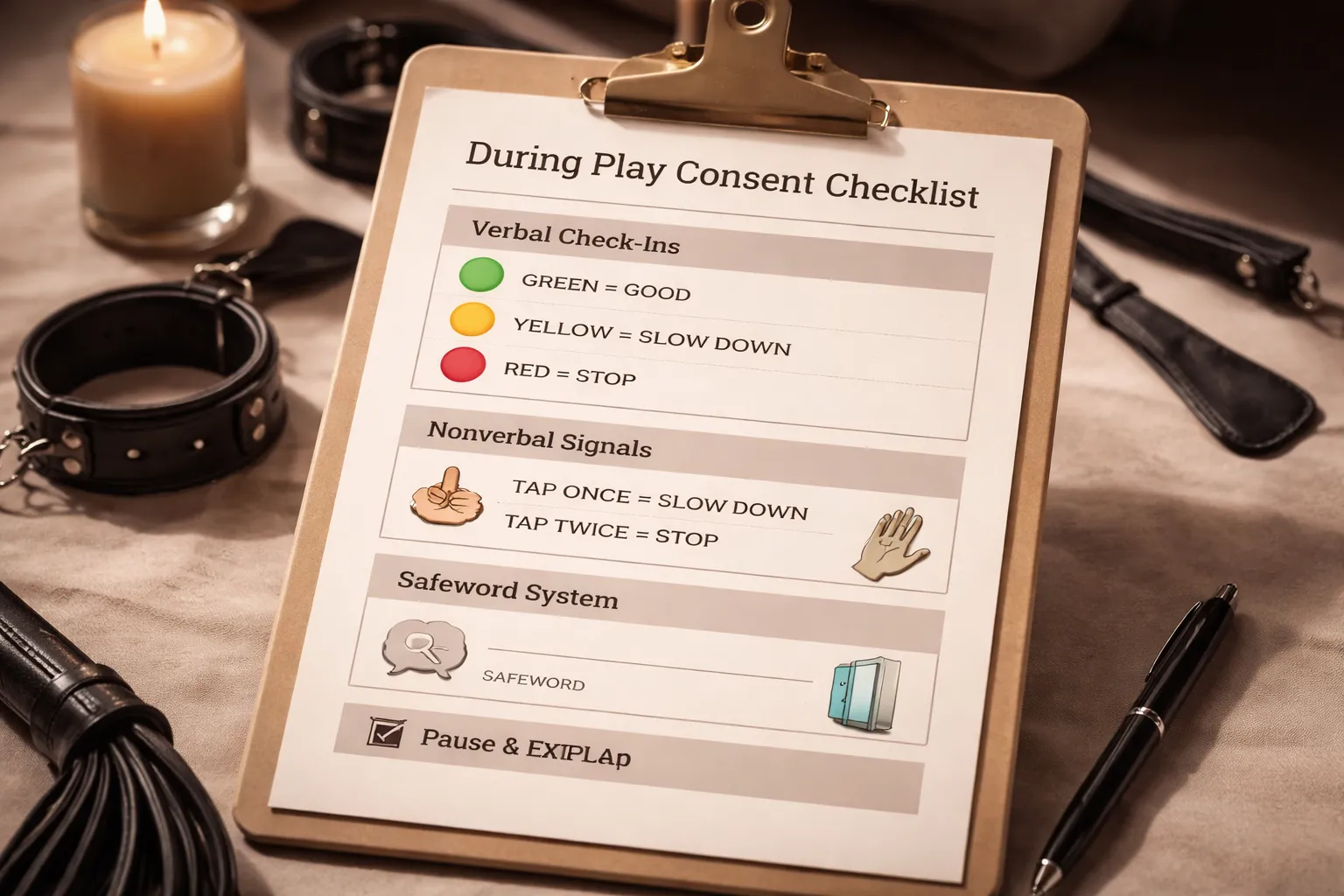
Consent in Real Time
Consent does not lock in. You confirm it while you play.
Use clear words. Keep your tone calm. Speak at normal volume.
- Ask before you change anything: “Can I do this?” “Do you want more?” “Do you want to switch?”
- Confirm the yes: “Say yes if you want it.” “Yes or no?”
- Check comfort: “How is this?” “Too much?” “Slower or stop?”
- Give easy exits: “You can say stop anytime.” “No hard feelings.”
- Respect silence: No answer means stop and ask again.
If you hear “no,” “stop,” “wait,” or “not that,” you stop. You do not negotiate.
Simple Check-In Systems
Agree on a system before clothes come off. Keep it simple so you use it.
- Verbal check-ins: Every few minutes, one person asks, “Green, yellow, or red?”
- Scale check: “0 to 10, how are you?” Treat 6 and below as a cue to slow down or pause.
- Eye contact rule: If you lose eye contact with your partner for long stretches, pause and reconnect.
- Buddy system: Each person stays responsible for their own partner’s comfort. You check your partner, not the room.
- Agreed signals: One tap means slow down. Two taps means stop. Hand squeeze means check in now.
- Safewords: Use words you will not say by accident. “Yellow” means pause and adjust. “Red” means stop now.
If you play in a loud space, rely on taps, hand signals, and direct eye contact.
When Things Change Mid-Scene
People change their mind. That is normal. Treat it as routine.
- Renegotiate fast: “I want to stop that.” “I am okay with kissing only.” “Clothes stay on now.”
- Reset the plan: “New limit. No penetration.” “We are switching to just watching.”
- Stop gracefully: “Pause. I need a break.” “I am done for tonight.”
- Move away: Sit up, step back, get water, put clothes on. Action makes the boundary clear.
You do not owe an explanation. You owe clarity.
Jealousy, Discomfort, and Overwhelm
If you feel a spike of jealousy or panic, you act early. You do not push through.
- Use a pause phrase: “Pause. I need to check in with my partner.”
- Regroup physically: Touch hands, hug, or sit side by side. Slow your breathing.
- Use the exit plan: “We are stepping out.” “We are leaving now.”
- Choose a simpler mode: Watching only. Cuddling only. Talking only.
If one partner calls a stop, the stop stands. No debate. No scorekeeping.
Alcohol, Drugs, and the Yes
Impairment changes consent. It also changes your judgment about risk.
- If someone seems impaired, you stop. Slurred speech, poor balance, delayed responses, glazed eyes, confusion.
- Do not “confirm” a yes from a drunk person. Treat it as a no.
- Set a rule before the night: “Two drinks max.” “No play after shots.” “No drugs, period.”
- When in doubt, end it: “We are done for tonight.”
Clear consent needs clear minds.
Etiquette During Play
Good etiquette protects consent. It prevents misunderstandings.
- Do not interrupt: Do not touch or join without an explicit invite from everyone involved.
- Ask before you watch close: Some people accept watching, others do not.
- No means no: No pushing, teasing, bargaining, or “just for a second.”
- Respect privacy: No photos. No video. No naming people later. No sharing details outside the agreed circle.
- Keep it clean: Change condoms between partners and between different types of sex. Use fresh lube and clean hands.
- Aftercare expectations: Ask what they want after. Water, a towel, a cuddle, space, or a quick goodbye.
For venue norms on privacy, health, and respectful conduct, see Safety and Etiquette: Health, Privacy, and Respect in Lifestyle Spaces.
Communication Skills for Beginners: During Play (Real-Time Consent and Check-Ins)
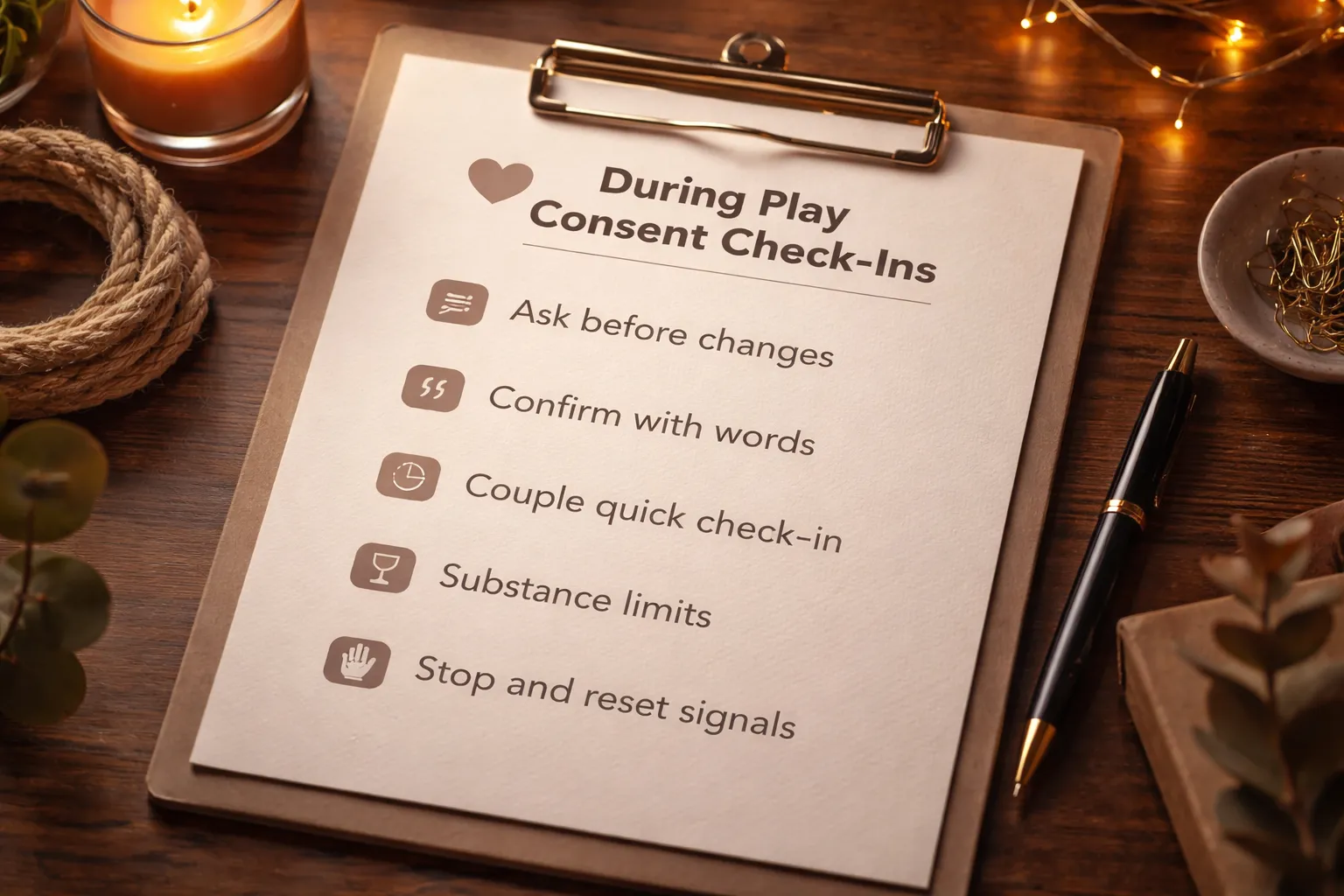
How to ask, and how to hear “no”
Ask in plain language. Use short sentences. Wait for a clear answer.
- “Do you want to keep going?”
- “Can I touch you here?”
- “Do you want oral, yes or no?”
- “Do you want to switch partners, yes or no?”
Hear “no” without debate. Say “Got it.” Stop. Change the activity or take a break.
- Do not ask why.
- Do not negotiate.
- Do not “joke” about it.
- Do not try again in five minutes.
If you get a “maybe,” treat it as “no for now.”
Micro-consent, check in at each change
Consent has to match the moment. You check in when you change intensity, position, pace, or activity.
- Before you escalate. “More?”
- Before you switch. “Change position?”
- Before you add someone. “Are you good with them joining?”
- Before you remove a barrier. “Condom stays on, yes?”
Use one rule. New move, new yes.
Nonverbal cues, but confirm with words
Read body language, then confirm out loud. New partners need explicit consent. Do not guess.
- If they freeze, stop.
- If they pull away, stop.
- If they go quiet, slow down and ask.
- If they stop making eye contact, check in.
Use simple confirmation.
- “Say yes if you want this.”
- “Tell me what you want next.”
- “Do you want me to stop?”
Silence is not consent. Nodding is not enough when you are unsure.
Couple check-ins without killing the vibe
Plan check-ins before you start. Keep them short. Use the same words every time.
- Quick question. “Green, yellow, or red?”
- Eye contact. Hold it for two seconds, then ask. “You good?”
- Planned pause. Agree on a two minute water break every 15 to 20 minutes.
- Partner-first rule. If your partner says pause, you pause. No explanation needed in the moment.
Do not make check-ins a group discussion. You can explain later, in private.
Alcohol and substances, capacity and stopping points
Alcohol and drugs reduce judgment and increase risk. Consent needs capacity. If capacity drops, you stop.
- Set a limit before you meet. Stick to it.
- Do not add new activities after heavy drinking.
- Do not treat impaired “yes” as valid consent.
- If anyone seems unsteady, confused, or unable to track what is happening, end play.
Use a clear rule. If you would not trust them to drive, you do not trust consent.
If something feels off, stop and reset
You do not need proof to stop. You need a signal and a plan.
- Use a stop word. “Stop.”
- Use a pause word. “Pause.”
- Use a reset line. “I need a break. Give me space.”
Step away. Get water. Get dressed if you want. Move to a different room.
Reset without blame. Keep it factual.
- “That does not work for me.”
- “I feel overwhelmed. I am taking a break.”
- “We are done for tonight.”
If someone argues, minimizes, or keeps pushing, you end the meet. You leave.
Communication Skills for Beginners: After Play (Aftercare, Debriefing, and Adjusting Agreements)
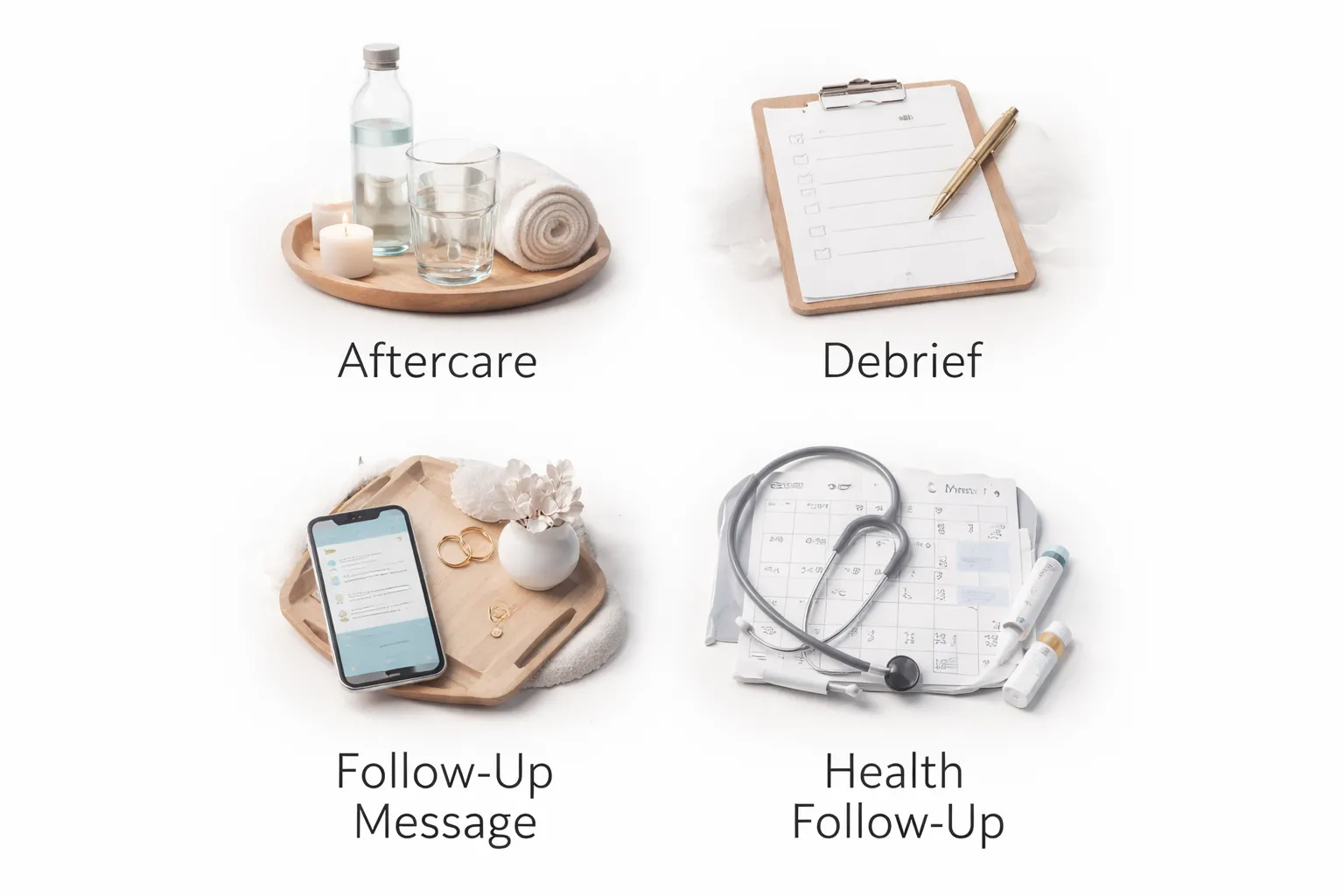
Aftercare: emotional reassurance, physical comfort, and decompression
Aftercare starts when play ends. Do not assume you and your partner want the same thing.
- Check in fast: Ask for one clear need. Water, snack, towel, shower, cuddle, or space.
- Regulate your body: Eat, hydrate, and slow your breathing. Adrenaline drops can feel like sadness or irritability.
- Offer reassurance: Use direct words. “I am here.” “I care about you.” “We are okay.”
- Respect decompression: Some people go quiet. Some people talk. Let each person choose their pace.
- Sleep plan: Decide if you go home, stay, or separate for the night. Do not improvise if you feel raw.
Debrief framework: what worked, what didn’t, what surprised you, what to change
Debrief within 24 hours. Keep it short. Aim for facts and feelings, not a trial.
- What worked: Name specific actions that felt good. Timing, pacing, touch, communication, and safer sex habits.
- What did not work: Describe the moment and impact. “When X happened, I felt Y, and I needed Z.”
- What surprised you: Jealousy spikes, unexpected arousal, discomfort, or new interests.
- What to change next time: One to three rules or preferences. Make them measurable.
Write down new agreements. Keep the list visible and shared.
Adjusting agreements without overcorrecting
Do not rewrite your whole rulebook after one night. Fix the failure point.
- Tighten one variable: Limits on positions, rooms, alcohol, time, or partner types.
- Add a pause rule: Either person can stop play without debate. You discuss later.
- Define communication cadence: Check-ins every 15 to 30 minutes, or after each partner change.
- Clarify “same room” rules: Same room can mean same bed, same sight line, or same space. Pick one.
Repair after triggers or conflict
Repair starts with ownership. You can name your feelings without blaming.
- Own your internal state: “I felt insecure and I shut down.”
- Name the behavior: Keep it concrete. “You left the room without telling me.”
- Ask for a specific fix: “Next time, text me before you move to another room.”
- Offer a clean apology: State what you did, the impact, and what you will do differently.
- Rebuild trust with actions: Shorter sessions, more check-ins, or a temporary reset to soft swap.
If you keep looping on the same fight, pause new play. Stabilize your relationship first.
Follow-up with other partners: gratitude, boundaries, privacy, and future expectations
Send a brief follow-up within 24 to 72 hours. Keep it respectful and discreet.
- Express gratitude: Thank them for their time and respect for boundaries.
- Confirm privacy: Restate what stays private. Do not share names, photos, or details.
- Close the loop on limits: If something crossed a line, state it calmly and clearly.
- Set expectations: Say if you want to meet again, need a break, or prefer to keep it at the same level.
- Do not negotiate by text when emotions run high: Use a call or in-person talk for anything sensitive.
Health follow-up: STI testing windows, symptom awareness, and transparency
Do your health admin fast. It protects you and your network.
| Item | Practical window | Notes |
|---|---|---|
| Chlamydia, Gonorrhea (NAAT) | About 7 to 14 days after exposure | Test throat, genital, and rectal sites based on contact. |
| Syphilis (blood test) | About 3 to 6 weeks, repeat at 3 months | Earlier tests can miss new infection. |
| HIV (4th gen antigen antibody) | About 2 to 6 weeks, confirm at 3 months | Ask your clinic which test they use. |
| Trichomoniasis | About 7 days to 1 month | Testing access varies by region and anatomy. |
| Hepatitis B, Hepatitis C | About 6 weeks to 6 months | Vaccinate for Hep B if you are not protected. |
| Pregnancy | About 2 to 3 weeks after risk | Emergency contraception works best as soon as possible. |
- Watch for symptoms: Unusual discharge, sores, burning, fever, pelvic pain, rash, or swollen nodes.
- Assume asymptomatic is possible: Many STIs show no signs. Do not rely on “feeling fine.”
- Share results: Tell partners if you test positive, or if you develop symptoms. Do it fast and with facts.
- Use a simple disclosure rule: New exposure, new symptoms, or positive test means you update your recent partners.
Communication Skills for Beginners: After Play (Aftercare, Debrief, and Growth)
Aftercare Basics
After play, slow down. Get water. Use the bathroom. Clean up. Change sheets if needed.
Do a quick physical check. Ask about pain, irritation, condom breaks, and any cuts. If something went wrong, deal with it now. Plan testing or emergency contraception if needed. Follow your safer sex plan.
Give emotional reassurance. Use clear words. Say what you enjoyed and what felt safe. Keep it specific.
Respect privacy needs. Some people want a cuddle. Some want space. Some want to leave fast. Ask. Do not take it personally.
- Good aftercare lines: “Do you want touch or space.” “Anything hurt.” “Do you want a recap now or tomorrow.”
- What to avoid: Critiques, jokes about bodies, and comparisons.
Debrief Framework (Fast and Useful)
Debrief while it is fresh, or set a time within 24 to 48 hours. Keep it short. Stay factual.
- What worked: Name two things that felt good and why. Keep it about actions.
- What did not work: Name one issue. Use “I felt” and “I needed.” Do not assign motives.
- What to change next time: One clear rule or request. Make it measurable.
- What stays the same: Confirm the boundaries that held up.
Write down your updated agreements. Memory fails after intense nights.
Handling Jealousy, Insecurity, and Unexpected Feelings
Expect emotional swing. Sex can trigger old fears. Treat the feeling as a signal, not a verdict.
- Name it: “I feel jealous.” “I feel left out.” “I feel replaceable.”
- Track the trigger: A look, a position, a partner choice, a long kiss, a private joke.
- Ask for a repair action: A cuddle, a shower together, a check-in text, sleep in the same bed, or a pause on repeats.
- Limit spirals: No interrogation. No phone stalking. No replaying the scene for hours.
If you cannot regulate, take a break from play. Choose sleep, food, and distance from alcohol. Revisit the topic when your nervous system calms down.
Repair After Missteps
When you mess up, own impact fast. Do not debate details first. Start with safety.
- Step 1: Stop the behavior. Create space and calm.
- Step 2: Acknowledge impact. “I see I crossed your line.”
- Step 3: Apologize without conditions. No “but.”
- Step 4: Ask what they need now. Then do it if you can.
- Step 5: Fix the system. Update rules, signals, or partner selection.
If consent got unclear, treat it as serious. Pause future meets with that person or couple until you rebuild trust. If you broke a hard boundary, expect consequences. You do not get to negotiate their reaction.
Ongoing Practices for Growth
Make check-ins routine. Short beats long. Use a weekly or post-event rhythm.
- Status check: “Green, yellow, or red.” Keep it simple.
- Boundary updates: Add or remove acts, people types, and settings.
- Health plan: Testing cadence, condom rules, and what counts as a risk event.
- Social plan: Who you tell, what you share, and how you handle photos and chat logs.
- Breaks: Take them early. Burnout creates sloppy consent.
Track patterns. If the same issue repeats, change the structure, not the promise. Smaller events. Fewer partners. More rules. Or step back for a while.
Where Beginners Start: Safer First Steps and Etiquette
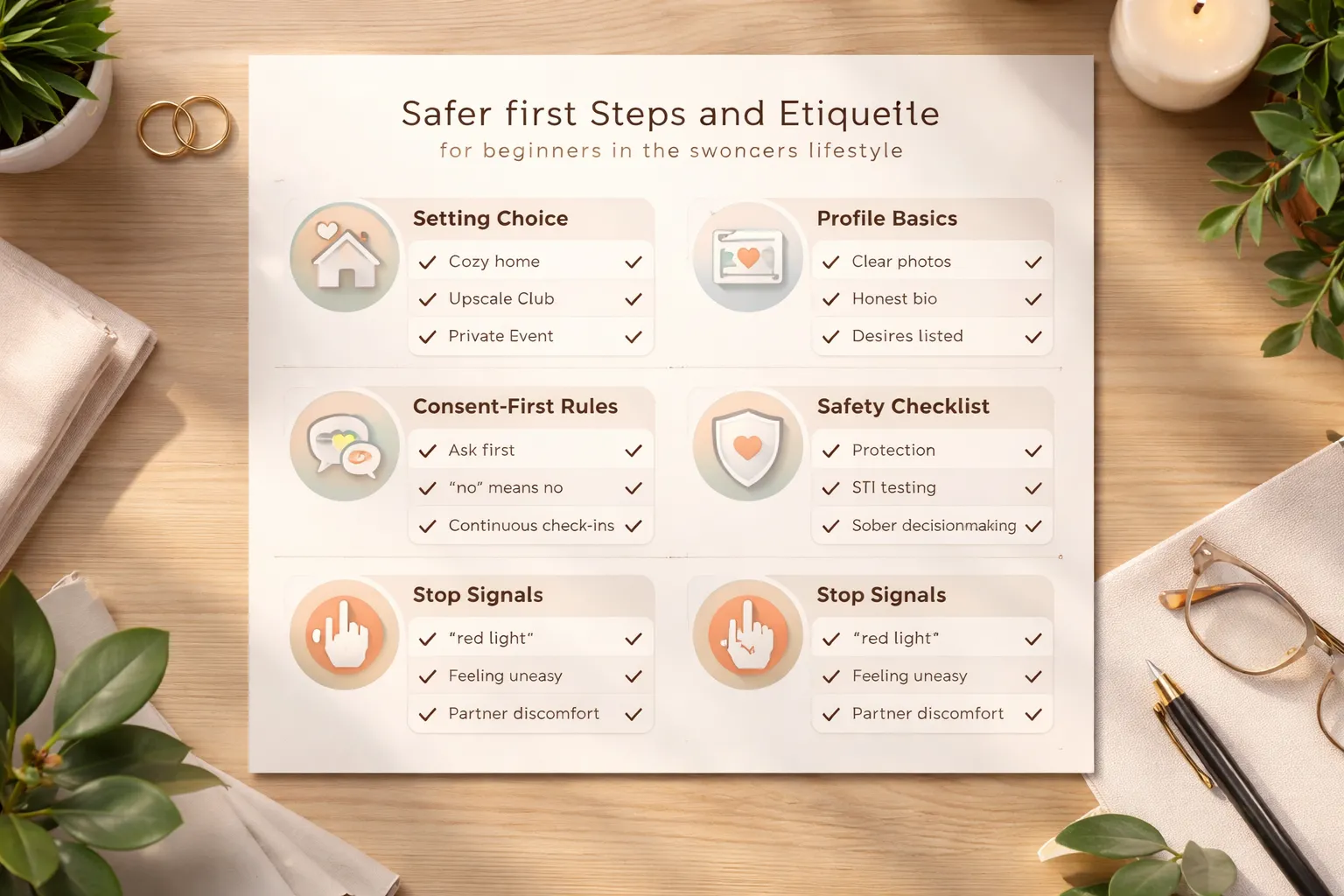
Choosing a Setting: Online Groups, Clubs, or Private Meetups
Your first step should match your risk tolerance and your social comfort level.
- Online groups, Lower cost. More time to screen. Higher risk of catfishing and mixed intentions. Use platforms with clear rules and active moderation.
- Clubs, Higher cost. More structure. Staff enforcement, house rules, and on-site consent norms. Less privacy, more public exposure.
- Private meetups, Highest privacy. Highest screening burden. Highest safety variability. Use them only after strong vetting and a public meet and greet.
For beginners, start where rules are visible and enforced. Structure reduces confusion.
Profile and Messaging Basics: Clarity, Kindness, No Pressure
Your profile should prevent wasted time and prevent misunderstandings.
- State your status, Couple or single, age range, location, and availability.
- State your intent, Social first, soft swap, full swap, or undecided. Use plain terms.
- State your boundaries, Condoms required, no oral without barriers, no filming, no intoxication, no overnight.
- State your screening, Testing cadence, last test date, and what you do with new exposures.
Message like an adult. Keep it short. Ask one or two clear questions. Accept a no fast.
- Do not pressure, No repeated asks, no guilt, no bargaining.
- Do not deceive, No old photos, no fake relationship status, no hidden rules.
- Do not rush, If someone tries to push you into private details or a fast meetup, slow it down.
Event Etiquette: Consent-First Touching and Conversation Norms
Etiquette starts before you arrive. Read the venue rules. Follow the dress code. Bring what you need, cash, ID, condoms, and your own supplies.
- Ask before touching, Hand on a waist, kiss, or any sexual contact needs a clear yes.
- Use simple consent checks, “Can I kiss you”, “Do you want to keep going”, “Condom on now”.
- Respect a no, Stop. Do not argue. Do not ask for a reason.
- Keep talk clean, No explicit comments to strangers. Start with normal conversation.
- Do not perform, Avoid loud commentary, crowding, or treating people like entertainment.
Follow the space rules. Many venues limit singles, restrict male attendance, or require couples to enter together. Do not try to bypass policies.
- Respect couple rules, Do not isolate one partner. Do not negotiate in a way that creates pressure.
- Respect single rules, If the venue limits singles, accept it. If a couple declines, move on.
- Respect privacy, No photos. No posting. No identifying details outside the event.
Safety Checklist: Practical Steps That Lower Risk
Use a checklist. It reduces mistakes when you feel excited or nervous.
- Transportation, Drive yourself, use rideshare, or set a firm pickup time. Do not rely on a new person for a ride.
- Meet and greet first, Public place. Short. No alcohol pressure. Leave if it feels off.
- Minimal personal info, Use a first name only. Avoid home address, workplace, and full legal name early on.
- Bring supplies, Condoms in your sizes, lube, barriers for oral, wipes, and a change of underwear.
- Substances, Set a limit before you go. If you cannot consent clearly, you stop.
- Exit plan, Agree on a word or signal with your partner. Use it without debate.
- Money, Pay your own entry and drinks. Avoid any situation that creates leverage.
When to Pause or Stop: Clear Red Flags
You should pause when reality stops matching the agreement. You should stop when you feel unsafe or pressured.
- Mismatched expectations, Someone pushes for acts you did not agree to, or tries to change terms midstream.
- Repeated boundary testing, They “forget” your rules, ask again after a no, or frame your boundary as a challenge.
- Emotional overwhelm, You feel panic, numbness, jealousy spikes, or shutdown. Take a break. Leave if needed.
- Consent confusion, Mixed signals, intoxication, or unclear yes means you stop and reset.
- Safety gaps, No condoms after agreement, hidden partners, surprise recording, or refusal to discuss testing.
Stopping is a complete sentence. You do not need to justify it. Leave, regroup, and debrief with your partner later.
- In het kort: Set rules, boundaries, and consent before you meet anyone.
- In het kort: Use clear words. Say yes, no, stop, and pause without softening.
- In het kort: Treat consent as active and ongoing. Check in during play.
- In het kort: Assume unclear signals mean no. Reset the moment things feel off.
- In het kort: Plan safety first. Agree on condoms, testing, and what happens if a rule breaks.
- In het kort: Stop fast for panic, numbness, jealousy spikes, or shutdown. Leaving is allowed.
- In het kort: Debrief after. Name what worked, what hurt, and what changes next time.
Key Takeaways
- You control access to your body. You can stop at any time.
- You need explicit consent. Silence and mixed signals do not count.
- You need shared rules with your partner. Put them in simple terms.
- You need clear boundaries with others. State them before clothes come off.
- You need sober decisions. If intoxication causes confusion, you stop.
- You need a stop plan. Use one word. Act on it.
- You need safer sex agreements. If someone breaks them, you end the encounter.
- You need aftercare and a debrief. Do it the same day if you can.
FAQ
What is the swingers lifestyle?
It is consensual, adult, non monogamous sex or play between individuals or couples. You set rules, you communicate, and you respect consent. You can stop at any time. People join for variety, connection, or shared experience, but consent stays the core.
Do we need to be a couple to start?
No. Some spaces welcome singles. Some do not. Read the venue rules before you go. If you are partnered, agree on boundaries first. If you are single, state your limits early and follow the group’s consent norms.
How do we set rules that work?
Keep them simple and measurable. Decide what you allow, what you do not, and what needs a check in. Add safer sex rules and a stop word. Write them down. Review them before each event. Change them only with sober agreement.
What does consent look like during play?
Ask, get a clear yes, and keep checking. Consent can change fast. If you hear no, stop. If you see hesitation, stop. If someone is too intoxicated to decide, you stop. You do not argue or negotiate in the moment.
How do we handle jealousy?
Plan for it. Name triggers before you go. Set time outs and a stop word. Stay close if that helps. Use aftercare and a same day debrief. If jealousy repeats, reduce intensity, change boundaries, or pause events until you feel stable.
What are common boundaries for beginners?
- Kissing allowed, intercourse not allowed.
- Play only in the same room.
- No one on one meetups.
- Condoms for all penetration.
- No alcohol or limit drinks.
- Stop word ends the encounter.
How do we talk to other people about our limits?
State limits before clothes come off. Use short sentences. Example, “Condoms always. No oral without a barrier. No anal. Ask before touching.” Repeat if needed. If someone pushes, you end the interaction and move away.
What safer sex rules should we use?
Agree on barriers, testing cadence, and what acts are allowed. Bring your own supplies. Use condoms for penetration, consider dental dams for oral. Do not assume anyone’s status. If a rule breaks, you stop and leave, then reassess as a couple.
What should we do after play?
Do aftercare first. Water, food, shower, quiet time, and reassurance. Debrief the same day if you can. Share facts and feelings. Keep blame out. Decide what to repeat, what to change, and what to pause. Then rest.
What are red flags we should watch for?
- Pressuring for acts you declined.
- Ignoring condoms or removing them.
- Heavy intoxication.
- Refusing to accept “stop” or “no”.
- Gossiping about private details.
- Trying to separate partners against plans.
How do we choose a safe first event?
Pick a well run venue with posted rules, staff, and clear consent policies. Go as observers first if allowed. Arrive early, stay sober, and leave when you want. Choose quality over crowd size. If you feel unsure, you exit.
Conclusion
Conclusion
Your best protection is clear talk. Set rules before you go. Confirm consent during play. Debrief after you leave.
Keep your first steps simple. Choose one venue or event. Go as observers if the space allows it. Stay sober. Keep your phones away. Leave at the first red flag.
Use one repeatable process every time:
- Before: agree on hard limits, soft limits, condoms, and exit timing.
- During: ask, wait for a clear yes, and stop fast when anyone says stop.
- After: check in, share what worked, name what did not, and update your rules.
Final tip. Write your rules down as a short checklist on your phone. Review it in the car before you walk in. Follow it, even if you feel pressure.
-
Swingers Lifestyle Guide: Safety, Etiquette, and Consent
1 month ago -
Swinging Consent and Boundaries: Safer Sex & Comfort
1 month ago -
Swinging vs Open Relationships: Emotional Impact Explained
1 month ago -
How to Debrief After Swinging: Break Jealousy Loops
1 month ago -
How to Debrief After Swinging: Fix Resentment Early
1 month ago
-
- Aftercare: emotional reassurance, physical comfort, and decompression
- Debrief framework: what worked, what didn’t, what surprised you, what to change
- Adjusting agreements without overcorrecting
- Repair after triggers or conflict
- Follow-up with other partners: gratitude, boundaries, privacy, and future expectations
- Health follow-up: STI testing windows, symptom awareness, and transparency
-
- What is the swingers lifestyle?
- Do we need to be a couple to start?
- How do we set rules that work?
- What does consent look like during play?
- How do we handle jealousy?
- What are common boundaries for beginners?
- How do we talk to other people about our limits?
- What safer sex rules should we use?
- What should we do after play?
- What are red flags we should watch for?
- How do we choose a safe first event?
-
- Aftercare: emotional reassurance, physical comfort, and decompression
- Debrief framework: what worked, what didn’t, what surprised you, what to change
- Adjusting agreements without overcorrecting
- Repair after triggers or conflict
- Follow-up with other partners: gratitude, boundaries, privacy, and future expectations
- Health follow-up: STI testing windows, symptom awareness, and transparency
-
- What is the swingers lifestyle?
- Do we need to be a couple to start?
- How do we set rules that work?
- What does consent look like during play?
- How do we handle jealousy?
- What are common boundaries for beginners?
- How do we talk to other people about our limits?
- What safer sex rules should we use?
- What should we do after play?
- What are red flags we should watch for?
- How do we choose a safe first event?
-
How to Debrief After Swinging: Break Jealousy Loops
1 month ago -
How to Repair Trust After a Boundary Is Broken
1 month ago -
How to Debrief After Swinging: Fix Resentment Early
1 month ago -
Aftercare & Support in Swinging: Red Flags and Resources
1 month ago -
Swinging Consent and Boundaries: Safer Sex & Comfort
1 month ago
-
Ethical Non‑Monogamy Terms: A Glossary of Common ENM Language
1 month ago -
How to Talk to Your Partner About Swinging (Without Pressure)
1 month ago -
Swinging Rules and Boundaries: Examples, Scripts, and Best Practices
1 month ago -
What Is the Swingers Lifestyle? A Beginner-Friendly Guide
1 month ago -
Swinging First Time Checklist: What to Do Before, During, and After
1 month ago