Swinging vs Open Relationship: Key Differences Explained

People often use “swinging” and “open relationship” as the same thing. They are not. The mix-up happens because both fall under ethical non-monogamy and both can involve sex outside your primary relationship.
Swinging usually means sex with other people as a couple, often in specific settings, with clear rules. An open relationship usually means you and your partner can date or have sex with others more independently, with boundaries you set together. The difference matters because the expectations, risks, and communication needs change fast when you pick the wrong model.
In this section, you will learn the core definition of each, the main ways they work in real life, and the practical signals that tell you which one fits your situation. If you want shared terms before you go deeper, use an ENM glossary at /ethical-non-monogamy-terms-a-glossary-of-common-enm-language.html.
Quick Definitions: What Is Swinging vs an Open Relationship?
Swinging: a couples-first, sex-focused model
Swinging means you and your partner have sex with other people by agreement. Most swinging stays recreational and physical. It usually does not aim for ongoing romance.
The couple stays the core unit. Many couples play together in the same room, or swap partners with clear rules. Some allow solo play, but many do not.
- Main goal: shared sexual experiences and novelty
- Common settings: parties, clubs, meetups, planned swaps
- Typical boundaries: play together, no dating, limits on repeat partners, condom rules
- Common success signal: you want sex that stays separate from romantic life
If you want a deeper beginner overview, read /what-is-the-swingers-lifestyle-a-beginner-friendly-guide.html. If you want myth checks, use /myths-about-the-swingers-lifestyle-what-s-true-vs-what-s-not.html.
Open relationship: permission for outside connections
An open relationship means you and your partner agree that each of you can have sex with others, and sometimes date others. The key feature is independent outside connections, not couple-based play.
Open relationships vary. Some allow sex only. Some allow romance. Some allow ongoing partners. Your rules define the model.
- Main goal: freedom for solo connections outside the primary relationship
- Common formats: casual hookups, friends with benefits, dating, ongoing partners
- Typical boundaries: disclosure rules, scheduling rules, safer sex rules, limits on overnights, limits on emotional involvement
- Common success signal: you want autonomy and you can manage time, privacy, and jealousy with clear agreements
Where polyamory fits
Polyamory means you can have more than one loving relationship at the same time, with consent. Many poly relationships include sex, but the defining feature is committed emotional bonds, not recreational sex.
Swinging and many open relationships focus on sexual openness. Polyamory focuses on multiple relationships. Some couples mix models, but you need to name what you want and write rules that match it.
For a direct comparison, see /swinging-vs-polyamory-what-s-the-difference-and-which-fits-you.html. For shared language, use /ethical-non-monogamy-terms-a-glossary-of-common-enm-language.html.
| Topic | Swinging | Open relationship | Polyamory |
|---|---|---|---|
| Core focus | Couple-based sex | Solo outside connections | Multiple loving relationships |
| Romance with others | Usually discouraged | Sometimes allowed | Expected and permitted |
| Most common structure | Together at events, swaps | Independent dating or hookups | Independent relationships |
| Typical risk point | Boundary drift at events | Mismatched expectations on feelings | Time and relationship imbalance |
Swinging vs Open Relationship: Key Differences (Side-by-Side Comparison)
Side-by-Side Comparison
| Category | Swinging | Open Relationship |
|---|---|---|
| Primary intent | Sexual variety with clear limits. You keep your core relationship central. | Relationship autonomy. Sex, dating, or both can sit outside the relationship. |
| Emotional expectations | Feelings with others usually stay off the table. Many couples treat romance as a boundary. | Feelings may happen. Some couples allow dating and emotional bonds, others limit them. |
| Partner configuration | Often couple-based. Swaps, threesomes, group play, and shared encounters. | Often individual-based. Each partner can date or hook up separately. |
| Frequency and structure | Event-driven. Parties, clubs, vacations, or planned meetups. | Ongoing. Regular texting, dating, and repeat connections are common. |
| Disclosure norms | High sharing. You often attend together and debrief together. | Depends on your rules. Some share everything, some keep details private, some use summaries only. |
| Common rules | Same room play, no solo meetups, no sleepovers, no repeat partners, condoms every time. | Scheduling limits, safer sex rules, no mutual friends or coworkers, disclosure timing, privacy boundaries. |
| Typical risk point | Boundary drift in the moment. Alcohol, group pressure, unclear signals. | Mismatched expectations about feelings. One partner wants casual, the other bonds. |
| Common stressor over time | Uneven interest. One partner wants more events than the other. | Time imbalance. Dating can pull attention away from the main relationship. |
| Community and culture | Clubs, house parties, resorts, swinger forums. Clear etiquette, lots of couple norms. | Dating apps, ENM meetups, online groups. Broader mix of relationship styles and rule sets. |
How to Use This Comparison
- If you want shared experiences, swinging usually fits better. You do it together, you leave together.
- If you want independent freedom, an open relationship usually fits better. You each manage your own connections.
- If feelings are a hard no, swinging culture tends to match that boundary. You still need clear limits and a plan for when feelings happen.
- If you can handle emotional complexity, open relationships give more room for dating, attachment, and longer arcs.
Terms You Will See
If you need quick definitions for common ENM words and rules, use your glossary. Ethical Non‑Monogamy Terms: A Glossary of Common ENM Language.
Rules, Boundaries, and Consent: How Agreements Commonly Differ
Typical Swinging Boundaries
Swinging agreements often focus on keeping sex recreational and contained. You set rules that reduce surprises and limit attachment.
- Same-room play: You keep sexual activity in the same space as your partner. You avoid private rooms or separate areas.
- No repeats: You avoid seeing the same person again. You reduce the chance of ongoing connection.
- Safer sex rules: You require condoms and barriers for specific acts. You set clear rules for fluids and contact.
- No solo play: You only play as a couple. You do not meet others alone.
If you are new, learn common event and profile language before you show up. See Swingers Lifestyle Slang: Acronyms, Codes, and What They Mean.
Typical Open-Relationship Boundaries
Open relationship agreements often manage time, emotions, and daily-life impact. You build rules that protect your primary relationship and your schedule.
- Who, where, when: You set limits on partner types, locations, and timing. Some couples ban coworkers, neighbors, or mutual friends.
- Overnights: You decide if sleepovers are allowed. If yes, you set frequency, notice, and day-of rules.
- Emotional boundaries: You define what dating means for you. You clarify if “I love you,” gifts, trips, or holidays are on or off limits.
- Friend and ex boundaries: You decide if friends, exes, or past hookups are allowed. Many couples ban them to prevent social fallout.
Use shared language for your structure and rules. Your glossary helps. See Ethical Non‑Monogamy Terms: A Glossary of Common ENM Language.
Consent Best Practices
Rules do not replace consent. You need both, every time.
- Explicit agreements: You write down key rules. You define terms like “sex,” “date,” “overnight,” and “barrier.”
- Ongoing check-ins: You review agreements on a schedule, after dates, and after events. You update rules when reality changes.
- Enthusiastic consent: You look for a clear yes. You treat hesitation as a no.
- Right to pause or stop: You agree on a stop word or signal. You leave without debate when your partner calls it.
Privacy vs Transparency
You need a plan for what you share and what stays private. This reduces conflict and protects other partners.
- What often gets shared: Who you are seeing, when you will be out, where you will be, and safer sex details that affect risk.
- What often stays private: Graphic sexual details, private texts, and personal disclosures from other partners.
- Default rule: You do not share another person’s identifying details without permission.
Safer Sex and STI Testing Protocols
Set protocols you can follow under stress. Keep them simple and consistent.
- Testing cadence: Many people choose testing every 3 months if they have ongoing new partners. Some test every 6 months with fewer changes. Pick a schedule and stick to it.
- Barrier use: You decide which acts require condoms, internal condoms, gloves, and dental dams. You decide rules for oral sex and sex toys.
- Disclosure: You share recent test dates, results, and current risk factors before sex. You disclose symptoms and known exposures fast, then you pause sex until you have a plan.
| Area | Swinging agreements often focus on | Open relationship agreements often focus on |
|---|---|---|
| Setting | Same-room play, events, couple-based meetups | Dates, ongoing connections, separate time |
| Repeat partners | Often limited or banned | Often allowed, sometimes encouraged |
| Solo activity | Often not allowed | Often allowed with notice and limits |
| Emotions | Often treated as a boundary risk | Often managed with explicit emotional rules |
| Time management | Usually event-based | Usually calendar-based |
Emotional and Relationship Impact: Jealousy, Compersion, and Attachment
Emotional and Relationship Impact: Jealousy, Compersion, and Attachment
Swinging and open relationships create different emotional pressure points. In swinging, many couples treat strong feelings as a stop sign. That can reduce drama, but it can also push emotions underground. In open relationships, feelings often show up because you spend more time, build routines, and repeat partners. You need rules for attachment, communication, and time, not just sex.
Jealousy tends to hit in different places. Swinging jealousy often centers on the moment, attention, and comparison. Open relationship jealousy often centers on priority, consistency, and fear of replacement. Compersion, feeling good about your partner’s pleasure, can grow in both, but it usually requires clear agreements and regular check-ins.
- Swinging: lower day-to-day attachment risk, higher in-the-room intensity.
- Open relationship: higher attachment risk, higher scheduling and emotional labor.
- Both: your outcomes track your honesty, boundaries, and repair skills.
Read our detailed guide: Emotional and Relationship Impact: Jealousy, Compersion, and Attachment - Swinging vs Open Relationship: Key Differences Explained
How to Choose What Fits: Questions to Ask Before You Try Either
Your goals
Start with what you want, not what sounds exciting.
- Sex-only exploration: You want variety, novelty, and shared experiences with low ongoing connection.
- Dating and connection: You want one-on-one time, flirting, and the option for repeat dates.
- Both: You want sexual variety and room for connection, with clear guardrails.
If your goal includes bonding, call it that. If your goal stays sexual, protect it with tighter rules. If you need language help, use a glossary like /ethical-non-monogamy-terms-a-glossary-of-common-enm-language.html.
Your relationship foundation
Ethical non-monogamy magnifies what you already do. It does not fix weak basics.
- Communication: You can ask for what you want. You can hear no without punishment.
- Trust: You keep agreements. You disclose mistakes fast.
- Conflict style: You repair. You do not stonewall. You do not escalate.
- Jealousy plan: You name triggers. You set coping steps. You schedule check-ins.
If you still argue about phones, flirting, or porn, solve that first. Start with low-risk steps before you add other people.
Time and logistics
Choose the structure you can support with your real life.
- Dating time: Open relationships often require messaging, dates, and follow-up.
- Scheduling: You need calendars, notice periods, and cancellation rules.
- Childcare: You need coverage, privacy, and predictable windows.
- Energy: You need bandwidth for jealousy talks, STI steps, and aftercare.
Many couples fail here. They agree in theory, then fight about time. Decide your weekly limit in hours, not vibes.
Dealbreakers to set before you start
Write these down. Vague rules break under pressure.
- Emotional attachment: Are feelings allowed. If yes, what happens when they grow.
- Overnights: Allowed or not. If allowed, how often and with how much notice.
- Friends and coworkers: Allowed or not. If allowed, what disclosure rules apply.
- Repeat partners: One-time only, occasional repeats, or ongoing connections.
- Solo play: Only together, or independent dates allowed.
- Safer sex rules: Condom use, testing cadence, and what counts as a risk event.
- Privacy: What details you share, what stays private, and what you never hide.
If you want a beginner overview of swinging norms, read /what-is-the-swingers-lifestyle-a-beginner-friendly-guide.html. If you think you want multiple relationships, compare with polyamory at /swinging-vs-polyamory-what-s-the-difference-and-which-fits-you.html.
A simple decision framework
Use these prompts as filters. Treat them as requirements, not preferences.
Pick one model for a trial period. Set a review date. Track outcomes against your agreements. Adjust once, then reassess.
Getting Started Safely (Beginner Roadmaps for Swinging and Open Relationships)
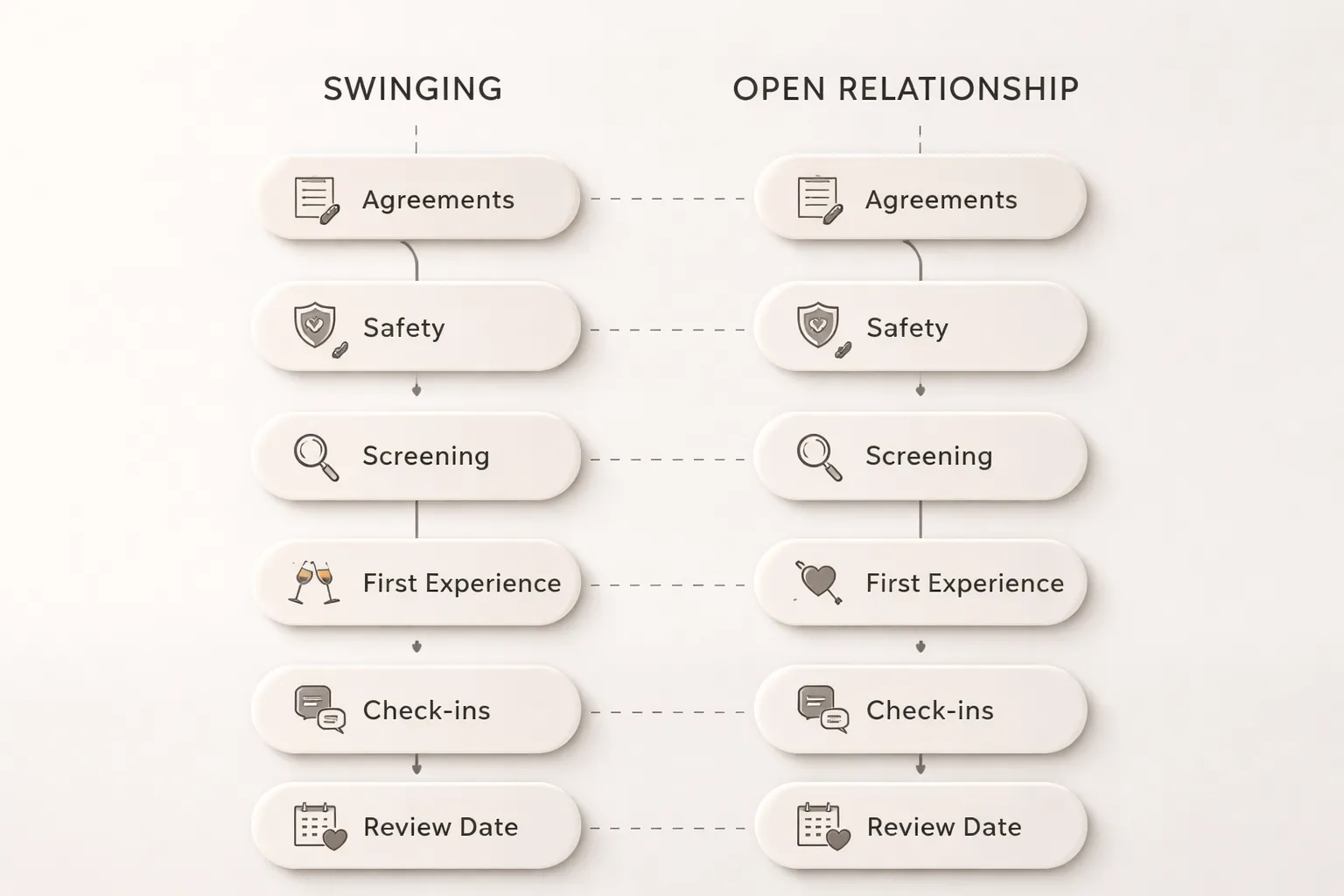
Start small. Move slow. Treat this as risk management, not a thrill plan. You need clear agreements, repeatable check-ins, and a stop rule you will use without debate. Most first-timer failures come from vague boundaries, unclear consent, and skipping safer sex basics. Build a simple roadmap for your model, then run a short trial with a review date. For swinging, focus on venue choice, social screening, and rules for play and exit. For open relationships, focus on time limits, disclosure, texting norms, and emotional boundaries. Track what you did, what you felt, and where you broke agreements. Fix the system before you add more partners. Learn the slang and common norms before you show up.
- Baseline: agreements in writing, safe word, exit plan, weekly check-in.
- Health: STI testing cadence, condoms, birth control, substance limits.
- Ops: screens, meet first, verify identity, no home address early.
- Privacy: no friends, no coworkers, separate socials, photo rules.
- Review: trial period, score outcomes, revise once, reassess.
Read our detailed guide: Getting Started Safely (Beginner Roadmaps for Swinging and Open Relationships) - Swinging vs Open Relationship: Key Differences Explained
FAQ: Swinging vs Open Relationship Differences
What is the main difference between swinging and an open relationship?
Swinging focuses on sex with others, usually as a couple activity, often with rules like same-room play. Open relationships allow ongoing partners and may include dating and emotional bonds. Both require consent, boundaries, and clear communication.
Does swinging allow dating?
Most swingers avoid solo dating. They prioritize couple-to-couple meets, parties, or swaps. Some couples allow limited dating, but it is less common. If dating matters to you, an open relationship structure usually fits better.
Do open relationships allow feelings?
Often, yes. Many open relationships allow emotional connection with outside partners. Some couples restrict feelings and keep it casual. You need clear rules on attachment, time, and disclosure to reduce conflict.
Is swinging usually “together,” or can you play separately?
Many couples swing together, same room or nearby. Some allow separate play with check-ins and limits. Decide what “together” means for you, and define rules for leaving the room, overnights, and aftercare.
Which option has more rules?
Both can have strict rules. Swinging often sets rules for acts, protection, alcohol, and same-room limits. Open relationships often set rules for dating frequency, texting, sleepovers, holidays, and emotional boundaries. Your risk tolerance drives your rules.
What does “ENM” mean, and how does it relate?
ENM means ethical non-monogamy. Swinging and open relationships fall under ENM when everyone consents and you follow agreed rules. Use shared terms to avoid confusion. See Ethical Non‑Monogamy Terms: A Glossary of Common ENM Language.
Is swinging safer than an open relationship?
Neither is automatically safer. Risk depends on partner count, condom use, testing cadence, and honesty. Swinging can mean higher event exposure. Open relationships can mean repeated exposure with fewer partners. Set testing and barrier rules and follow them.
How often should you test for STIs?
Many ENM couples test every 3 months, and sooner after a new partner or a condom failure. Include HIV, syphilis, gonorrhea, chlamydia, and hepatitis as advised by your clinic. Share results and set rules for pauses when waiting.
What boundaries matter most when starting?
Pick a few non-negotiables. Examples include condoms for all penetration, no overnights, no friends or coworkers, and no home address sharing early. Define stop words, substance limits, and aftercare. Review your rules after a trial period.
How do you avoid jealousy and resentment?
Use clear agreements and fast feedback. Schedule check-ins, track what worked, and stop what caused harm. Keep time budgets for your primary relationship. Do not agree to terms you cannot keep. Adjust rules once, then reassess after more data.
Where can you learn common swinging terms and etiquette?
Misunderstood terms cause conflict. Learn basics before you message couples or attend events. Read Swingers Lifestyle Slang: Acronyms, Codes, and What They Mean and What Is the Swingers Lifestyle? A Beginner-Friendly Guide.
Conclusion: The Core Takeaway on Swinging vs Open Relationships
Swinging and open relationships both allow sex outside your relationship. The difference is structure and intent.
- Swinging centers on couple-based sex, shared settings, and clear event etiquette. It often stays recreational.
- An open relationship centers on independent dating or sex, with fewer group norms and more logistics to manage.
Your best fit depends on how you handle autonomy, time, privacy, and emotional attachment. Decide what you want first, then write rules that match it.
Use one practical test. If you need high control and shared experiences, start with swinging. If you need independence and solo choice, start with an open relationship. Track outcomes for 30 days. Update rules once. Reassess together.
Reduce conflict by using the same language. Learn terms before you set rules or message others. Use Swingers Lifestyle Slang: Acronyms, Codes, and What They Mean and Ethical Non‑Monogamy Terms: A Glossary of Common ENM Language.
-
Swingers Lifestyle Slang: Acronyms, Codes, and What They Mean
6 months ago -
Ethical Non‑Monogamy Terms: A Glossary of Common ENM Language
6 months ago -
What Is the Swingers Lifestyle? A Beginner-Friendly Guide
6 months ago -
Swinging vs Polyamory: What’s the Difference (and Which Fits You)?
6 months ago -
Myths About the Swingers Lifestyle (What’s True vs What’s Not)
6 months ago
-
-
- What is the main difference between swinging and an open relationship?
- Does swinging allow dating?
- Do open relationships allow feelings?
- Is swinging usually “together,” or can you play separately?
- Which option has more rules?
- What does “ENM” mean, and how does it relate?
- Is swinging safer than an open relationship?
- How often should you test for STIs?
- What boundaries matter most when starting?
- How do you avoid jealousy and resentment?
- Where can you learn common swinging terms and etiquette?
-
-
-
- What is the main difference between swinging and an open relationship?
- Does swinging allow dating?
- Do open relationships allow feelings?
- Is swinging usually “together,” or can you play separately?
- Which option has more rules?
- What does “ENM” mean, and how does it relate?
- Is swinging safer than an open relationship?
- How often should you test for STIs?
- What boundaries matter most when starting?
- How do you avoid jealousy and resentment?
- Where can you learn common swinging terms and etiquette?
-
-
How to Debrief After Swinging: Break Jealousy Loops
6 months ago -
How to Repair Trust After a Boundary Is Broken
6 months ago -
How to Debrief After Swinging: Fix Resentment Early
6 months ago -
Aftercare & Support in Swinging: Red Flags and Resources
6 months ago -
Swinging Consent and Boundaries: Safer Sex & Comfort
6 months ago
-
Swinging First Time Checklist: What to Do Before, During, and After
6 months ago -
How to Handle Jealousy in Swinging: Practical Tools That Work
6 months ago -
How to Talk to Your Partner About Swinging (Without Pressure)
6 months ago -
Swingers Lifestyle Slang: Acronyms, Codes, and What They Mean
6 months ago -
Ethical Non‑Monogamy Terms: A Glossary of Common ENM Language
6 months ago