Swinging vs Polyamory: What’s the Difference (and Which Fits You)?
Swinging and polyamory both fall under ethical non monogamy. They work in different ways. Swinging focuses on sex with other people, usually as a couple, with limited emotional attachment. Polyamory focuses on having more than one romantic relationship, with consent from everyone involved.
This guide breaks down the core differences in goals, rules, time demands, and emotional expectations. You will learn how each style handles boundaries, communication, jealousy, privacy, and safer sex. You will also see which common assumptions do not match real world practice. If you want background basics, start with What Is the Swingers Lifestyle? A Beginner Friendly Guide, then review Myths About the Swingers Lifestyle.
Definitions: Swinging vs Polyamory Differences at a Glance
What is swinging?
Swinging is a social and sexual activity. Most often, it involves couples. Some single people participate, depending on the event or community rules.
The focus sits on sex and shared experiences. Many swingers keep their primary relationship as the center. Emotional exclusivity varies by couple, but many prefer limited romantic attachment to outside partners.
Swinging often happens in specific settings. House parties, clubs, takeovers, and hotel meetups are common. Some people also use apps to arrange private dates.
If you need basic terms and codes, use Swingers Lifestyle Slang: Acronyms, Codes, and What They Mean.
What is polyamory?
Polyamory means having more than one romantic relationship. Everyone involved consents. People aim for ongoing connection, not a one time encounter.
Poly relationships can include sex, but romance is the defining feature. Many poly people schedule regular time with multiple partners. They also negotiate expectations around commitment, communication, and future planning.
Polyamory can be hierarchical or non hierarchical. Some people prioritize a nesting partner. Others avoid ranking partners. You will see many models and many labels.
If you want a clear vocabulary baseline, use Ethical Non‑Monogamy Terms: A Glossary of Common ENM Language.
Shared umbrella: ethical non-monogamy (ENM) and consent
Swinging and polyamory both fit under ethical non monogamy. ENM means you do not hide partners, intentions, or agreements. You get clear consent from everyone affected.
Both styles rely on communication. Both require boundaries you can explain and enforce. Both work best when you talk early about safer sex, disclosure, and time.
Differences at a glance
| Category | Swinging | Polyamory |
|---|---|---|
| Primary goal | Shared sexual experience | Multiple romantic relationships |
| Typical structure | Often couple centered | Many structures, often partner network |
| Emotional expectations | Often limits on romance, varies by couple | Romance is expected and supported |
| Time demand | Event based, periodic | Ongoing, schedule intensive |
| Common settings | Parties, clubs, private meetups | Dating, relationships, shared life logistics |
| Boundaries | Often detailed sex rules and play limits | Often focused on time, communication, commitments |
| Privacy | Many prefer discretion | Varies, some are open, some are private |
| Common friction points | Rule breaking, mismatched play preferences | Uneven time, attachment shifts, unmet needs |
Common misconceptions
- “Poly is just swinging.” Polyamory centers romance and relationship building. Swinging centers sex and shared experiences. Some people do both, but the core intent differs.
- “Swinging is cheating.” Swinging uses consent and explicit agreements. Cheating uses secrecy and broken promises. The difference is the agreement.
- “Poly means no boundaries.” Poly people often use more structure, not less. They negotiate time, disclosure, and relationship expectations.
- “Swingers have no feelings.” Feelings happen in any context. Many swingers manage this with clear limits, debriefs, and partner check ins.
For a deeper myth breakdown, see Myths About the Swingers Lifestyle (What’s True vs What’s Not).
Core Differences: Sex, Love, Time, and Emotional Investment
Primary intent: recreational sex vs building multiple relationships
Swinging centers on sex with others, as a shared activity. Many couples treat it like a hobby. They may repeat with the same people, but the goal stays sexual and recreational.
Polyamory centers on relationships. You build emotional bonds with more than one partner. Sex may happen, but it is not the main driver.
If you want a baseline definition of swinging, read What Is the Swingers Lifestyle? A Beginner-Friendly Guide.
Emotional boundaries: allowed, discouraged, or negotiated
Swinging often sets limits on romance. Some couples avoid dating, overnights, pet names, and daily texting with play partners. Others allow light connection but keep the primary relationship first.
Polyamory expects emotional connection. Rules often focus on care and clarity, not on blocking feelings. Agreements cover disclosure, safer sex, time planning, and how you handle conflict.
Terms vary by community. Use Ethical Non‑Monogamy Terms: A Glossary of Common ENM Language if you want shared definitions.
Time and energy demands: occasional events vs ongoing maintenance
Swinging usually runs on events. You plan a night out, a party, a club visit, or a meet up. Outside that window, you return to normal life.
Polyamory runs on relationships. You schedule dates, communication, birthdays, family time, and emotional support. You manage multiple calendars and multiple needs.
- Swinging time load: event planning, rules check, aftercare, STI testing schedule.
- Poly time load: ongoing dates, regular communication, conflict repair, long term planning.
Visibility and outness: privacy norms and social circles
Swinging tends to stay private. Many people use separate social accounts, avoid telling family, and keep play partners out of work circles. Discretion protects jobs, kids, and reputations.
Polyamory varies. Some people stay private, others live openly. If you build multiple committed relationships, outness can matter for holidays, housing, and who you can bring to events.
- Swinging: common to use aliases, private groups, and rules about photos.
- Polyamory: more pressure to integrate partners into real life, if relationships deepen.
Typical structures: couple-centric swinging vs multi-partner relationship networks
Swinging commonly starts with an established couple. They set shared rules, play together, and debrief after. Some allow solo play, but many treat it as a joint activity.
Polyamory often forms networks. You may have a primary partner, or you may not. You may date separately. Partners can date other partners. The structure depends on agreements.
If you want a comparison with another common model, see Swinging vs Open Relationship: Key Differences Explained.
Jealousy and compersion: how each culture tends to approach them
Both communities deal with jealousy. The difference shows up in what you do next.
Swinging often reduces jealousy through limits and control. Couples use play together rules, vetoes, same room play, and strict boundaries. They rely on reassurance and post event check ins.
Polyamory tends to treat jealousy as a signal. You name the need under it, then adjust agreements, communication, and support. Many people aim for compersion, but no one requires it.
| Area | Swinging | Polyamory |
| Primary goal | Shared sexual experiences | Multiple loving relationships |
| Emotional stance | Often limits romance, negotiates connection | Plans for emotional bonds |
| Time demand | Event based | Ongoing relationship maintenance |
| Privacy norms | Usually discreet | Ranges from discreet to out |
| Common structure | Couple-centric, play together | Networked, partners may date separately |
| Jealousy tools | Limits, control, debriefs | Communication, needs work, agreement updates |
Rules, Consent, and Communication: How It Works in Practice

Common agreements in swinging
Swinging runs on clear limits, fast check-ins, and a shared plan for the night. Most rules focus on what you do, where you do it, and how you stop.
- Soft swap vs full swap. Soft swap often means kissing, touching, oral, and no penetration. Full swap usually includes intercourse. You define the line in plain words.
- Same-room vs separate-room. Same-room rules keep partners within sight. Separate-room rules allow privacy, but need tighter check-ins and stronger trust.
- Play-together vs play-apart. Many couples start with “we only play together.” Some later allow solo play, but that moves closer to open relationship territory. See Swinging vs Open Relationship: Key Differences Explained.
- Vetoes and stop signals. Some couples use a veto, either before anything starts or in the moment. Others ban vetoes mid-activity and rely on a stop word that ends everything without debate.
- Boundaries that show up often. Condom use, no kissing, no overnights, no repeat partners, no dating, no emotional bonding language, no contact outside events, no substance use limits, and “ask before you do X.”
- Debriefs. Many couples do a short debrief after. What felt good, what felt off, what changes next time.
If you do not share terms, you will misread each other. Swinging has slang that can hide real meaning, learn it before you rely on it. See Swingers Lifestyle Slang: Acronyms, Codes, and What They Mean.
Common agreements in polyamory
Polyamory runs on relationship design. Rules usually focus on time, disclosure, and how each relationship can grow.
- Relationship agreements. You set expectations on sexual health, time, holidays, overnights, meeting metamours, and how you handle new partners.
- Autonomy. Many poly people avoid “permission” rules. They use agreements you can keep without policing your partner.
- Disclosure norms. You decide what gets shared about dates, sex, feelings, and conflict. You also decide what stays private to protect each relationship.
- Scheduling. Calendars matter. You plan date nights, family time, work, and recovery time. You also plan for changes, travel, and emergencies.
- Escalator limits. Some agreements limit cohabitation, marriage, kids, or financial entanglement. Others allow it, but define how it affects existing partners.
Consent models that work
Consent fails when you assume. It works when you name actions, limits, and exits.
- Explicit negotiation. Say what you want to do. Say what you do not do. Confirm barriers, STI testing, and birth control plans. Confirm sobriety expectations.
- Ongoing consent. Check in during. Use simple prompts like “still good,” “slow down,” “stop.” Treat any hesitation as a no.
- Aftercare. Plan the landing. Water, food, a quiet ride home, reassurance, and a next-day check-in. This matters in both swinging and poly, even when sex feels casual.
Handling conflict in real life
Conflict will show you whether your rules work. Fix the system, do not just blame a person.
- Renegotiation. Update agreements after new information, strong emotions, or a boundary hit. Write it down. Repeat it back to each other.
- Repair conversations. Use a tight format, what happened, what it meant to you, what you need now, what changes next time. Keep it time-boxed.
- When to pause. Pause new partners or events when you see panic, sleep loss, constant checking, or repeated boundary breaks. Resume only after you set a new plan and both of you can follow it.
Privacy and disclosure
Privacy rules protect people. They also prevent triangulation and oversharing.
- Decide what counts as private. Names, photos, texts, sexual details, kink details, and health data need clear rules.
- Set a disclosure timeline. For example, “tell you before a date,” “tell you before sex,” or “tell you within 24 hours.” Pick one and follow it.
- Separate feelings from logistics. Many people share schedule and sexual health updates, but keep intimate emotional details private unless the partner consents.
- Match public visibility. Decide what you share with friends, family, and work. Set rules for social media tags, photos, and events.
If you need shared language for agreements, boundaries, and roles, use a glossary and stick to it. See Ethical Non‑Monogamy Terms: A Glossary of Common ENM Language.
Benefits, Challenges, and Risks (Emotional, Practical, and Sexual Health)
Potential Benefits of Swinging
Novelty. You can explore new experiences without building new romantic bonds. For many people, that feels simpler to manage.
Shared erotic experiences. You and your partner can treat sex as a joint activity. That can increase communication, clarity, and sexual confidence.
Community. Many swinger spaces run on clear norms, consent checks, and event rules. That structure can reduce guesswork. If you want a baseline overview of how the lifestyle works, read What Is the Swingers Lifestyle? A Beginner-Friendly Guide.
Potential Benefits of Polyamory
Expanded intimacy. You can build more than one committed bond. That can fit you if you want romantic connection, not just sexual variety.
Support networks. More partners can mean more practical and emotional support, if everyone agrees on expectations and capacity.
Relationship diversity. Different partners can meet different needs. You still need clear agreements so you do not outsource problems in your primary relationship.
Common Challenges in Swinging
- Pressure. You may feel you need to perform, keep up, or say yes to fit in. Build a rule that either partner can pause or leave with no debate.
- Mismatched desire. One of you may want it more often. That creates resentment fast if you treat swinging as a duty.
- Boundary drift. Rules can erode when you get excited, drink, or fear awkwardness. Use clear stop words, keep phones on, and debrief after every event.
- Jealousy spikes. Even if you expect “no feelings,” you can still feel replaced or compared. Plan for aftercare, not just the date.
If you need clarity on common misconceptions that create pressure, see Myths About the Swingers Lifestyle (What’s True vs What’s Not).
Common Challenges in Polyamory
- Time management. Calendars become a core skill. You must protect sleep, work, and family time, or everything collapses.
- Emotional complexity. You manage multiple attachments, breakups, and conflict loops. You need strong communication, not “vibes.”
- Hierarchy conflicts. You may say “no hierarchy,” but your choices still create one. Housing, money, kids, and vacations force priority decisions.
- Uneven growth. One partner may gain relationships faster. That can trigger insecurity and fairness arguments.
Benefits and Tradeoffs at a Glance
| Area | Swinging | Polyamory |
|---|---|---|
| Main upside | Novel sexual variety with a shared couple focus | Multiple loving relationships and long-term intimacy |
| Main stress point | Event pressure and boundary drift | Time load and emotional complexity |
| Logistics load | Moderate, often event-based | High, ongoing scheduling and relationship maintenance |
| Common conflict | Mismatched desire, jealousy after play | Hierarchy disputes, unequal attention |
Sexual Health Basics (Testing, Barriers, Disclosure)
STI risk depends on behaviors, partner count, barrier use, and local infection rates. You can lower risk with consistent systems.
- Testing cadence. Set a shared schedule. Many ENM people test every 3 months if they have new or multiple partners, and every 6 months if they have fewer changes. Increase testing after any condom failure, symptoms, or known exposure.
- Use condoms and barriers. Use external condoms for intercourse. Use internal condoms or dental dams for oral or vulva contact if you want lower risk. Use gloves for manual play if there are cuts, nails, or multiple partners.
- Get clear on what “protected” means. Define it in your agreements. Some people count oral as unprotected. Others do not. Do not assume you share a definition.
- Disclosure rules. Share recent test dates, results, and current risk changes before you meet. Disclose new partners and barrier breaks fast. Do not bury this in vague language.
- Vaccines. Ask your clinician about HPV and Hepatitis A and B vaccines. They reduce risk and simplify decision-making.
- Risk reduction habits. Avoid sex when you have symptoms. Limit alcohol if it weakens your boundaries. Keep condoms and lube accessible. Use separate condoms when switching partners.
If you need shared language for agreements, roles, and safety practices, use Ethical Non‑Monogamy Terms: A Glossary of Common ENM Language.
Emotional and Practical Risks
- Attachment surprises. Feelings can show up even when you set a “no feelings” rule. Decide what you will do if someone wants more.
- Comparison. You may compare bodies, performance, or attention. Limit detailed play-by-play reports if they trigger spirals.
- Conflict spillover. A new partner can become part of your arguments. Keep your relationship repairs between you and your partner.
- Money and time creep. Hotels, apps, events, travel, gifts, and grooming add up. Set budgets and time limits.
- Breakups and friend fallout. Shared communities can get messy. Avoid dating inside a tight friend group unless you can handle a split.
Social Risks (Stigma, Workplace, Family, Online Privacy)
- Stigma. Some people will judge you. Decide your disclosure level, then stay consistent.
- Workplace exposure. Assume screenshots happen. Avoid identifiable photos on public profiles. Use separate emails and usernames. Keep faces off public albums if you need discretion.
- Family and custody concerns. In some places, non-monogamy can complicate separations or custody fights. Get legal advice if your situation has real risk.
- Social media tags. Ban tagging by default. Require consent before posting any photo, even “anonymous” group shots.
- Data trails. Use strong passwords and two factor authentication. Lock down location sharing. Do not reuse usernames across platforms.
Which Fits You? A Decision Guide (Self-Assessment + Scenarios)
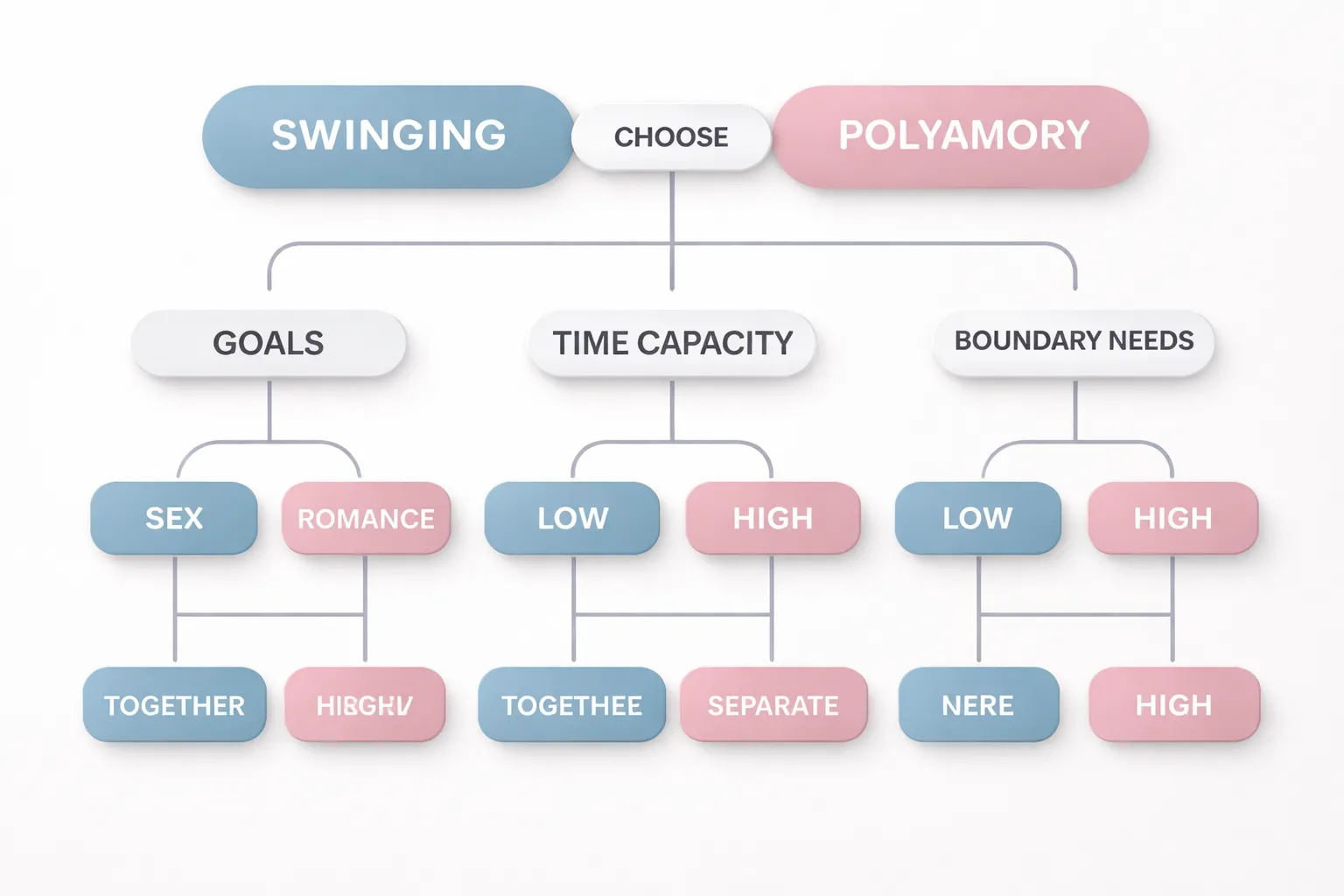
Questions to ask yourself
- Sex vs romance: You want sexual variety with clear limits, swinging often fits. You want ongoing romantic bonds, polyamory often fits.
- Novelty vs depth: You want new partners and low attachment, pick models built for short arcs. You want deep connection over time, pick models built for long arcs.
- Time capacity: Swinging can run on nights out and events. Polyamory needs regular time, messaging, dates, and emotional labor.
- Jealousy profile: You handle your partner having sex with others better than them falling in love, swinging often fits. You handle love better than secrecy, polyamory can fit if you can process jealousy fast and directly.
- Privacy needs: You need high discretion for work or family, casual play with strict rules can be easier to contain than multiple visible relationships.
- Communication tolerance: You can talk about sex in detail and set rules, swinging fits. You can talk about feelings, schedules, and change over time, polyamory fits.
Use clear language. If you need definitions, bookmark a glossary of ENM terms so you and your partner use the same words.
Quick self-assessment table
Relationship status considerations
- Single: Swinging can feel couple-centric. You may get fewer invites and less control. Polyamory can offer more agency, but it also brings more complexity and partner selection risk.
- Partnered: You can start with shared rules and shared pacing. You also risk using rules to avoid hard talks. If rules exist, write them down and review them.
- Married: Legal and family ties raise stakes. You need stronger privacy and stronger conflict skills. You also need agreement on how much time and money you can spend.
- Long-distance: Swinging can work during travel with clear safety protocols. Polyamory can work if you can sustain connection across distance without hiding or neglect.
- Internal link: Swinging vs Open Relationship: Key Differences Explained
Boundary preferences that change your fit
- Together vs separate: Together play reduces uncertainty, but can limit autonomy. Separate dating increases autonomy, but needs trust, disclosure, and stronger scheduling skills.
- Sleepovers: No sleepovers keeps things lighter and can reduce attachment. Sleepovers create intimacy and can accelerate feelings.
- Emotional exclusivity: If you need romance to stay exclusive, build a structure that supports that. If you can allow love, define what commitments stay primary, if any.
- Disclosure level: “Tell me everything” works for some and burns others out. “Tell me what affects my health, time, and feelings” works for many.
- Safer sex rules: Decide condom use, testing cadence, and what counts as a higher-risk act. Agree on what happens after a slip.
If you keep hitting the same argument, you may need clearer terms and clearer expectations. Many myths create bad expectations.
Real-world scenarios
Scenario: We want to play together.
- Start with a shared “yes list” and “no list”. Include kissing, oral, intercourse, and photos.
- Set a stop signal. One word. No debate.
- Agree on a hard exit rule. If one of you says stop, you both leave.
- Pick venues with clear consent culture. Avoid private houses first.
- Plan the debrief. Same night, short. Next day, deeper.
Scenario: I want to date independently.
- Define your base relationship commitments. Time, money, holidays, family exposure.
- Set disclosure rules that protect health and logistics. Testing, barriers, new partners, overnights.
- Set scheduling rules. Example, two nights a week stay protected for your core relationship.
- Prepare for feelings to change. Write a plan for renegotiation, not a plan for control.
Scenario: We want both.
- Split it by lane. “Swinging lane” equals casual, together or event-based. “Dating lane” equals ongoing, separate or structured.
- Use different rules for each lane. Do not pretend one rule-set fits both.
- Track bandwidth. If you miss sleep, workouts, or work, you are over capacity.
If you need a basics refresher before you pick a lane, read a beginner guide to the lifestyle.
- Internal link: What Is the Swingers Lifestyle? A Beginner-Friendly Guide
Green flags and red flags
Green flags you are ready.
- You can say no without punishment.
- You can name your limits and keep them under pressure.
- You can talk about sex, testing, and condoms without shutting down.
- You can repair conflict fast. You own mistakes.
- You can handle your partner receiving attention without trying to control the room.
Red flags you are not ready yet.
- You plan to “fix” a dead bedroom or infidelity fallout by adding people.
- You need alcohol or drugs to participate.
- You cannot agree on condom rules or testing.
- You use threats, guilt, or “fine, do what you want” to end discussions.
- You cannot keep commitments now. Adding partners will not improve this.
- You cannot tolerate your partner having separate desires.
How to try safely: first steps and low-stakes experiments
- Step 1, align on your why: Each of you writes one paragraph. Swap. Look for mismatches.
- Step 2, set non-negotiables: Safer sex rules, disclosure rules, and a stop plan.
- Step 3, run low-stakes reps: Go to a meetup and leave early. Flirt only. No contact. Practice saying no.
- Step 4, try soft swaps: If swinging, start with touching and kissing rules you both like. Stop before anyone feels trapped.
- Step 5, try one date only: If poly-curious, allow one coffee date with a strict time cap and full disclosure after.
- Step 6, review and adjust: After each step, rate stress from 1 to 10. If stress stays above 7, pause and fix the weak point.
Keep your experiments reversible. You can always scale up later. You cannot undo a pressured yes.
FAQ: Swinging vs Polyamory Differences
What is swinging in simple terms?
Swinging is consensual sex with other people, often as a couple. Most swingers avoid romantic bonds and keep a primary relationship central. Rules tend to focus on sex, boundaries, and safer sex. Many meet at parties, clubs, or through apps.
What is polyamory in simple terms?
Polyamory is consensual non monogamy that allows love and ongoing relationships with more than one partner. People may date separately or together. Agreements often cover time, emotional care, communication, and relationship status. Sex can be part of it, but romance is the core difference.
Is swinging the same as an open relationship?
No. Swinging usually means partner swapping and sex focused events. Open relationships often mean you can have sex with others, sometimes solo, with rules that vary by couple. Many open relationships allow repeat partners. Read Swinging vs Open Relationship: Key Differences Explained.
Can swingers fall in love with other partners?
It can happen, but many swingers set rules to avoid romance. If love develops and you choose to allow it, you may be moving toward polyamory. Do not ignore it. Update agreements, talk about time, disclosure, and what changes in your primary relationship.
Can polyamorous people swing?
Yes. Some poly people enjoy sex parties or swapping while keeping multiple romantic relationships. You need clear consent from all partners and clear disclosure. Set rules for events, barriers, and what you share after. Do not assume your partners want the same level of detail.
Which one has more rules?
Both can have many rules. Swinging rules often cover sex acts, condoms, and staying together at events. Polyamory rules often cover dating time, emotional boundaries, and relationship commitments. The right setup uses fewer rules and more clear agreements you can keep.
What is the biggest difference between swinging and polyamory?
Swinging centers on sex, often with couples, usually with limits on romance. Polyamory allows romantic relationships and long term dating with more than one person. If you want sex only, swinging fits more often. If you want love and partners, polyamory fits more often.
How do you choose between swinging and polyamory?
Decide what you allow. Sex only, romance, overnights, holidays, and full dating. Decide what you can handle, time, jealousy, and privacy. Then pick the label that matches. If you need terms, use Ethical Non‑Monogamy Terms: A Glossary of Common ENM Language.
What terms should you know before joining either?
Learn consent terms, safer sex basics, and common community labels. In swinging, learn soft swap, full swap, unicorn, and room rules. In polyamory, learn metas, hierarchy, and boundaries. For swinger terms, see Swingers Lifestyle Slang: Acronyms, Codes, and What They Mean.
Can you switch from swinging to polyamory?
Yes. Many people start with swinging, then want ongoing dating or romance. Treat it as a relationship change. Talk about time, emotional support, money, and public disclosure. Set new agreements and revisit often. If you need a start point, read What Is the Swingers Lifestyle? A Beginner-Friendly Guide.
- In het kort: Swinging centers on sex with others, usually as a couple, with low romantic involvement.
- In het kort: Polyamory centers on ongoing relationships, with room for love, time, and deeper emotional ties.
- In het kort: Your best fit depends on what you want more of, sexual variety, romantic connection, or both.
- In het kort: Clear agreements matter more than labels. Revisit them as your needs change.
- In het kort: Switching is possible, but it requires new rules for time, emotions, money, and disclosure.
Swinging: You prioritize shared experiences, novelty, and clear sexual boundaries. Many couples keep dating and romance outside the setup, or limit it on purpose. Expect more focus on events, play partners, and consent rules.
Polyamory: You prioritize relationships. That means scheduling, emotional support, and long-term expectations. You may date separately, together, or both. You need stronger communication systems because feelings tend to grow.
What usually breaks people: Vague rules, poor calendars, and hidden feelings. Jealousy happens in both. You manage it with honesty, aftercare, and clear repair steps.
What to do next: Learn the language so you negotiate faster and with less confusion. Use a glossary for ENM terms, and review common swinger slang and acronyms. If you want a baseline, start with the beginner guide to swinging.
Conclusion: Choose the Model That Matches Your Values and Capacity
Conclusion: Choose the Model That Matches Your Values and Capacity
You do not need the perfect label. You need a structure you can run every week.
Swinging fits you if you want sex-first experiences, clear event boundaries, and low ongoing emotional complexity. Polyamory fits you if you want multiple loving bonds and you can support time, emotional labor, and long-term negotiation.
Pick based on constraints, not fantasy. Track your time, money, energy, and stress for 30 days. Then choose the model that fits your real capacity.
- Time: How many nights per week can you commit without resentment.
- Communication load: How many hard talks you can handle without avoidance.
- Privacy: How much disclosure you need, and how much you can offer.
- Risk tolerance: Your STI plan, testing cadence, and barrier rules.
- Attachment style: How you respond to bonding, distance, and change.
Run a small pilot. Do not overhaul your relationship in one step. Set a 60-day trial with written agreements, a shared calendar, and a weekly check-in.
| Do this now | Why it works |
|---|---|
| Write 5 non-negotiables each, and 5 flexible items. | You reduce vague rules and hidden assumptions. |
| Define repair steps for jealousy and boundary slips. | You prevent spirals after mistakes. |
| Set an STI agreement, and schedule tests. | You lower risk and reduce anxiety. |
| Use a shared calendar, and cap commitments. | You avoid overbooking and resentment. |
| Learn the same terms before you negotiate. | You reduce confusion and speed up decisions. |
Final tip: Get specific with language before you act. Use the ENM glossary, review swinger slang and acronyms, and if you lean swinger, start with the beginner guide to swinging.
-
- Primary intent: recreational sex vs building multiple relationships
- Emotional boundaries: allowed, discouraged, or negotiated
- Time and energy demands: occasional events vs ongoing maintenance
- Visibility and outness: privacy norms and social circles
- Typical structures: couple-centric swinging vs multi-partner relationship networks
- Jealousy and compersion: how each culture tends to approach them
-
-
- What is swinging in simple terms?
- What is polyamory in simple terms?
- Is swinging the same as an open relationship?
- Can swingers fall in love with other partners?
- Can polyamorous people swing?
- Which one has more rules?
- What is the biggest difference between swinging and polyamory?
- How do you choose between swinging and polyamory?
- What terms should you know before joining either?
- Can you switch from swinging to polyamory?
-
- Primary intent: recreational sex vs building multiple relationships
- Emotional boundaries: allowed, discouraged, or negotiated
- Time and energy demands: occasional events vs ongoing maintenance
- Visibility and outness: privacy norms and social circles
- Typical structures: couple-centric swinging vs multi-partner relationship networks
- Jealousy and compersion: how each culture tends to approach them
-
-
- What is swinging in simple terms?
- What is polyamory in simple terms?
- Is swinging the same as an open relationship?
- Can swingers fall in love with other partners?
- Can polyamorous people swing?
- Which one has more rules?
- What is the biggest difference between swinging and polyamory?
- How do you choose between swinging and polyamory?
- What terms should you know before joining either?
- Can you switch from swinging to polyamory?
-
How to Debrief After Swinging: Break Jealousy Loops
1 month ago -
How to Repair Trust After a Boundary Is Broken
1 month ago -
How to Debrief After Swinging: Fix Resentment Early
1 month ago -
Aftercare & Support in Swinging: Red Flags and Resources
1 month ago -
Swinging Consent and Boundaries: Safer Sex & Comfort
1 month ago
-
Ethical Non‑Monogamy Terms: A Glossary of Common ENM Language
1 month ago -
How to Talk to Your Partner About Swinging (Without Pressure)
1 month ago -
Swinging Rules and Boundaries: Examples, Scripts, and Best Practices
1 month ago -
What Is the Swingers Lifestyle? A Beginner-Friendly Guide
1 month ago -
Swinging First Time Checklist: What to Do Before, During, and After
1 month ago