Swinging Rules and Boundaries: Examples, Scripts, and Best Practices

Swinging works when you set rules, agree on boundaries, and enforce both every time. Without them, you risk broken trust, unsafe sex, and conflict that follows you home. Rules handle logistics. Boundaries protect what matters most to you, your body, your relationship, and your privacy.
This guide shows you how to build clear agreements before you play. You will learn the difference between rules and boundaries, common examples couples use, and simple scripts you can say in the moment. You will also get best practices for consent checks, safer sex limits, stop words, and what to do when someone crosses a line. You will learn how to reset after a bad experience and how aftercare supports repair. If you need a broader starting point, use the beginner guide. If you want deeper consent tools, use the consent and communication guide.
Swinging Rules and Boundaries Examples: Definitions, Differences, and Mindset
Definitions: Rules vs Boundaries vs Preferences
You need clear terms. They reduce confusion in the moment.
Rules are relationship agreements. They apply to both of you. They tell you what you will do as a couple.
Boundaries are self-limits. They describe what you will do or not do. They protect your body, time, and emotional bandwidth.
Preferences are nice-to-haves. They guide choices but they do not control anyone.
| Type | Definition | Who controls it | What happens if it changes |
|---|---|---|---|
| Rule | Shared agreement about behavior | Both partners together | Renegotiate before the next meet |
| Boundary | Personal limit you enforce | You | You state it and act on it |
| Preference | What you like or tend to choose | You | You adapt without drama |
Use rules for shared logistics and safety. Use boundaries for your non-negotiables. Use preferences to stay flexible.
- Rule examples: We only play when we both say yes. We debrief the same night. We do not host at our home.
- Boundary examples: I will not do anal. I will stop if I feel pressured. I will leave if condoms are not used.
- Preference examples: I prefer soft swap. I prefer daytime meets. I prefer no heavy drinking.
Keep your list short. Fewer items make it easier to follow.
Swinging Rules and Boundaries Examples: Clear, Usable Sets
These example sets cover common situations. Edit them to fit your real life.
- Consent first set: Ask before each new act. Either partner can pause. Either partner can end the scene.
- Safer sex set: Condoms for all penetration. New condom when changing partners. No sex if anyone has symptoms.
- Substances set: Two drink max before play. No drugs. If someone seems impaired, you stop.
- Privacy set: No faces in photos. No sharing names or workplaces. No posting without written permission.
- Time and attention set: Check in every 15 to 30 minutes. Do not disappear with another partner. Leave together.
- Communication set: You share plans before you confirm. You do not negotiate in secret. You debrief within 12 hours.
If you need help building your first draft, start with the beginner guide at /how-to-start-swinging-for-beginners-your-step-by-step-guide.html. If you want a tighter pre-meet checklist, use /questions-couples-should-ask-before-swinging-boundaries-safer-sex-goals.html.
The Consent Framework: Enthusiastic, Ongoing, Informed
Consent is not a one-time yes. Treat it like a live setting you keep checking.
- Enthusiastic consent: You look for clear, active participation. If you get silence, freezing, or hesitation, you pause and ask.
- Ongoing consent: A yes can change at any time. You check again when you change positions, add an act, or add a person.
- Informed consent: People need the real context to agree. That includes condom rules, STI testing windows, relationship status, and any limits that affect them.
Build consent into your structure. Make it normal to ask. Make it normal to stop.
Rules and Boundaries Need the Right Mindset
Rules and boundaries work best when you treat them as tools, not weapons.
- You use them to reduce risk. You do not use them to control feelings.
- You keep them realistic. If you cannot follow it in a high arousal moment, it will fail.
- You expect updates. New experiences create new information.
- You prioritize repair. If something goes wrong, you pause and reset. You do not push through.
Common Misconceptions That Create Problems
Misconception: Rules prevent feelings.
Rules do not control emotions. They control behavior. Attraction can happen. Attachment can happen. You plan for it with check-ins, pacing, and honest debriefs.
Misconception: Jealousy means failure.
Jealousy means you found a signal. It can point to fear, insecurity, unmet needs, or unclear agreements. You treat it as data. You adjust your plan.
Misconception: One yes overrides one no.
It does not. One no stops the plan. That applies to your couple rules and to any sexual act with any person. You do not debate. You stop.
If you decide swinging no longer fits, use /how-to-stop-swinging-and-close-the-relationship-without-resentment.html to exit cleanly.
Core Categories of Swinging Boundaries (with Clear Examples You Can Copy)
Sexual Boundaries
Set act limits first. Write them in plain language. Treat them as stop signs.
- Acts allowed: “Kissing, mutual oral, and intercourse are allowed.”
- Acts never: “No anal. No choking. No rough sex. No filming.”
- Escalation rule: “If we did not say yes before the night, the answer is no in the moment.”
- Touch permissions: “No one touches either of us without asking first, every time.”
- Positions and exposure: “No full nudity in common areas. Private rooms only.”
Decide your barrier rules and your risk tolerance. Do not leave it vague.
- Condom rule: “Condoms for all penetration, every time, no exceptions.”
- Oral barrier rule: “Dental dams for oral on vulva and anus. Condoms for oral on penis.”
- Swap rule: “No fluid bonding with anyone else. No condom removal for any reason.”
- Supply rule: “We bring our own condoms and lube. If we do not have them, we stop.”
Set your STI plan. Define what “safe enough” means to you.
- Testing window: “We only play with people who tested within the last 30 days and can show results.”
- Allowed infections list: “If someone discloses an active outbreak, we do not play.”
- Post-event plan: “We test 10 to 14 days after any new partner, and again at 6 weeks.”
- Pregnancy plan: “Condoms plus birth control. If a condom fails, we use emergency contraception the same day.”
Emotional Boundaries
Emotional drift breaks couples faster than sex. Put clear limits on attachment behaviors.
- No dating rule: “We do not date other people. We only do swinger events and mutual meets.”
- No overnights rule: “No sleepovers. We leave together.”
- Reconnection rule: “After we get home, we spend 20 minutes together before phones or sleep.”
- Repeat partner rule: “No repeats without a two yes decision at home, not at the event.”
Set messaging rules. Messaging creates intimacy fast.
- No private messaging: “All messages stay in a shared chat. No DMs.”
- Limited private messaging: “DMs only for scheduling, no flirting, no sexual talk.”
- Time limit: “No texting other partners after 9 p.m.”
- Transparency script: “If someone messages you, you show it within 24 hours.”
Plan for crushes. They happen. You manage them early.
- Crush disclosure rule: “If either of us feels attached, we say it within 48 hours.”
- Pause rule: “We pause contact with that person for 30 days and reassess.”
- Rebalance rule: “We schedule one date night for us before any next event.”
Time and Place Boundaries
Decide how you move through a room. This removes confusion and pressure.
- Only together: “We only play when we are both present. No solo play.”
- Same room only: “Same room at all times. No separate rooms.”
- Separate rooms allowed: “Separate rooms are allowed only after we agree in private first.”
- Check-in rule: “We check in every 30 minutes, even if things feel fine.”
Set hosting rules. Hosting raises safety and privacy issues.
- No hosting: “We do not host at our home.”
- Hosting limits: “If we host, it is only vetted couples, and no phones in bedrooms.”
- Home privacy: “No photos. No sharing our address outside the group.”
Use curfews and travel rules. Late nights reduce judgment.
- Curfew: “We leave by 1 a.m., even if we are mid-conversation.”
- Hotel rule: “If we book a hotel, we book our own room, not a shared suite.”
- Travel rule: “No swinging while traveling for work. Vacation play only.”
Communication Boundaries
Agree on what gets shared, and when. This prevents interrogation and secrecy.
- Share everything: “We share all sexual acts and any condom issues the same night.”
- Share highlights only: “We share the basics, who, what acts, and protection used. No explicit play-by-play.”
- Hard disclosure line: “We always disclose any rule breaks, STI exposures, and new partners within 12 hours.”
Schedule your debrief. Do not do it when you are tired or drunk.
- Debrief timing: “We debrief the next day at 11 a.m., not right after the event.”
- Debrief format: “Each of us says: what worked, what did not, what we change next time.”
- Stop word: “If either of us says ‘pause’, we stop the talk and resume after a break.”
Protect privacy with friends and the community. Decide your disclosure level.
- Public discretion: “We do not tell coworkers or family. We do not post anything online.”
- Community discretion: “We do not share names, photos, or details about other couples.”
- Event rule: “We do not gossip about who did what. We keep it private.”
Substance Boundaries
Substances change consent. Set hard limits before you go.
- Alcohol limit: “Two drinks max each, then water only.”
- No drugs: “No illegal drugs. No exceptions.”
- Impairment rule: “If either of us feels buzzed, we do not start anything new.”
- Consent rule: “No one can give consent while impaired. If someone seems impaired, we stop.”
- Exit script: “We are done for tonight. We are heading out. Take care.”
Social Boundaries
Define who is off-limits. This protects your real life.
- Friends off-limits: “No friends, no neighbors, no kids’ parents.”
- Coworkers off-limits: “No coworkers, no clients, no bosses, no vendors.”
- Exes off-limits: “No exes. No past hookups.”
- Local radius rule: “No meets within 10 miles of home.”
Set discretion expectations for your partners.
- Discretion script: “We need discretion. No tagging, no public comments, no sharing our info.”
- Photo rule: “No photos or video, even if faces are not shown.”
- Name rule: “We use first names only until trust is built.”
Copy-and-Paste Boundary Templates
Pre-Event Agreement Checklist: Turning Boundaries Into Simple, Usable Rules
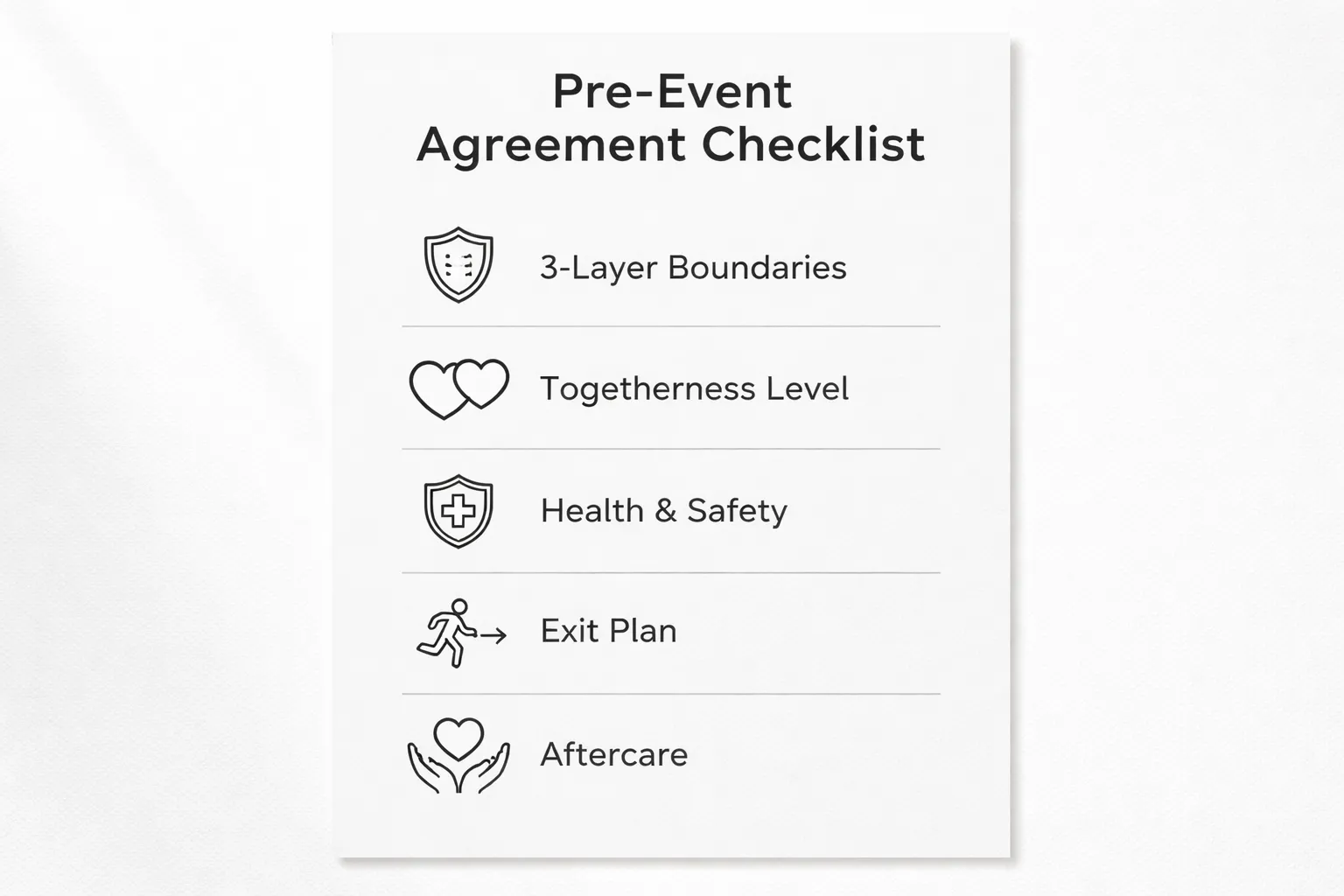
Pre-Event Agreement Checklist: Turn Boundaries Into Simple, Usable Rules
Boundaries fail when they stay vague. Convert them into rules you can follow under pressure. Write them down. Read them out loud. Confirm you both agree.
Use this checklist before every event. Adjust it to the venue, the couple, and your current stress level.
The 3-layer model: Non-negotiables, Flexible zones, Try once items
Sort every boundary into one of three buckets. This keeps you from debating in the moment.
- Non-negotiables: Hard stops. If a non-negotiable gets challenged, you decline and move on.
- Flexible zones: Allowed with conditions. You define the conditions in plain words.
- Try once items: One-time experiment. You set a clear stop rule and a review plan after.
Examples you can copy into your notes.
- Non-negotiable: “We do not do private messaging. Use our group chat only.”
- Non-negotiable: “No friends, coworkers, or exes. We keep lifestyle separate from daily life.”
- Flexible zone: “Same-room only, separate-room is a no tonight.”
- Try once: “We try soft swap for 20 minutes. Either of us can stop it with one phrase.”
If you need more prompts, use your full pre-planning list at Swinging First Time Checklist: What to Do Before, During, and After.
Decide your togetherness level: Soft swap vs full swap, same-room vs separate-room
Agree on your format before you meet anyone. People assume. You should not rely on hints.
- Swap level: soft swap only, full swap allowed, or no swap.
- Room rule: same-room only, separate-room allowed, or separate-room preferred.
- Visibility: lights on or off, door open or closed, check-ins allowed or not.
- Pace rule: kissing first, then hands, then oral, then intercourse, or skip steps if both agree.
Script you can use.
- Togetherness script: “Tonight we are soft swap only, same-room only. If that does not work for you, we understand.”
Health and safety agreements: Testing cadence, disclosure, contraception, barrier protocols
Make health rules specific. “We are clean” is not a plan. Use dates, acts, and barriers.
- Testing cadence: “We test every 3 months.” Or, “We test before any new partner.”
- Disclosure rule: “We share our last test date and our current partner count since then.”
- Barrier protocol: condoms for penetration, condoms for toys, dental dams for oral if you require it.
- Change rules: new condom for every partner switch, every act switch, and every re-entry.
- Contraception: “No internal ejaculation,” “birth control plus condom,” or “vasectomy plus condom.”
- Red lines: “No sex if anyone has sores, symptoms, or feels unwell.”
Substance limits belong here because consent depends on them.
- Substance template: “We stay sober enough to consent. If we drink past our limit, we stop.”
For deeper consent and communication mechanics, use Swinging Consent and Communication: Tips to Stay Safe and Aligned.
Exit plans: Safe word or phrase, check-in frequency, leaving without argument
You need a clean way to stop. No debate. No blame. No negotiation in front of others.
- Stop phrase: pick one phrase that ends the scene. Example, “Red.”
- Pause phrase: pick one phrase that triggers a quick check-in. Example, “Yellow.”
- Check-in frequency: every 10 minutes, after any new act, or whenever either of you asks.
- Exit rule: “If either of us says we are done, we leave within 5 minutes.”
- No-argument rule: “We do not fight at the venue. We debrief later at home.”
Overnight and transport rules prevent pressure and confusion.
- Overnight template: “We do not do overnights. We leave together.”
Aftercare and reconnection: Reassurance needs, decompression routines, next-day check-in
Schedule aftercare before you go. You will not improvise well when you are tired or flooded.
- Reassurance: “We say ‘I choose you’ on the way home.” Or, “We cuddle for 15 minutes before sleep.”
- Decompression: shower together, quiet drive, no phones for 30 minutes, or separate decompression time.
- Debrief timing: a short check-in that night, a full talk the next day.
- Review rules: “We name one good moment, one hard moment, and one change for next time.”
Messaging and follow-up should match your agreement, not your emotions.
- Messaging template: “We do not do private messaging. Use our group chat only.”
One-page pre-event checklist you can screenshot
Scripts and Phrases: How to State Boundaries, Negotiate, and Say No (Without Awkwardness)
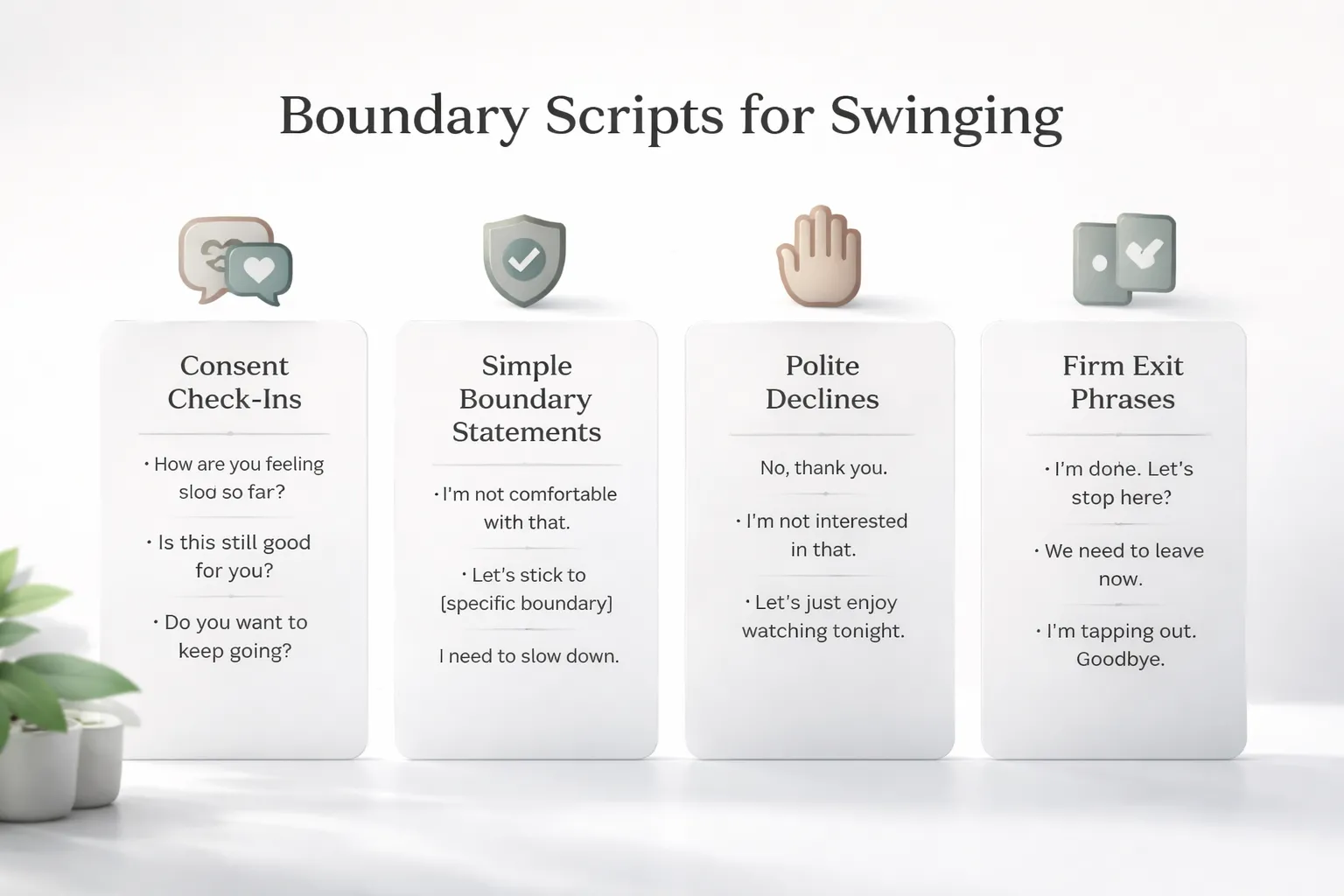
Simple boundary statements you can say fast
Use short lines. State what you will do. State what you will not do. Then stop talking.
- Tonight we are only doing X. “We’re only doing soft swap tonight.”
- This is our limit. “We’re condoms for all penetration, no exceptions.”
- This is off the table. “No oral tonight.”
- Same room only. “We stay in the same room the whole time.”
- No partner switching. “We’re not switching partners tonight.”
- Time boundary. “We’re leaving by 1 a.m.”
- Substance boundary. “We’re capped at two drinks each.”
Keep your reason private. You do not need to justify a boundary.
Couple-to-couple negotiation opener (clear, not rigid)
Lead with friendly clarity. Share your rules in categories. Ask for theirs. Avoid long stories.
- “Hi, we’re interested. Quick logistics, what are your boundaries tonight?”
- “We keep it simple. Condoms for penetration, same room, and we pause if either of us says so. How do you two play?”
- “We’re a yes to kissing and touching, a no to oral and penetration. Does that work for you?”
- “We prefer to start slow. We check in often. Are you comfortable with that pace?”
- “We have one hard rule, and a few preferences. Hard rule, condoms always. Preferences, lights on and no photos. What about you?”
Consent check-ins that keep things smooth
Check-ins prevent misreads. Use plain words. Use names if it helps.
- “Can I kiss you?”
- “Can I touch your breasts?”
- “Can I go down on you?”
- “Do you want me to keep going?”
- “Are you still good with condoms only?”
- “Are you still good with same room?”
- “Do you want to pause?”
- “Do you want a drink, water, or a break?”
- “Let’s check in. Green, yellow, or red?”
Declining politely without killing the vibe
Say no. Thank them. Close the loop. Do not negotiate against yourself.
- “No thanks, but we appreciate the invite.”
- “We’re going to pass tonight. Have a good time.”
- “Thanks, we’re not a match on boundaries.”
- “We’re taking it slow, so we’re a no tonight.”
- “We’re done for the evening. Thanks for being respectful.”
- “We’re going to reconnect as a couple now. Enjoy your night.”
Renegotiating in the moment (without apology)
Renegotiation is normal. Use direct language. Offer a smaller yes if you want.
- Slow down. “We need to slow down. Let’s pause and check in.”
- Same room switch. “We need to stay in the same room from here.”
- Clothes back on. “We’re going to put clothes back on and reset.”
- Change activity. “Let’s stop penetration and keep it to kissing and hands.”
- Reduce intensity. “We’re keeping this lighter. No more new moves.”
- Stop substances. “We’re done drinking now. Water only.”
If you use aftercare plans, say it out loud. “We need a quick cuddle break, then we can decide what’s next.” For more structure, link your plan to your aftercare rules on your site.
Handling pressure or boundary pushing
Pressure often sounds polite. Treat it as a no-signal. Repeat the boundary once. Then end the interaction.
- Repeat once. “No. That’s outside our rules.”
- Use a broken record line. “We’re not doing that.”
- Call out the push. “You keep asking after we said no. Stop.”
- Reset the room. “We’re taking a break now. Please give us space.”
- End it clean. “We’re done. We’re leaving.”
If someone tries to bargain, do not debate. “No. Our answer stays the same.”
Exit lines you can use without escalation
Exit early beats regret later. Use your stop phrase. State the next action. Move.
- “Red. We’re stopping now.”
- “Pause. We need a private check-in.”
- “We’re calling it. Thanks, we’re heading out.”
- “We need to reconnect. We’re leaving within ten minutes.”
- “Please step back. We’re done.”
One-page script you can memorize
Best Practices: Boundary Maintenance, Jealousy, and What to Do If a Rule Gets Broken
Error: Invalid type for 'messages[1].content': expected one of a string or array of objects, but got a boolean instead.Etiquette and Safety in Swinging Spaces (Clubs, Parties, and Apps): Quick Standards to Follow
Swinging spaces run on fast, clear standards. You need consent, privacy control, and solid sexual health habits. Clubs, house parties, and apps each have their own friction points, dress codes, phone rules, and screening norms. You avoid drama by setting expectations before you arrive, communicating in simple sentences, and leaving early if your partner feels off. You protect your reputation by treating photos, names, and chats as confidential. You reduce risk by using barriers, asking direct STI questions, and knowing how to exit a situation without argument. You also plan for aftercare and emotional reset once you get home. Use the checklist below as your baseline, then tailor it to your relationship and the venue.
Quick standards that keep you safe and welcome
- Consent stays active. Ask, wait for a clear yes, stop on a no.
- No touching without permission. Hands stay to yourself until invited.
- Use the venue rules. Follow dress code, play-room rules, and staff direction.
- Protect privacy. No photos, no recording, no identifying details in public chats.
- Limit alcohol and drugs. Impairment breaks consent and gets you removed.
- Practice safer sex. Bring condoms, lube, and barriers, do not rely on others.
- Talk STI status plainly. Share testing windows, dates, and risk factors.
- Respect “no thanks”. Do not negotiate, tease, or follow.
- Do not pressure couples. One yes and one no equals no.
- Exit cleanly. Say you are done, thank them, leave the space.
- Plan aftercare. Check in, hydrate, debrief later, sleep.
Scripts you can use in the moment
- Consent check: “Are you into kissing, or do you want to keep it social?”
- Boundary: “Condoms every time, no exceptions.”
- Partner-first pause: “We are going to check in for a minute.”
- Soft no: “Thanks, we are going to pass.”
- Hard stop: “Stop. I said no.”
- Exit: “We are heading out. Have a good night.”
Space-by-space etiquette checklist
| Setting | Do | Avoid |
|---|---|---|
| Clubs | Ask staff about rules, tip when expected, keep play spaces clean | Phone use, public intoxication, arguing with security |
| House parties | Follow host instructions, bring what you promised, respect private rooms | Inviting extra guests, oversharing identities, taking over spaces |
| Apps | State boundaries early, verify profiles, move to a public meet first | Sending explicit pics without consent, doxxing, pushing for fast meetups |
Read our detailed guide: Etiquette and Safety in Swinging Spaces (Clubs, Parties, and Apps): Quick Standards to Follow - Swinging Rules and Boundaries: Examples, Scripts, and Best Practices
- In het kort: Write your rules down, keep them short, review them often.
- In het kort: Use clear “yes, no, maybe” lists for acts, condoms, and swapping.
- In het kort: Set a stop word, use it once, stop fast, no debate.
- In het kort: Decide how you handle alcohol, sleepovers, and solo play before you meet anyone.
- In het kort: Put safety first on apps and in clubs, verify, meet public, protect identities.
- In het kort: Debrief after every meet, then update rules based on facts.
Rules and boundaries examples you can copy today
- Condom rule: “Condoms for all penetration, every time. No exceptions.”
- Oral rule: “Oral is yes with condoms and dental dams. No fluids in mouth.”
- Swap rule: “Soft swap only tonight. No penetration.”
- Same-room rule: “We play only in the same room. We keep visual contact.”
- Check-in rule: “We check in every 15 minutes. One thumbs-down ends it.”
- Alcohol rule: “Two-drink max. If either of us feels buzzed, we stop.”
- Sleepover rule: “No sleepovers. We leave together.”
- Phone rule: “No photos. Phones stay away during play.”
- Privacy rule: “No last names, workplace, or home address. No tagging or sharing.”
- Solo rule: “No solo dates. All meets are together.”
- Aftercare rule: “When we get home, we shower, eat, then talk for 20 minutes.”
Short scripts that prevent confusion
- Before play: “Our rules are condoms for penetration, soft swap only, and same room.”
- Consent check: “Are you good with this, yes or no?”
- Pause: “Pause. We need a quick check-in.”
- Stop word: “Red. We are stopping now.”
- Boundary reminder: “No anal, no exceptions.”
- Exit: “Thanks, we are done for tonight. We are leaving together.”
- App message: “We share faces after a quick video call. First meet is public.”
Best practices that reduce drama
- Pick 5 core rules. Safer sex, swapping type, same-room or separate-room, alcohol, exit plan.
- Define “stop”. One word. One signal. Stop means stop.
- Agree on pacing. One new step per night. No stacking firsts.
- Use a debrief. What felt good, what felt bad, what changes next time. Use a simple framework from /how-to-debrief-after-swinging-with-your-partner-a-simple-framework.html.
- Plan for closing. If it stops working, pause or end without blame. Use /how-to-stop-swinging-and-close-the-relationship-without-resentment.html.
Quick starter table: decide in 10 minutes
Use this rule: If you cannot say it in one sentence, you cannot enforce it in the moment.
Next step: Write your first draft, then talk it through using /how-to-talk-to-your-partner-about-swinging-without-pressure.html.
FAQ: Swinging Rules and Boundaries Examples (Practical Answers)
What are the most common swinging rules that work in real life?
- Condoms for all penetration, every time.
- No alcohol past your limit.
- No leaving the venue without a text.
- Stop means stop, no debate.
- Debrief same night or next morning.
What is the one sentence rule you can enforce in the moment?
Use rules you can say fast, like, "Condoms always," "No means stop," and "Check in every 30 minutes."
What are good first time boundaries for beginners?
- Soft swap only.
- Same room only.
- No repeat meets without joint yes.
- Leave anytime if either asks.
What scripts help you say no without killing the vibe?
- "Thanks, we are a no tonight."
- "We do soft swap only."
- "Same room only for us."
- "We are going to pause and check in."
How do you set a safe word or stop signal for swinging?
Pick one word that means full stop, like "Red", and one that means slow down, like "Yellow", then agree that Red ends all play and you both leave together.
How often should you check in with your partner during play?
Set a timer rule you can enforce, like "Check in every 30 minutes", or use event based check ins, like "Before any new act, ask me with eye contact."
What are practical STI rules couples actually follow?
- Share test results before sex.
- Test every 3 months if active.
- No condomless penetration.
- No play with symptoms.
How do you handle condoms, lube, and cleanup without awkwardness?
Bring your own kit and use one sentence logistics rules, like "We use our condoms only," and "We clean up before switching partners."
What are clear consent rules for group settings?
- Ask before touching.
- Yes must be spoken.
- No arguing after a no.
- Anyone can stop the room.
How do you handle jealousy in the moment?
Use a simple interrupt rule, like "If I say pause, we stop and step away for 5 minutes," then decide whether to return or leave, with no punishment talk until the debrief.
What do you do if one partner freezes or shuts down?
Agree on one line, "If either freezes, we stop and leave the room," then switch to care mode, water, breath, and a short check in, and end the night if you do not reset fast.
What boundaries help prevent catching feelings?
- No daily texting with play partners.
- No one on one dates.
- No private emotional dumping.
- Joint yes for repeats.
What privacy rules reduce drama fast?
- No photos, no exceptions.
- No full names until trust.
- No tagging, no social posts.
- Verify identities before meeting.
What are simple logistics rules that prevent fights?
- Arrive and leave together.
- Same ride home.
- No sleepovers at first.
- Curfew time set before you go.
What should you do after a rule gets broken?
Use one enforceable step, "We stop tonight and leave," then debrief within 24 hours, name what happened, set a new one sentence rule, and pause new meets until you both feel steady.
How do you talk through rules without pressure?
Use the format from /how-to-talk-to-your-partner-about-swinging-without-pressure.html, lead with choice, state one need, offer options, then ask for a clear yes or no and accept no without bargaining.
Talk it through using the no pressure script
- Open: "I want to talk about swinging rules, and you can say no at any point."
- Goal: "I want us to feel safe and stay close, even in a sexy setting."
- One rule at a time: "My must have is condoms always."
- Offer options: "We can do soft swap only, or we can stay social only."
- Check consent: "Are you a yes, a no, or a maybe for that rule?"
- Handle a no: "Okay, we will not do that, what would feel safe instead?"
- Close: "If either of us says pause, we leave together, then we talk tomorrow."
Conclusion: Build Agreements That Protect Consent, Connection, and Fun
Agreements keep swinging clean. They protect consent. They protect your bond. They keep the night fun.
Write your rules down. Keep them short. Use three buckets.
- Musts: Nonnegotiable safety and respect. Example, condoms always. No secrets.
- Maybes: Allowed only with a clear, specific yes. Example, soft swap only. Same room only.
- Nos: Off limits. No debate. No pressure. No “just this once.”
Use one final rule that ends confusion.
- Pause rule: If either of you says pause, you stop. You leave together. You do not negotiate in the moment.
- Debrief rule: You talk the next day. You update the agreement before you play again.
Track what works. Change one thing at a time. If you need tighter consent and communication habits, read Swinging Consent and Communication: Tips to Stay Safe and Aligned. If you need a stronger repair step after play, use Aftercare in Swinging: What It Is and Why It Matters.
Final tip. Decide your exit plan before you arrive. Agree on the words you will use. Agree on where you will go. Agree that you both choose safety over keeping the mood.
-
Swinging First Time Checklist: What to Do Before, During, and After
6 months ago -
How to Handle Jealousy in Swinging: Practical Tools That Work
6 months ago -
How to Talk to Your Partner About Swinging (Without Pressure)
6 months ago -
Aftercare in Swinging: What It Is and Why It Matters
6 months ago -
Questions Couples Should Ask Before Swinging (Boundaries, Safer Sex, Goals)
6 months ago
-
- Pre-Event Agreement Checklist: Turn Boundaries Into Simple, Usable Rules
- The 3-layer model: Non-negotiables, Flexible zones, Try once items
- Decide your togetherness level: Soft swap vs full swap, same-room vs separate-room
- Health and safety agreements: Testing cadence, disclosure, contraception, barrier protocols
- Exit plans: Safe word or phrase, check-in frequency, leaving without argument
- Aftercare and reconnection: Reassurance needs, decompression routines, next-day check-in
- One-page pre-event checklist you can screenshot
-
- Simple boundary statements you can say fast
- Couple-to-couple negotiation opener (clear, not rigid)
- Consent check-ins that keep things smooth
- Declining politely without killing the vibe
- Renegotiating in the moment (without apology)
- Handling pressure or boundary pushing
- Exit lines you can use without escalation
- One-page script you can memorize
-
-
- What are the most common swinging rules that work in real life?
- What is the one sentence rule you can enforce in the moment?
- What are good first time boundaries for beginners?
- What scripts help you say no without killing the vibe?
- How do you set a safe word or stop signal for swinging?
- How often should you check in with your partner during play?
- What are practical STI rules couples actually follow?
- How do you handle condoms, lube, and cleanup without awkwardness?
- What are clear consent rules for group settings?
- How do you handle jealousy in the moment?
- What do you do if one partner freezes or shuts down?
- What boundaries help prevent catching feelings?
- What privacy rules reduce drama fast?
- What are simple logistics rules that prevent fights?
- What should you do after a rule gets broken?
- How do you talk through rules without pressure?
- Talk it through using the no pressure script
-
-
- Pre-Event Agreement Checklist: Turn Boundaries Into Simple, Usable Rules
- The 3-layer model: Non-negotiables, Flexible zones, Try once items
- Decide your togetherness level: Soft swap vs full swap, same-room vs separate-room
- Health and safety agreements: Testing cadence, disclosure, contraception, barrier protocols
- Exit plans: Safe word or phrase, check-in frequency, leaving without argument
- Aftercare and reconnection: Reassurance needs, decompression routines, next-day check-in
- One-page pre-event checklist you can screenshot
-
- Simple boundary statements you can say fast
- Couple-to-couple negotiation opener (clear, not rigid)
- Consent check-ins that keep things smooth
- Declining politely without killing the vibe
- Renegotiating in the moment (without apology)
- Handling pressure or boundary pushing
- Exit lines you can use without escalation
- One-page script you can memorize
-
-
- What are the most common swinging rules that work in real life?
- What is the one sentence rule you can enforce in the moment?
- What are good first time boundaries for beginners?
- What scripts help you say no without killing the vibe?
- How do you set a safe word or stop signal for swinging?
- How often should you check in with your partner during play?
- What are practical STI rules couples actually follow?
- How do you handle condoms, lube, and cleanup without awkwardness?
- What are clear consent rules for group settings?
- How do you handle jealousy in the moment?
- What do you do if one partner freezes or shuts down?
- What boundaries help prevent catching feelings?
- What privacy rules reduce drama fast?
- What are simple logistics rules that prevent fights?
- What should you do after a rule gets broken?
- How do you talk through rules without pressure?
- Talk it through using the no pressure script
-
-
How to Debrief After Swinging: Break Jealousy Loops
6 months ago -
How to Repair Trust After a Boundary Is Broken
6 months ago -
How to Debrief After Swinging: Fix Resentment Early
6 months ago -
Aftercare & Support in Swinging: Red Flags and Resources
6 months ago -
Swinging Consent and Boundaries: Safer Sex & Comfort
6 months ago
-
Swinging First Time Checklist: What to Do Before, During, and After
6 months ago -
Swinging vs Open Relationship: Key Differences Explained
6 months ago -
How to Handle Jealousy in Swinging: Practical Tools That Work
6 months ago -
How to Talk to Your Partner About Swinging (Without Pressure)
6 months ago -
Swingers Lifestyle Slang: Acronyms, Codes, and What They Mean
6 months ago