Swinging First Time Checklist: What to Do Before, During, and After

Swinging goes wrong when you skip basics. Consent. Boundaries. Safer sex. Clear exits. This checklist walks you through what to do before, during, and after your first swing so you lower risk and avoid preventable drama.
You will learn how to prepare with your partner, set rules you can follow, and screen a couple or venue. You will get a simple packing list, a communication plan for the night, and scripts for stopping or leaving fast. You will also learn what to do after, debrief, handle jealousy, and reset boundaries before you repeat.
If you still need the big picture, start with How to Start Swinging for Beginners: Your Step‑by‑Step Guide. If you need a consent-first talk at home, use How to Talk to Your Partner About Swinging (Without Pressure).
Swinging First Time Checklist: Mindset, Expectations, and Fit
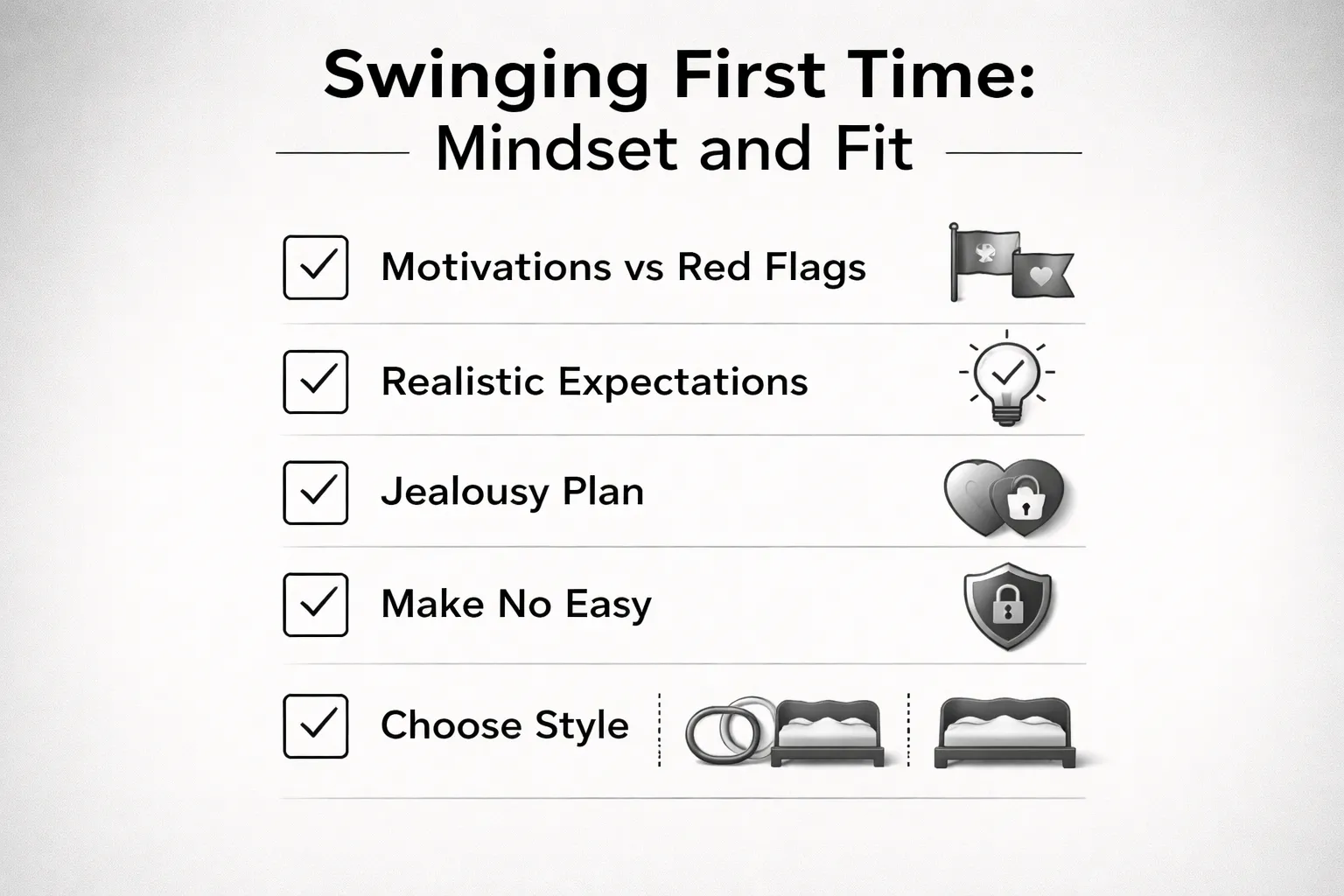
Is Swinging Right for You?
You need two things before you do anything else. Interest, and stability. Swinging can add novelty. It can also expose weak spots fast.
Common motivations that tend to work:
- Shared curiosity. You both want to explore, and you can talk about it without fear.
- Clear values. You agree on what counts as cheating, what counts as sex, and what counts as a dealbreaker.
- Strong communication. You can say what you want, and hear “no” without punishment.
- Team mindset. You plan together, arrive together, and leave together.
Red flags that often predict a bad first experience:
- Fixing a relationship. You use swinging to solve distance, resentment, or mismatched desire.
- One partner is “convincing” the other. Any pressure counts, even if it sounds polite.
- Jealousy already runs your relationship. Frequent checking, accusations, or control.
- Poor boundaries. You cannot name limits, or you break limits at home.
- Substances as a requirement. You need alcohol or drugs to feel okay with the idea.
If you need the full sequence, use How to Start Swinging for Beginners: Your Step by Step Guide. If you still feel stuck on the consent talk, use How to Talk to Your Partner About Swinging (Without Pressure).
Set Realistic Expectations for a First Experience
Your first time can feel awkward. That is normal. You are learning a new social setting with high stakes.
Plan for a “small win” night. Examples:
- Go to a club and leave after one drink.
- Flirt, then stop.
- Make out only.
- Same room touching only, no swapping.
Also plan for “no play” as a valid outcome. You can do everything right and still decide it is not a match. That still counts as progress.
What often surprises first timers:
- It feels more like a social event than porn.
- You spend time talking. A lot.
- Attraction can change once clothes come off.
- Rules get tested in the moment, even good rules.
Jealousy and Insecurity: Anticipate, Normalize, Prepare
Jealousy is common. It does not mean you are broken. It means you hit a trigger.
Expect these moments:
- Your partner gets attention first.
- You compare your body to someone else.
- You feel left out for five minutes.
- You want to stop, then feel guilty for stopping.
Use simple tools before you go:
- Name your triggers. Each of you lists two situations that might sting.
- Pick a repair action. Examples, hold hands, step outside, bathroom check in, go home.
- Decide on aftercare. Food, shower together, quiet time, phones off.
If jealousy is a big theme for you, go deeper with How to Handle Jealousy in Swinging: Practical Tools That Work.
Pressure Kills Pleasure: Make “No” Easy
If “no” is hard, consent is weak. Weak consent creates regret. Regret ends the lifestyle fast.
Build a no pressure system:
- Use opt in, not opt out. Nothing happens until both of you say yes.
- Allow sudden stops. No debate. No pouting. No “just a little more.”
- Protect face. You do not need to explain your no to other people.
- Back each other in public. Disagree later, in private.
If you want a consent-first framework for the night, use Swinging Consent and Communication: Tips to Stay Safe and Aligned.
Different Styles of Swinging and How They Affect Comfort
Style controls intensity. Pick the lowest intensity that still feels exciting. You can always step up later.
Match style to your nervous system, not your fantasy. If either of you feels dread, step down. If both of you feel steady, you can explore more.
Before You Go: The Pre-Swinging Conversation Checklist (Rules, Boundaries, Signals)
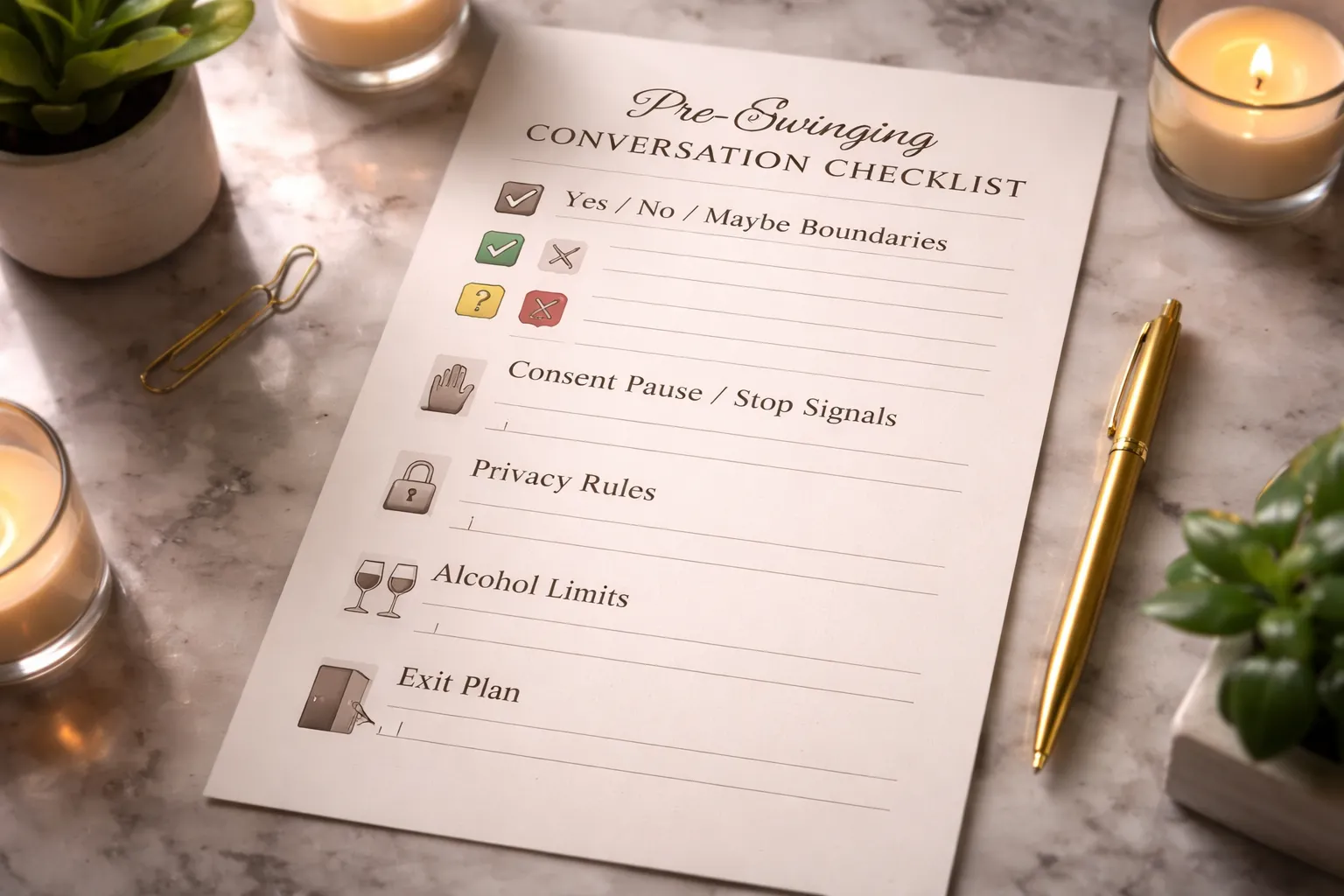
Set the Frame Before You Talk
Have this talk when you feel calm. Not mid-argument. Not mid-arousal.
Use clear language. Say what you want. Say what you will not do. If you need help starting the conversation, use a no-pressure approach like the one in /how-to-talk-to-your-partner-about-swinging-without-pressure.html.
Define Boundaries With Yes, No, Maybe Lists
Write three lists each. Compare them line by line. Your shared plan is the overlap, not the average.
- Acts: oral, intercourse, anal, manual, kissing, condom use, internal ejaculation, swallowing, rimming.
- Positions and control: who leads, who initiates, who can move partners, who can reposition bodies.
- Language: names you allow, dirty talk you want, words that trigger you, relationship terms you ban.
- Kink and intensity: spanking, choking, restraints, impact toys, humiliation, dom-sub play. Define limits in plain terms.
- Toys: allowed types, condom use on toys, sharing rules, cleaning rules, who brings what.
Keep maybes specific. “Maybe kissing” is vague. “Maybe closed-mouth kissing, no tongues, stop if either of us tenses” is usable.
Hard Rules vs. Flexible Preferences
Hard rules protect your relationship and health. Preferences shape comfort. Do not treat them as equal.
- Hard rules: any “no,” safer sex rules, privacy rules, stop signals, no solo wandering, no leaving with others, no drugs, no filming.
- Flexible preferences: lighting, music, who you start with, same room vs separate room, pace, flirting style.
If you disagree, you do not compromise. You step down the plan. You pick the safer option. You revisit later.
For more examples and scripts, use /swinging-rules-and-boundaries-examples-scripts-and-best-practices.html.
Consent Plan: How Either Partner Can Pause or Stop
Build a plan that works even if one of you freezes.
- Either partner can pause at any time. No debate. No “just a minute.”
- Either partner can stop the night. You leave together.
- Pause means: hands off, bodies separate, clothes on if needed, water break, private check-in.
- Stop means: you end all play and exit. No negotiation with the other couple.
Say this out loud before you go. If you cannot say it, you are not ready to do it.
Check-In Signals: Verbal, Nonverbal, and Rescue Texts
Use signals that work in loud rooms and low light.
- Verbal cues: “Pause,” “Check in,” “I need you,” “I am done.” Keep them short.
- Safewords: one word for pause, one word for stop. Pick words you will not say during sex.
- Nonverbal signals: hand squeeze pattern, tapping your partner’s shoulder, touching your own necklace or wrist, stepping to the bathroom and returning within a set time.
- Rescue texts: pre-write a text like “Need you now.” Agree that any rescue text triggers an immediate check-in.
Also set “reconnect cues.” Example, you touch foreheads for five seconds, then decide to continue or stop.
Privacy and Discretion Rules
Assume you will see these people again. Plan for that now.
- Anonymity: decide what names you use, what details you share, and what stays private.
- Photos and video: default to none. If you allow it, require explicit consent every time and state where files live and when they get deleted.
- Face pics: decide if you share them, and if so, when. Many first timers choose “no faces” until trust builds.
- Social media: no tagging, no follows without asking, no posting about locations, no screenshots of chats.
- Discretion in public: agree on PDA limits, greetings, and how you act if you run into someone you know.
Alcohol and Substance Boundaries
Impairment breaks consent. Set a hard line before you go.
- Drink limit: choose a number per person. Write it down.
- No new substances: do not experiment for the first time on a swinging night.
- Impairment rule: if either of you feels foggy, dizzy, or slow, you do not play. You switch to social only or you leave.
- Hydration and food: eat first. Drink water. Low blood sugar makes emotions worse.
Exit Plan: Transport, Time Limits, Leave Together
Your exit plan prevents panic and reduces pressure.
- Transportation: decide who drives, where you park, and your backup ride option.
- Time limit: set an end time. Put it in your calendar. Use an alarm if needed.
- Leave together policy: you leave as a unit. No exceptions on your first time.
- Exit script: one sentence you will use with others, like “Thanks, we are heading out.” Do not explain.
- Decompression plan: quiet ride home, no heavy talk until you are fed and calm, then a short check-in.
If you worry about attachment or feelings after meeting a great couple, read /how-to-handle-feelings-for-another-couple-in-swinging.html.
Quick Pre-Departure Checklist
| Rules agreed | Yes, no, maybe lists merged into one shared plan. |
| Consent tools | Pause word, stop word, nonverbal signal, rescue text. |
| Safer sex | Condom rules, testing expectations, lube, barriers, toy hygiene. |
| Privacy | No photos by default, no faces, no social posts. |
| Substances | Drink limit set, impairment rule set. |
| Exit | End time set, transport set, leave together confirmed. |
Practical Prep Checklist: Safety, Sexual Health, and Logistics

Sexual health talk, testing, and what “tested” means
Agree on a testing cadence before you meet anyone. Many experienced couples test every 3 months if they have ongoing partners. Some test every 6 months if they play rarely and use barriers every time. Pick a cadence you can follow.
Define what you mean by “tested.” Ask for the test type and date, not a vague statement. A full panel often includes HIV, syphilis, gonorrhea, and chlamydia. Hepatitis screening may require separate tests. HSV often does not show on standard panels unless someone asks.
- Share results. Swap screenshots or portal results. Include the date collected and the results page, not a text summary.
- Set a freshness window. Common windows are 30 to 90 days. Shorter windows reduce risk but limit options.
- Talk about exposures. Ask about new partners since the last test and whether barriers were used.
- Know the window period. Some infections can test negative early. If someone had a recent unprotected exposure, treat them as untested for that timeframe.
Write your safer sex rules down in one line. Share them early. For consent and communication basics, use your own rules framework and keep it consistent with what you set in Swinging Consent and Communication: Tips to Stay Safe and Aligned.
Barrier plan: condoms, dams, gloves, and lube compatibility
Decide what acts require barriers. Decide when you switch barriers. Then stick to it.
- External condoms. Use for penetration. Change condoms when you switch partners, switch holes, or change from oral to penetration.
- Internal condoms. Useful for people who prefer more control over barrier placement. Learn insertion before the event.
- Dental dams. Use for oral on vulva or anus. Bring your own. Most hosts do not supply them.
- Gloves. Use for fingering if you want a cleaner switch between partners. Change gloves between partners and between anal and vaginal contact.
Match lube to your barrier and toys.
- Latex condoms. Avoid oil-based lubes. Use water-based or silicone-based lube.
- Silicone toys. Use water-based lube if you are not sure about the toy finish. Some silicone lubes can degrade some silicone toys.
- Anal play. Use more lube than you think you need. Reapply often.
Set toy hygiene rules. Use condoms on shared toys. Clean between partners. Do not move a toy from anus to vagina without a new condom and cleaning.
Birth control and pregnancy risk planning
Barriers reduce STI risk and pregnancy risk, but they are not perfect. Decide your pregnancy plan before you play.
- Primary method. Decide what you rely on, condoms, IUD, pill, implant, ring, or other method.
- Backup rules. Decide what happens if a condom breaks or slips. Decide who buys emergency contraception and how fast you will act.
- No-ejaculation rules. If you use a “no finish inside” rule, treat it as a preference, not as birth control.
If pregnancy is a hard no, keep penetration rules strict. Use condoms every time. Avoid edge-case decisions when you are aroused or tired.
Hygiene and comfort items
Cleanliness affects comfort and confidence. Keep it simple and practical.
- Showering. Shower close to the event. Bring quick-clean wipes for touch-ups.
- Grooming. Do what you normally do. Do not try a new waxing or hair removal routine right before the event.
- Breath. Pack mints, floss picks, and a small mouthwash if the setting allows it.
- Towels. Bring a small towel if you are going to a private meet. Ask the host what they provide.
- Skin comfort. Bring unscented wipes and a gentle moisturizer. Avoid strong fragrance. Some people react to it.
What to pack for a first time
Assume the venue has less than you need. Pack your own basics.
- Condoms. Bring more than you expect to use. Bring multiple sizes and a few brands if you are not sure what fits best.
- Lube. Bring a water-based lube and, if you like it, a silicone lube for longer sessions. Keep oil-based lubes away from latex.
- Barriers. Dental dams and nitrile gloves.
- Toy kit. Only if allowed. Include toy condoms, toy cleaner, and a small bag to separate clean and used items.
- Aftercare items. Water, electrolytes, snacks, makeup remover wipes, spare underwear, and a change of clothes.
- Logistics. Phone charger, cash, ID, and a discreet bag.
Choosing the setting: club vs. house party vs. private meet
Your first setting shapes your first experience. Pick the option that matches your risk tolerance and social comfort.
For many first-timers, a reputable club can reduce uncertainty. For others, a coffee meet that stays social can be the best first step. You control the pace.
Vetting and screening: who you meet matters
Screening starts with how they communicate. You want clarity, respect, and consistency.
- Look for alignment. They can restate your boundaries without arguing. They share theirs without testing yours.
- Watch responsiveness. They answer direct questions directly, testing, barriers, comfort with “no,” and logistics.
- Confirm consent culture. They support pause words and stop words. They accept that you may leave at any time.
- Red flags. Pressure to skip condoms. “We are clean.” Refusal to share dates of tests. Pushing for secrecy that blocks your safety planning. Anger at boundaries. Heavy substance focus.
Get boundary clarity in writing before you meet. Use scripts and examples from Swinging Rules and Boundaries: Examples, Scripts, and Best Practices.
Budget and timing: reduce stress before you start
Money and time issues cause fights. Set limits in advance.
- Costs. Cover charges, memberships, tips, drinks, condoms and lube, hotel, rideshare, parking.
- Transport. Do not rely on someone you just met for a ride. Plan your own exit.
- Timing. Set arrival and end time. Add buffer time for check-in, breaks, and leaving together.
- Decompression. Block time after, even if you think you will be fine. Eat, hydrate, shower, sleep.
Plan your debrief the next day, not in the car. Use a simple structure from How to Debrief After Swinging With Your Partner (A Simple Framework).
During: In-the-Moment Checklist (Consent, Communication, and Pace)
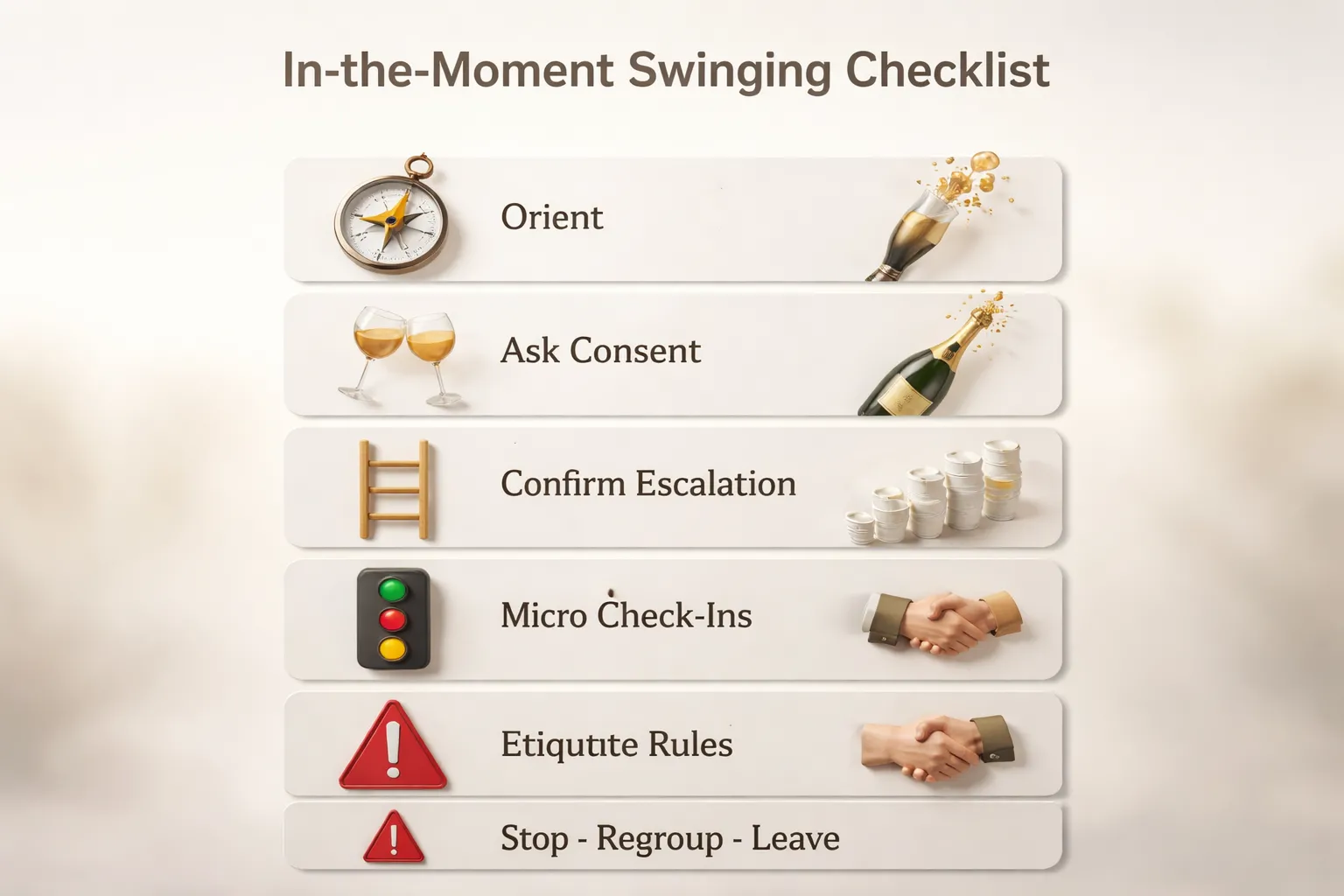
Arrive and orient, observe first
Take 10 to 20 minutes to settle.
- Check in with staff. Learn house rules, wristbands, room boundaries, and phone policy.
- Do a slow lap. Note exits, bathrooms, water, quiet areas, and security.
- Start with low-stakes contact. Smile, small talk, compliments.
- Skip the rush to play. You make better choices after you acclimate.
Consent in real time, ask before touching
Use clear, specific requests. Get a clear yes.
- Before touch: “Can I hold your hand.” “Can I kiss you.”
- Before joining: “Are you open to us sitting with you.” “Are you looking to play tonight.”
- Before entering a room: “Do you want company.” “Do you want privacy.”
- Before photos or contact exchange: “Are you okay swapping numbers.”
Recheck consent when anything changes, location, clothing, roles, partners, intensity, or alcohol level.
Confirm before escalating
Escalation needs a new yes. Every time.
- State the next step. Ask. Wait.
- Use plain words. “Hands under clothes.” “Oral.” “Penetration.”
- Confirm barriers. Condoms, dental dams, gloves, lube.
- Confirm limits. “No anal.” “No kissing.” “No solo play.”
If you want a tighter system, use a simple ladder, green for yes, yellow for slow, red for stop. Keep it consistent all night. For deeper guidance, see /swinging-consent-and-communication-tips-to-stay-safe-and-aligned.html.
How to say no, and how to hear no
No must stay easy. You protect the vibe by keeping it clean.
- Say no fast. “No thanks.” “Not tonight.” “We are going to pass.”
- Do not negotiate. Do not justify. Do not explain.
- Use your exit line. “Nice meeting you. Enjoy your night.”
- If you hear no, stop. Smile. Say “Thanks for being clear.” Move on.
If someone pushes after a no, end contact and involve staff.
Pacing options for beginners
You control pace. You can keep it light and still have a great night.
| Level | What it can include | Good for |
|---|---|---|
| Flirting only | Talking, compliments, light touch with consent | First visit, nerves, learning the room |
| Dancing | Dancing, close contact, stopping anytime | Testing comfort without a private space |
| Make-outs | Kissing, hands over clothes | Trying chemistry with clear boundaries |
| Soft swap | Sexual play without penetration, rules vary by couple | Exploring while keeping a hard line |
| Full swap | Penetration with others, with agreed boundaries | Only if both feel solid and steady |
Agree on your maximum level before you start. You can always step down. Do not step up under pressure.
Managing emotions live
Do micro check-ins. They prevent big blowups.
- Use a timer or routine. Check in every 20 to 30 minutes, or after any new interaction.
- Keep it short. “Green, yellow, or red.” “Want to continue or pause.”
- Watch body cues. Freezing, avoiding eye contact, forced laughter, pulling away.
- Ground fast. Drink water, eat something, breathe slow, feet on the floor, hand squeeze signal.
If one of you turns yellow, slow down. If one of you turns red, stop. Step out with no shame. Couples who handle this well tend to do better long term. See /does-swinging-ruin-relationships-what-helps-couples-succeed.html.
Club etiquette basics
- Respect space. Ask before sitting, touching, or joining.
- No pressure. Compliments are fine. Persistence is not.
- No means no. One no ends the request.
- Mind the audience. Follow posted rules on public play.
- Keep it discreet. Do not out people. Do not share details outside.
- Tip and thank staff if appropriate. They keep the place safe.
If something feels off, stop and leave
Trust the signal. Act early.
- Stop the interaction. “We are going to pause.”
- Regroup in a neutral spot. Bathroom, patio, car, lobby.
- Use your preplanned exit. Leave together.
- No explanations required. You do not owe anyone a reason.
Save the full processing for later. Use your next-day plan from /how-to-debrief-after-swinging-with-your-partner-a-simple-framework.html.
After: Post-Experience Checklist (Aftercare, Debrief, and Next Steps)
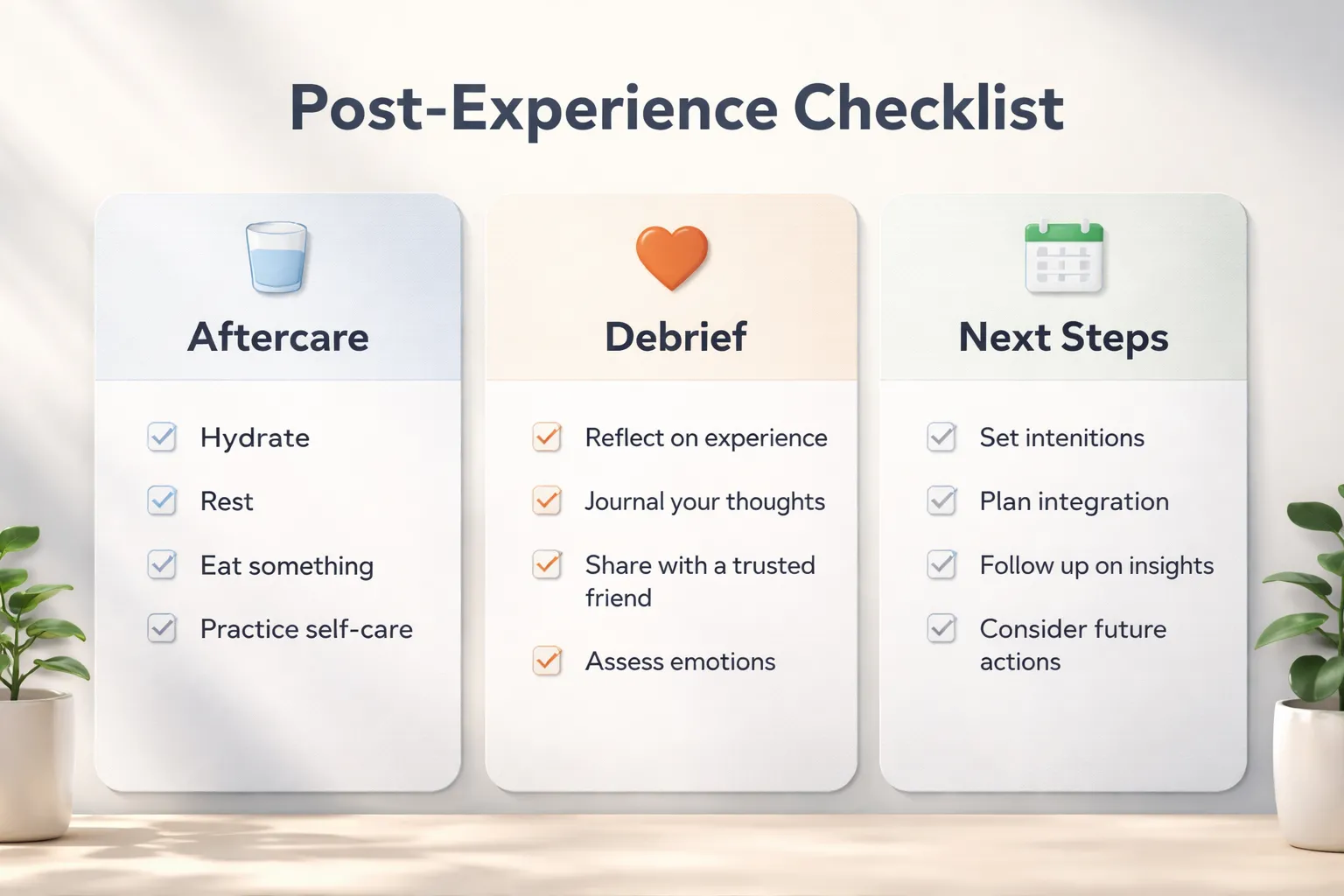
Immediate Aftercare, Reconnect First
Do the basics before you analyze anything. Get water. Eat something small. Use the bathroom. Shower if you want.
Reconnect with your partner. Sit close. Hold hands. Breathe together. Use simple reassurance.
- Say: “I am here with you.”
- Say: “We are on the same team.”
- Say: “We can talk tomorrow.”
Avoid interrogation. Skip play-by-play questions. Do not demand instant clarity. Your nervous system needs downshift time.
If you need structure, use your aftercare plan and scripts from /aftercare-in-swinging-what-it-is-and-why-it-matters.html.
Debrief Framework, Keep It Short and Specific
Debrief when you both feel steady. Many couples do better the next day. Use a timer. Stop at 20 to 30 minutes.
- What felt good: name 1 to 3 moments. Keep it behavioral.
- What did not: name 1 to 3 moments. No character attacks.
- Surprises: what you did not expect in your body or emotions.
- Boundaries to adjust: what changes next time.
- One request: a clear action your partner can take.
Use “I felt” statements. Avoid “you always” and “you never.” Track patterns, not blame.
For a step-by-step template, use /how-to-debrief-after-swinging-with-your-partner-a-simple-framework.html.
Handle the Emotional Hangover
Jealousy, guilt, comparison, and insecurity can hit after the excitement drops. Treat it like stress, not proof you failed.
- Jealousy: name the trigger. Ask for reassurance and a specific behavior.
- Guilt: check consent and agreements first. If you broke a rule, own it and repair it.
- Comparison: stop ranking bodies and performance. Return to what you and your partner want.
- Insecurity: ask for closeness, not details that feed rumination.
If either of you cannot regulate, pause the topic. Sleep. Eat. Move your body. Revisit with the debrief framework.
Relationship Maintenance, Lock In Safety
Put your relationship back in the center. Do one bonding action within 24 hours.
- Plan a date with no swinging talk for the first hour.
- Have sex together if you both want it. Do not use sex as a repair demand.
- Share one appreciation each. Make it specific.
- Review your rules when you feel calm, then update them.
If you need better boundaries and scripts, use /swinging-rules-and-boundaries-examples-scripts-and-best-practices.html and /questions-couples-should-ask-before-swinging-boundaries-safer-sex-goals.html.
Follow Up With Others, Keep It Polite and Private
Send a short message if you plan to stay in contact. Keep it respectful. Do not over-explain.
- If you want to see them again: “We had a good time. We are open to meeting again. We will confirm after we debrief.”
- If you do not: “Thank you for tonight. We are going to keep things at home for now. Take care.”
- If you are unsure: “Thanks for meeting. We are going to take a few days, then we will follow up.”
Protect privacy. Do not share names, photos, or details outside the group. Decide what gets saved, what gets deleted, and what stays off text.
Set contact boundaries. Decide who messages, what apps you use, and what topics stay off-limits.
Health Follow Up, Track Risk and Timing
Write down what happened while it is fresh. Keep it private. Record the safer-sex choices you made. This helps if you need testing later.
- Condom use and any breaks or slip-offs.
- Oral barriers used or not used.
- Fluid exposure, ejaculation location, and cleanup.
- New partners and approximate date and time.
Watch for symptoms. Many STIs have no symptoms. Test based on exposure and your risk plan, not feelings.
Use your normal testing routine if you already have one. If you do not, set one now and stick to it.
Decide the Next Step, No Blame
Choose one path. Say it clearly. Treat it like a joint decision.
- Repeat: keep what worked. Change one variable at a time.
- Modify: tighten rules, change venue, reduce alcohol, pick slower pacing, or limit contact types.
- Pause: set a time-bound pause and a review date. Do not use “pause” as punishment.
Write your updated checklist for next time. Keep it short. Put your boundaries in words you can say out loud.
Common First-Time Mistakes (and How to Avoid Them)
Skipping the rules talk or assuming you’re on the same page
Many first-time problems start before you leave the house. You skip the rules talk. You rely on hints. You assume you mean the same thing by “soft swap” or “no kissing.”
- Fix: Define terms in plain words. Say what you will do, and what you will not do.
- Fix: Set three items before you go, permitted acts, hard no’s, and stop signals.
- Fix: Write it down. Keep it to one screen. Use it as your shared script.
- Resource: Use examples and scripts from Swinging Rules and Boundaries: Examples, Scripts, and Best Practices.
Letting alcohol drive decisions
Alcohol lowers your ability to hold boundaries and read cues. It also raises risk, condom errors, forgotten agreements, and next-day regret.
- Fix: Decide your limit before you arrive. Pick a number, then stop.
- Fix: Do first contact sober. Save drinks for later, or skip them.
- Fix: If you feel buzzed, slow down. Move to talking, not touching.
Agreeing to more than you want to “keep up”
You may feel pressure to match your partner, match another couple, or “be cool.” You say yes when you mean maybe. Then you freeze, fawn, or push through.
- Fix: Use a default no. You can always upgrade later.
- Fix: Say one clear line out loud, “I’m not doing that tonight.”
- Fix: Change one variable at a time. Do not jump from flirting to full swap in one night.
Not having an exit plan
Without an exit plan, you stay too long. You negotiate while flooded. You wait for a “good reason” to leave. You do not need one.
- Fix: Set a time limit and a check-in time. Put both on your phone.
- Fix: Pick an exit phrase you can say fast, “We’re going to head out. Thanks.”
- Fix: Arrange your own ride. Do not depend on the host.
Not discussing STI barriers and testing expectations upfront
People avoid this talk to keep things “sexy.” That choice increases risk and confusion. Testing status does not replace barriers. Timing matters.
- Fix: Decide your barrier rules before you meet anyone. Include oral sex, toys, and switching partners.
- Fix: Share testing windows, test type, and date. Do not accept “I’m clean” as data.
- Fix: Bring your own supplies. Condoms in multiple sizes, lube, gloves, and toy covers.
- Fix: If you cannot agree fast, you do not play.
Poor communication with other couples or singles
Mixed signals create conflict. You flirt hard, then pull back with no words. You say “we’re open,” but your rules are tight. You nod along to avoid awkwardness.
- Fix: State your boundaries early. Use simple lines, “Kissing is yes. Penetration is no.”
- Fix: Speak in “we” only when it is truly joint. Otherwise say “I.”
- Fix: Confirm consent at each step. Ask once per change, not once per night.
- Fix: If you are long distance, clarify who can agree in the moment, and how you will check in. See Swinging for Long Distance Couples: How to Make It Work.
Treating it like a performance instead of an experience
Performance mode pushes you to chase a goal. You focus on “success.” You ignore your body. You miss signs of stress, jealousy, or shutdown. That spills into the next day.
- Fix: Define a low bar for a good night, “We talk, we leave feeling close.”
- Fix: Use check-ins during the night. Keep them short. Ask, “Green, yellow, or red.”
- Fix: End with reconnection. Food, shower, or quiet time. Then a short debrief the next day.
- Resource: If you worry about relationship impact, use Does Swinging Ruin Relationships? What Helps Couples Succeed as your guardrails.
FAQ
What should you do before your first swinging night?
Agree on boundaries, safer sex rules, and your exit plan. Pick a safe word and a public signal. Bring condoms, lube, and wipes. Set a low bar for success, connection and no regret. Use this: /questions-couples-should-ask-before-swinging-boundaries-safer-sex-goals.html.
How do you set boundaries that work?
Write them down. Keep them specific, “kissing ok, no oral.” Add what happens if a rule breaks, pause and leave. Review before you go in. Update after. Use examples and scripts here: /swinging-rules-and-boundaries-examples-scripts-and-best-practices.html.
What safer sex basics should you follow?
Use condoms for oral and penetration. Bring your own. Change condoms between partners and between oral and penetration. Use water based lube with latex. Ask about STI testing dates and results. Do not assume. If you drink, set a hard limit.
How do you handle jealousy in the moment?
Use fast check-ins, “green, yellow, red.” If you hit yellow, slow down, reconnect, or step out. If you hit red, stop and leave. Do not argue in the room. Use tools here: /how-to-handle-jealousy-in-swinging-practical-tools-that-work.html.
What should you do during the event?
Stay together until you both feel steady. Reconfirm rules with other people before any contact. Watch alcohol and timing. Keep your phone and keys on you. Use check-ins every 20 to 30 minutes. Leave early if you feel pressured.
What if one of you wants to stop?
Stop. No debate. Use the agreed signal and exit. Protect your relationship first. If you want, offer a simple line to others, “We are done for tonight.” Debrief later when you both feel calm.
How do you say no without making it awkward?
Use short scripts. “No thanks.” “We are not a match.” “We are keeping it to flirting tonight.” Repeat once, then disengage. You do not owe an explanation. Leave the space if someone keeps pushing.
What aftercare should you do after swinging?
Reconnect first. Food, shower, water, and quiet time. Say one thing you appreciated. Sleep. Do a short debrief the next day, what worked, what did not, and one change. Use this guide: /aftercare-in-swinging-what-it-is-and-why-it-matters.html.
How soon should you talk about what happened?
Do a quick check-in the same night, “Are you okay, what do you need.” Save details for the next day. Set a time limit, 20 minutes. End with a plan, “next time we will leave earlier” or “we will tighten a rule.”
What if you regret it the next day?
Pause new events. Name the trigger, alcohol, rushed consent, unclear boundaries, or comparison. Adjust rules and your pace. If regret sticks for weeks, get a sex positive therapist. Treat it like data, not a verdict on your relationship.
Conclusion
Swinging goes best when you treat it like a process. You plan, you execute, you debrief, you adjust. Keep your rules simple. Keep your consent clear. Protect your privacy and sexual health. Leave early if your body says stop.
- Pick one goal for next time. Examples, less alcohol, earlier exit time, tighter boundaries, more check ins, no new partners.
- Write your rules down. Use short statements. Share them with your partner before you go.
- Keep a reset plan. A safe word, a ride plan, and a no questions asked exit.
- Debrief within 24 hours. Set 20 minutes. Each of you names one win, one hard moment, one change.
- Pause after regret. Identify the trigger and change your setup before you book anything new.
If you need support, start with better communication and consent structure. Read /how-to-talk-to-your-partner-about-swinging-without-pressure.html and /swinging-consent-and-communication-tips-to-stay-safe-and-aligned.html. For jealousy tools, use /how-to-handle-jealousy-in-swinging-practical-tools-that-work.html. When it goes well, track what worked so you can repeat it, see /benefits-of-swinging-for-couples-why-some-relationships-thrive.html.
Final tip, decide your exit time before you arrive. Put it on your calendar. Treat leaving on time as success.
-
How to Handle Jealousy in Swinging: Practical Tools That Work
6 months ago -
How to Talk to Your Partner About Swinging (Without Pressure)
6 months ago -
Swinging Rules and Boundaries: Examples, Scripts, and Best Practices
6 months ago -
Aftercare in Swinging: What It Is and Why It Matters
6 months ago -
Questions Couples Should Ask Before Swinging (Boundaries, Safer Sex, Goals)
6 months ago
-
- Set the Frame Before You Talk
- Define Boundaries With Yes, No, Maybe Lists
- Hard Rules vs. Flexible Preferences
- Consent Plan: How Either Partner Can Pause or Stop
- Check-In Signals: Verbal, Nonverbal, and Rescue Texts
- Privacy and Discretion Rules
- Alcohol and Substance Boundaries
- Exit Plan: Transport, Time Limits, Leave Together
- Quick Pre-Departure Checklist
-
- Sexual health talk, testing, and what “tested” means
- Barrier plan: condoms, dams, gloves, and lube compatibility
- Birth control and pregnancy risk planning
- Hygiene and comfort items
- What to pack for a first time
- Choosing the setting: club vs. house party vs. private meet
- Vetting and screening: who you meet matters
- Budget and timing: reduce stress before you start
-
- Skipping the rules talk or assuming you’re on the same page
- Letting alcohol drive decisions
- Agreeing to more than you want to “keep up”
- Not having an exit plan
- Not discussing STI barriers and testing expectations upfront
- Poor communication with other couples or singles
- Treating it like a performance instead of an experience
-
- What should you do before your first swinging night?
- How do you set boundaries that work?
- What safer sex basics should you follow?
- How do you handle jealousy in the moment?
- What should you do during the event?
- What if one of you wants to stop?
- How do you say no without making it awkward?
- What aftercare should you do after swinging?
- How soon should you talk about what happened?
- What if you regret it the next day?
-
-
- Set the Frame Before You Talk
- Define Boundaries With Yes, No, Maybe Lists
- Hard Rules vs. Flexible Preferences
- Consent Plan: How Either Partner Can Pause or Stop
- Check-In Signals: Verbal, Nonverbal, and Rescue Texts
- Privacy and Discretion Rules
- Alcohol and Substance Boundaries
- Exit Plan: Transport, Time Limits, Leave Together
- Quick Pre-Departure Checklist
-
- Sexual health talk, testing, and what “tested” means
- Barrier plan: condoms, dams, gloves, and lube compatibility
- Birth control and pregnancy risk planning
- Hygiene and comfort items
- What to pack for a first time
- Choosing the setting: club vs. house party vs. private meet
- Vetting and screening: who you meet matters
- Budget and timing: reduce stress before you start
-
- Skipping the rules talk or assuming you’re on the same page
- Letting alcohol drive decisions
- Agreeing to more than you want to “keep up”
- Not having an exit plan
- Not discussing STI barriers and testing expectations upfront
- Poor communication with other couples or singles
- Treating it like a performance instead of an experience
-
- What should you do before your first swinging night?
- How do you set boundaries that work?
- What safer sex basics should you follow?
- How do you handle jealousy in the moment?
- What should you do during the event?
- What if one of you wants to stop?
- How do you say no without making it awkward?
- What aftercare should you do after swinging?
- How soon should you talk about what happened?
- What if you regret it the next day?
-
-
How to Debrief After Swinging: Break Jealousy Loops
6 months ago -
How to Repair Trust After a Boundary Is Broken
6 months ago -
How to Debrief After Swinging: Fix Resentment Early
6 months ago -
Aftercare & Support in Swinging: Red Flags and Resources
6 months ago -
Swinging Consent and Boundaries: Safer Sex & Comfort
6 months ago
-
Swinging vs Open Relationship: Key Differences Explained
6 months ago -
How to Handle Jealousy in Swinging: Practical Tools That Work
6 months ago -
How to Talk to Your Partner About Swinging (Without Pressure)
6 months ago -
Swingers Lifestyle Slang: Acronyms, Codes, and What They Mean
6 months ago -
Ethical Non‑Monogamy Terms: A Glossary of Common ENM Language
6 months ago