Swinging Consent and Communication: Tips to Stay Safe and Aligned

Sex with new partners raises risk. Confusion raises it more. Consent and communication keep you safe, reduce conflict, and protect your relationship.
This guide covers the consent basics that matter in swinging, clear ways to state boundaries, and simple check-in scripts you can use before, during, and after play. You will learn how to handle changes mid-scene, how to use safewords and stop signals, and how to align on safer sex rules so nobody guesses.
You will also get tips for debriefs and aftercare, plus a plan for what to do when feelings spike or expectations clash. If you need a starting checklist, use Questions Couples Should Ask Before Swinging. For post-date repair, read Aftercare in Swinging.
What Are Swinging Consent and Communication Tips?
Definition of Consent in Swinging
Consent in swinging means clear, specific permission for a specific act, with a specific person, at a specific time.
You do not consent by showing up, flirting, getting naked, or saying yes earlier. You consent when you say yes now.
Assumptions create risk. Use direct words. Confirm details. Get a real answer.
Definition of Communication
Communication is how you set expectations, check alignment, and correct course fast.
Do it in three phases. Before play, during play, and after play.
- Before: define boundaries, safer sex rules, and stop signals. Share deal breakers. Agree on what happens if someone freezes or changes their mind.
- During: ask, confirm, and pause when needed. Keep check-ins short. Watch for silence, stiffness, and drift.
- After: debrief facts first. Then feelings. Agree on next steps, including repair if anyone feels hurt.
If you need a structured approach, use your first-time checklist and your beginner guide to standardize what you cover each time.
Why Swinging Needs Extra Clarity
Swinging adds variables that do not exist in one-on-one sex.
- Multiple parties: one yes does not cover everyone. Each person needs their own yes.
- Changing dynamics: comfort can drop mid-scene. New acts can show up fast. Keep consent tied to the current moment.
- Alcohol and party settings: judgment drops. Memory gets fuzzy. You need simpler rules and more check-ins.
Key Principles to Stay Safe and Aligned
- Enthusiastic consent: look for clear, eager agreement. If you get hesitation, slow down or stop.
- Ongoing check-ins: treat consent as continuous. Confirm when you switch positions, add an act, or change partners.
- Respect “no” without negotiation: accept the answer. Do not persuade, tease, pressure, or keep asking.
- One person can stop the scene: build this rule into your plan. No debate in the moment.
- Use plain language: avoid hints. Say what you want and what you do not want.
- Match safer sex rules: align on condoms, barriers, testing, and fluid boundaries before anyone touches anyone.
Common Consent Myths That Cause Problems
- Myth: Being at a club means yes. Reality: the venue is not consent. Each act still needs agreement.
- Myth: Flirting equals consent. Reality: flirting can stop at any time. Ask before you touch.
- Myth: A prior date equals consent tonight. Reality: each session starts from zero.
- Myth: Partners consent for each other. Reality: each person controls their own body. You cannot outsource consent.
- Myth: “We are a package deal” overrides a no. Reality: anyone can decline any act with anyone.
- Myth: Silence means yes. Reality: silence means stop and check in.
- Myth: Alcohol excuses boundary slips. Reality: intoxication increases responsibility to slow down or end the scene.
Quick Terms You Can Use
| Situation | Clear words |
|---|---|
| Before touching | “Are you comfortable if I touch your chest?” |
| Before a new act | “Do you want oral, yes or no?” |
| Check-in | “Green, yellow, or red?” |
| Stop | “Stop. Hands off.” |
| Change plan | “I want to pause and talk with my partner.” |
Pre-Swing Alignment: The Conversation to Have Before You Go

Motivations and expectations
Start with your goal. Say it in one sentence each. Keep it specific.
- Fun and play.
- Exploration and learning.
- Social connection.
- Sexual variety.
- Fantasies you want to try.
Then set expectations. Decide what a “good night” looks like. Examples, meet people only, make out only, soft swap, full swap. If your expectations do not match, do not improvise at the venue.
Define your “why” and your “not now”
Say why you want this, and say why you might pause. Use real conditions, not vague promises.
- Timing, travel stress, work load.
- Postpartum and body recovery.
- Relationship strain or recent conflict.
- Health issues, sleep debt, medication changes.
- Grief, anxiety spikes, depression symptoms.
Agree on a stop rule. If either of you says “not now,” you leave or shift to social mode. No debate. If you ever decide to close the relationship, set a clean plan and review it together, see How to Stop Swinging and Close the Relationship (Without Resentment).
Agree on scope
Scope prevents on-the-spot pressure. Pick your lane before you walk in.
- Soft swap vs full swap. Define what counts as sex for you.
- Same-room vs separate-room. Decide if you must see each other at all times.
- Voyeur or exhibition only. Confirm if touching is off limits.
- One couple only vs multiple partners. Set a number for the night.
- Gender rules. No “assumed” permissions.
If you are long distance, add a rule for travel weeks and reunion weekends. Put it in writing if you need it, see Swinging for Long Distance Couples: How to Make It Work.
Create a yes, no, maybe list
Write it down. Compare lists. You align on the overlap. Your “no” list sets the floor.
| Category | Decide before you go |
|---|---|
| Acts | Oral, intercourse, anal, kissing, manual, BDSM elements |
| Positions | Any off-limits positions, pain limits, mobility limits |
| Toys | Shared vs personal only, condoms on toys, cleaning rules |
| Protection types | Condoms for all penetration, dental dams, gloves, lube type |
| Fluids | No semen exchange, no swallowing, no internal finish |
| Testing | How recent, which tests, proof required or not |
| Photos and video | No recording, consent required, storage and deletion rules |
| Overnight | No overnights, only together, or allowed with conditions |
Use simple labels during the event. “Yes,” “no,” and “maybe later” work better than explanations. If a “maybe” turns into a “no,” you do not owe a reason.
Emotional boundaries
Sex is the easy part for some couples. Emotions create the fallout. Name your triggers and your repair steps.
- Jealousy triggers, long kissing, eye contact, pet names, private jokes.
- Attachment risks, repeat dates, texting, social time without your partner.
- Aftercare needs, quiet time, shower, food, cuddling, debrief timing.
- Hard lines, no sleepovers, no one-on-one dates, no ongoing chat.
Set a rule for feelings. If either of you starts to bond fast, you pause new meets and talk. For practical tools, see How to Handle Jealousy in Swinging: Practical Tools That Work and How to Handle Feelings for Another Couple in Swinging.
Privacy boundaries
Privacy failures cause real damage. Decide your disclosure level before you meet anyone.
- Discretion rules, who can know, friends, coworkers, family.
- Social media rules, no tags, no check-ins, no event photos.
- Face pics, allowed or blocked, and where they can be stored.
- Identifying info, last names, workplaces, home address, car details.
- Messaging platforms, app only vs phone numbers.
Use a standard line. “We do not share face photos or last names.” Repeat it. Do not negotiate it in the moment.
Logistics boundaries
Logistics protect consent. Fatigue, alcohol, and money problems change decisions.
- Substances, sober only, drink limit, no drugs, no new substances.
- Spending, cover charges, drinks, hotel, tipping, cash limit.
- Curfew, leave time, hard end time for play.
- Transportation, one car, rideshare plan, no driving after drinking.
- Exit plan, code word, where to regroup, who holds keys and phone.
Pick a debrief window. Some couples talk that night, others wait until morning. Choose a time, and keep it short. Focus on facts, what worked, what did not, and what you change next time.
Consent in the Moment: Clear Signals, Check-Ins, and Safety Stops
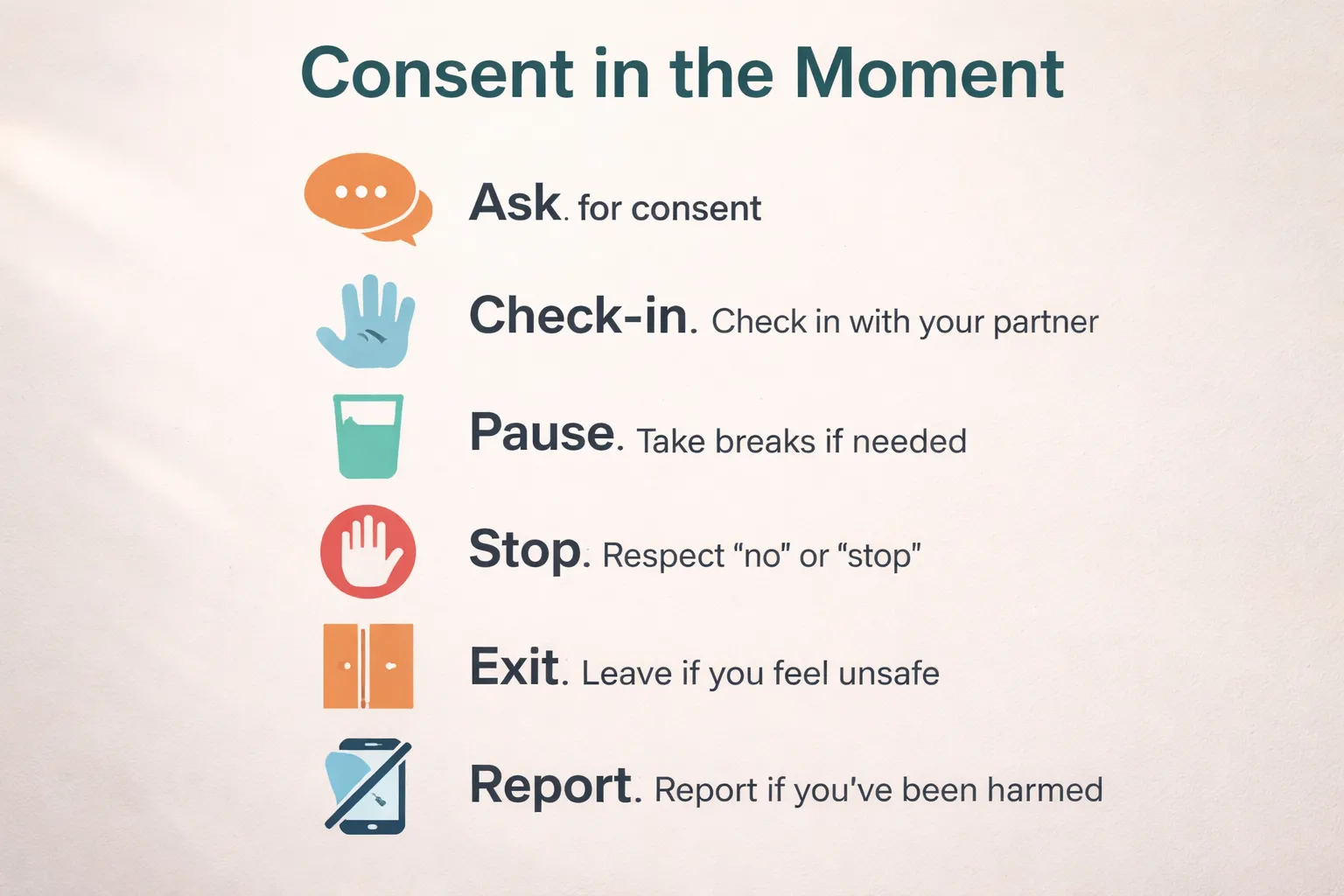
How to Ask Clearly
Ask for consent in plain words. Keep your voice calm. Give the other person an easy out.
- Start simple: “Are you into kissing?”
- Name the next step: “Can I touch your waist?”
- Be specific: “Do you want oral, or should we keep it to hands?”
- Confirm roles: “Do you want to lead, or should I?”
- Set limits fast: “Any no-go areas or hard limits?”
- Pair consent with safer sex: “Condoms only. Are you good with that?”
- Invite a stop anytime: “If anything feels off, say ‘pause’ and we stop.”
Use names. Use clear nouns. Avoid hints and coded language.
How to Say No Kindly and Firmly
You do not owe a reason. You do not need to negotiate. Say no once, then redirect.
- “No thanks.”
- “I’m not into that.”
- “Not tonight.”
- “I’m going to stop here.”
- “Please don’t touch me there.”
- “I’m stepping out. Have a good night.”
If someone pushes after a no, treat it as a red flag. End the interaction.
Ongoing Consent, Check-Ins That Match the Moment
Consent is not a one-time yes. You need new consent when you change the activity, the partner, the position, or the intensity.
- Activity change: “Want to move from kissing to touching?”
- Intensity change: “Is this pressure okay?”
- Partner change: “Are you okay if my partner joins?”
- Room change: “Do you want to stay here or move somewhere quieter?”
- Protection change: “New condom before we switch?”
Keep check-ins short. Ask. Listen. Adjust fast.
Nonverbal Cues Are Not Enough
Body language can mislead. People freeze. People fawn. People smile to stay safe. Confirm with words.
- If you see silence, stillness, or tense breathing, stop and ask.
- If someone turns away, covers up, or stops responding, stop and ask.
- If you cannot hear a clear yes, treat it as no.
Use verbal confirmation before hands move, before clothes move, and before you escalate.
Build a Couple Stop System
Agree on a simple stop system before you enter a party space. Keep it easy to use in front of others.
- Safeword or phrase: “Red” means stop now. “Yellow” means slow down and check in.
- Public cover phrase: “We need to check the car” or “I need water” means exit with no debate.
- Hand squeeze: One squeeze means check-in. Two squeezes means leave.
- Pause protocol: Say “pause.” Hands off. Step back. Ask, “Are you okay, yes or no?”
Honor the stop every time. No discussion in the moment. Debrief later.
Alcohol and Party Pressure
Impairment breaks consent. Do not rely on slurred words, delayed responses, or “sure, whatever.”
- If someone seems drunk or high, stop. Do not start anything new.
- If you feel impaired, call your own stop. Move to water, food, and a quiet space.
- Set a drink limit before you arrive, and treat it as a hard rule.
- Avoid “group momentum.” Consent does not get easier because others act casual.
If you want the lifestyle to support your relationship, protect your judgment first. This fits the same boundary mindset you set in advance in questions couples should ask before swinging.
Bystander Consent, Touching, Joining, Watching, Filming
Do not assume access because you are in a sexual space. Ask before you touch, join, watch, or record.
- Touching: Ask even for “small” contact like hips, hair, or thighs.
- Joining: Ask every person involved, not just one.
- Watching: Ask the people playing and the host if needed.
- Phones and filming: Treat it as no unless you get explicit permission from everyone, each time.
Many events ban photos. Follow house rules. If you want long-term trust, you protect privacy.
If Boundaries Get Crossed
Act fast. Keep it simple. Your job is to stop harm, then get support.
- Stop: Say “Stop” or “Hands off.” Move their hand away if needed.
- Separate: Step back. Create distance. Get to your partner.
- Regroup: Use your exit phrase. Go to your planned safe spot.
- Report: Tell the host or event staff. Give names and a short description.
- Leave: If you do not feel safe, end the night.
Later, debrief as a couple. Update your rules and screening. If you need a stronger structure for trust and boundaries, align it with your approach in swinging while married.
Aftercare and Debriefs: Staying Aligned After a Swinging Experience
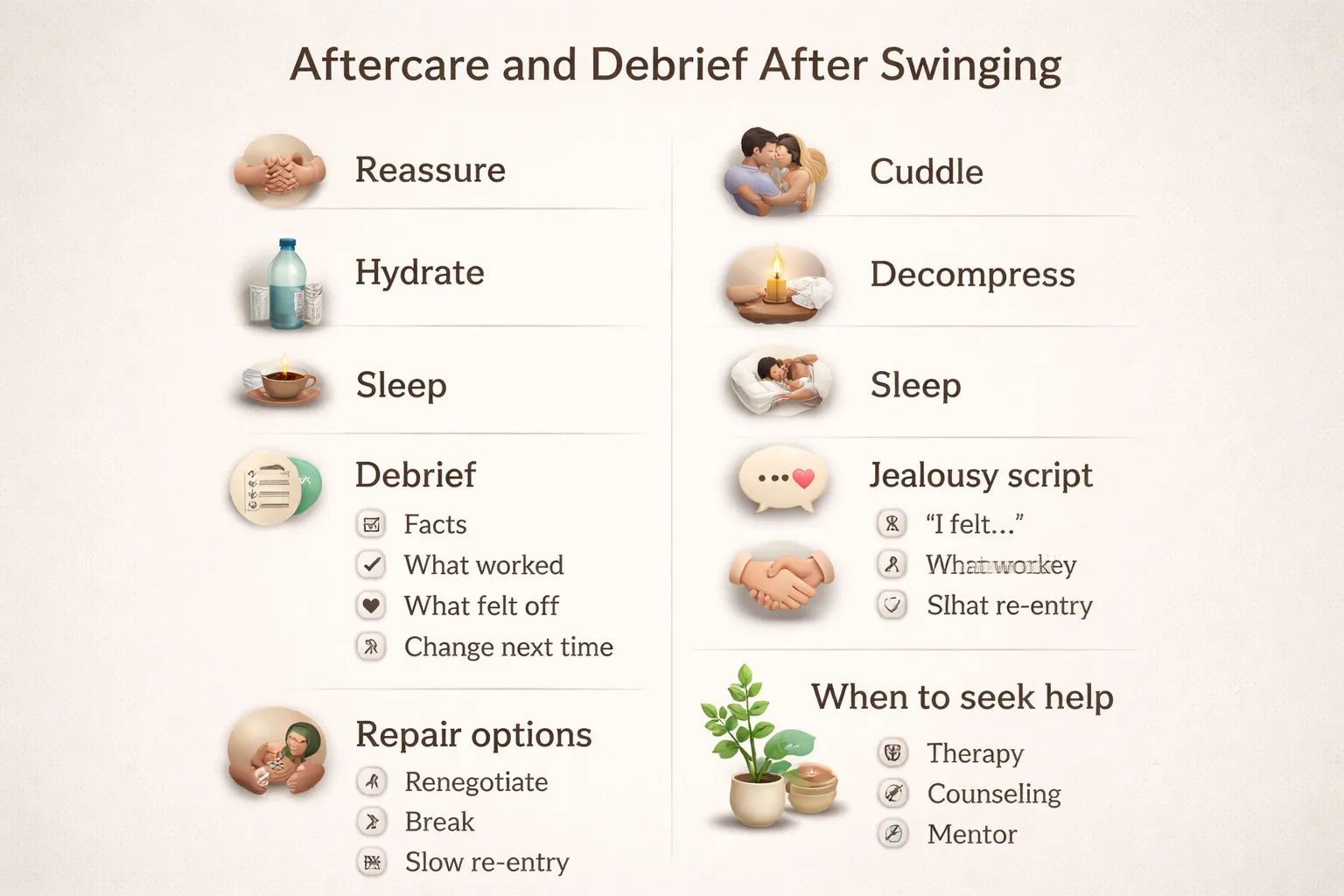
Immediate Aftercare: Reassurance, Comfort, and Reset
Aftercare starts when you leave the room. Do it on purpose. Do not wait for a fight.
- Reassure first. Say what you appreciate. Keep it specific. “I loved seeing you relaxed.” “I felt close to you.”
- Re-connect physically. Cuddle, hold hands, shower together, or sit close. Choose what feels safe for you both.
- Hydrate and eat. Sex, alcohol, and late nights hit your body. Drink water. Get salt, protein, and carbs.
- Decompress. Take quiet time before deep talks. Some people need silence first. Some need a short walk. Agree on a window like 30 to 60 minutes.
- Sleep plan. Decide if you talk tonight or tomorrow. Do not force a heavy debrief at 2 a.m.
If this was your first time, use a checklist mindset. Keep it simple and repeatable. You can also review your broader plan in our first-time guide at /swinging-first-time-checklist-what-to-do-before-during-and-after.html.
Debrief Framework: What Worked, What Felt Off, What Changes Next
Debrief within 24 to 72 hours. Pick a calm setting. Set a time limit like 20 to 40 minutes.
- Facts. Where you went, who you met, what happened. Keep it clean and accurate.
- What worked. Name behaviors you want again. Example, “You checked in with eye contact, it helped me stay grounded.”
- What felt off. Describe the moment and the impact. Skip mind reading. Skip labels.
- What to change next time. Turn feelings into rules, signals, or limits. Example, “If one of us freezes, we leave within 5 minutes.”
- One next step. Choose one small adjustment. Too many changes create confusion.
Track patterns. If the same issue repeats three times, treat it as a rule problem, not a mood problem.
Talk About Jealousy Without Blame
Jealousy shows up fast after a high-intensity night. You stay aligned by naming it without attacking your partner.
- Use “I felt” statements. “I felt anxious when you disappeared for 10 minutes.” “I felt replaceable when you praised them in front of me.”
- Separate triggers from accusations. A trigger is a moment. An accusation is a story. Stick to the moment.
- Ask for a specific repair. “Next time, tap my hand before you move rooms.” “After we leave, I want 10 minutes in the car to reconnect.”
- Confirm your baseline. Say what stays true. “I choose you.” “We leave together.” “We tell the truth.”
If jealousy keeps spiking, you need tools, not willpower. See /how-to-handle-jealousy-in-swinging-practical-tools-that-work.html.
Repairing a Mismatch: Renegotiate, Pause, Re-Enter Slower
Sometimes one of you feels good and the other feels scraped raw. Treat that as a mismatch, not a failure.
- Renegotiate rules. Tighten access, slow pacing, or remove the act that caused the hit. Put it in writing.
- Take a break. Set a clear end date like 30 days. Use the time to rebuild closeness and sleep.
- Create slower re-entry. Start with flirting only. Then soft swap. Then full swap. Add steps only when both of you feel steady.
- Close the loop on resentments. Name what you need to feel safe again. Do not stack new experiences on top of old pain.
If your best move is to stop, do it clean. Use /how-to-stop-swinging-and-close-the-relationship-without-resentment.html.
When to Seek Help
Get support early when the same pain repeats, or when talks turn into fights.
- Sex-positive therapy. Use it for shame spirals, sexual anxiety, or trauma responses.
- Couples counseling. Use it for trust breaks, boundary violations, or communication shutdowns.
- Community mentors. Use them for venue norms, pacing, and practical safety. Choose people who respect consent and privacy.
Bring specifics to help sessions. List the rules you set, the moments that hurt, and what you tried to change. You will move faster with clean data.
Practical Scripts and Checklists (Use-Ready Communication Tools)
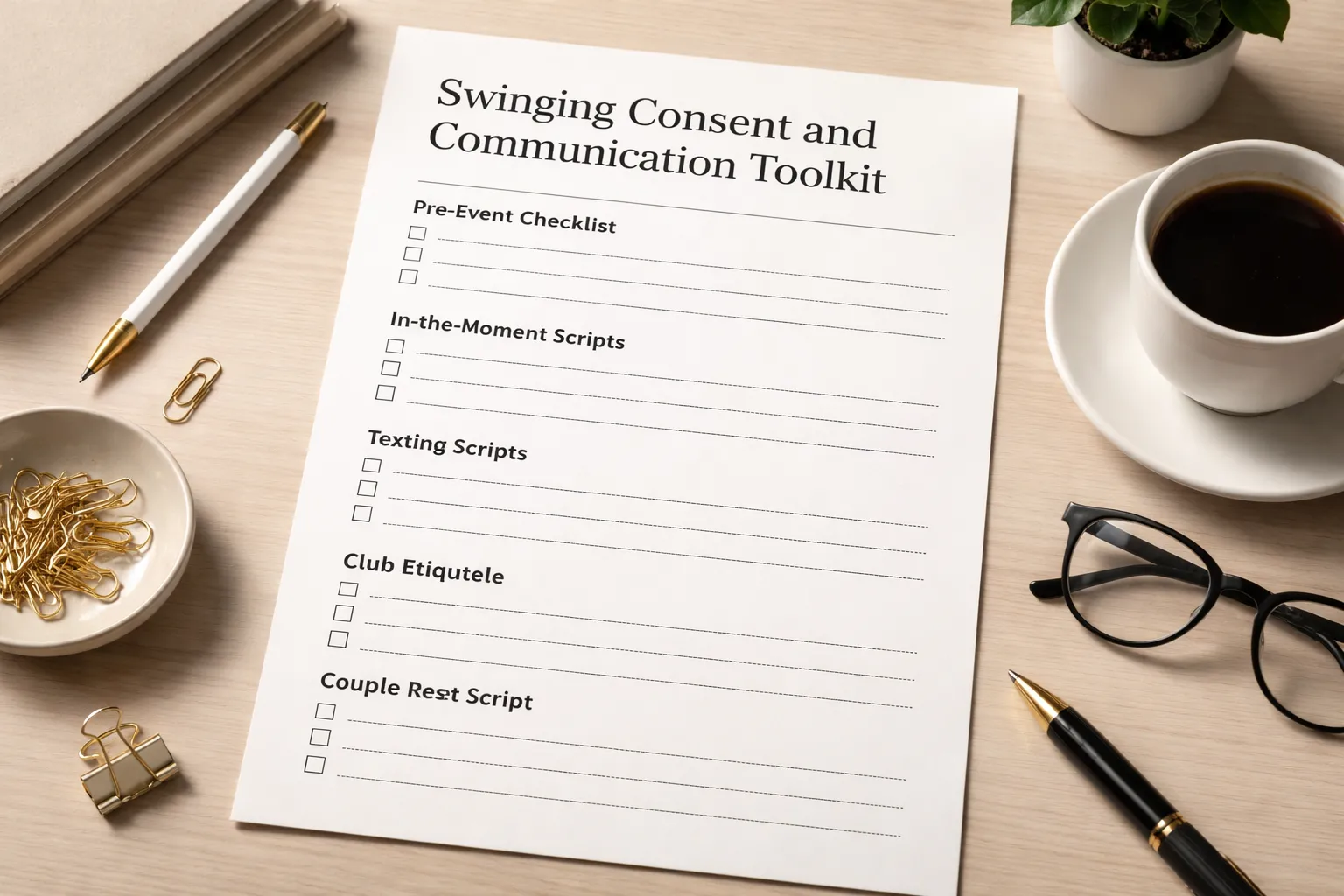
Pre-Event Checklist (Boundaries, Protection, Signals, Exit Plan)
- Define your yes list. Acts you both want and allow.
- Define your no list. Acts that end the interaction.
- Define your maybe list. Acts that require a pause and a check-in.
- Set partner rules. Same room, same bed, separate play, no overnights, no phone numbers, your call.
- Set condom and barrier rules. Condoms for all penetration, dental dams for oral, gloves for hands, lube only from your kit.
- Set fluid rules. No finishing in mouth, no swallowing, no internal finishing, or specify what you allow.
- Testing status. Date of last STI panel, what tests, results, new partners since, condom use since.
- Substance limits. Max drinks, no drugs, or specific hard stops. If either feels impaired, you leave.
- Privacy rules. No photos, no full names, no workplace info, no identifying details in messages.
- Health and trauma triggers. Anything that needs a warning or a hard stop.
- Signals. A “pause” word, a “stop now” word, and a “we leave” phrase.
- Exit plan. Your own transport, cash, charged phones, agreed time limit, and a clear reason you can use.
- Aftercare plan. Food, water, shower preference, cuddle or space, and a debrief time.
Quick Testing and Protection Table (Use Before You Meet)
In-the-Moment Scripts (Direct, Clean, Repeatable)
Asking to join. “Hi. We are interested. Are you open to us joining, yes or no?”
Confirming consent before touch. “Can I touch your hips and kiss you? If you say stop, I stop.”
Confirming condom use. “I use condoms for any penetration. No exceptions. Are you aligned?”
Confirming boundaries. “We are okay with kissing and oral. No anal. No finishing in mouth.”
Pausing. “Pause. I need a minute to check in with my partner.”
Stopping. “Stop. I am done.”
Declining. “No. Thanks for asking. We are not a match.”
Redirecting pressure. “I said no. If you push again, we leave.”
Reconfirming during play. “Still good? Same pace? Any change?”
Leaving politely. “We are going to head out. Thanks for the time.”
Texting and Messaging Scripts (Flirting With Consent and Privacy)
First message. “We are a couple. We like clear consent and safe play. What are you into, and what are your hard no’s?”
Consent-forward flirt. “I want to flirt with you. Are you open to that here?”
Privacy boundary. “We do not share last names or face photos before we meet. Are you good with that?”
Photo request boundary. “We do not send explicit photos. We can swap non-identifying pics, or meet in public first.”
STI and protection check. “Last panel date, and any new partners since then? We use condoms for penetration.”
Meet logistics. “We prefer a short coffee or a club social first. One hour. Either of us can end it.”
Boundary mismatch. “Sounds like our rules do not match. No hard feelings. We will pass.”
After-date follow-up. “Thanks for meeting. We are interested in a second meet. Same rules. No pressure if you are not.”
Host and Club Etiquette Checklist (Rules, Norms, Reporting)
- Read the venue rules before you arrive. Dress code, phone policy, consent policy, play areas.
- Ask staff how consent works there. What counts as a violation, what staff will do, where to report.
- Use clear asks. Ask before touching. Ask before joining. Ask before removing clothing.
- Respect “no” the first time. No debate. No follow-up pitch.
- Keep voices low. Protect privacy. Do not gossip about people you see.
- No photos, no recordings. If you see a phone out, flag staff.
- Know the safe contact. Who on staff handles problems, where they stand, what they wear.
- Report fast. If someone pressures, follows, grabs, or ignores a boundary, tell staff now.
- Do not “handle it” alone. Get staff, get your partner, leave if needed.
- Exit without drama. You do not owe anyone a reason beyond “we are done.”
Reset Script for Couples (Recalibrate Without Blame)
Simple reset. “I need to slow down. Can we recalibrate?”
What you need. “I feel flooded. I need water, a quiet corner, and five minutes with you.”
Set the next action. “We can watch only, talk only, or leave. I need you to choose with me.”
Confirm the rule. “If either of us says we leave, we leave. No debate.”
Repair after. “I want to debrief tonight. Facts first, feelings second, then what we change next time.”
Fast Debrief Checklist (Use the Same Night)
- What happened. Two minute summary, no interpretation.
- What worked. Specific moments you want to repeat.
- What hurt. Specific moments that crossed a line or felt off.
- What you learned. One rule you tighten, one rule you loosen, or one rule you add.
- What you need now. Sleep, closeness, space, reassurance, or therapy support.
- In het kort: Get clear on consent before you play; treat consent as a live process, not a one-time yes.
- In het kort: Use plain rules, simple signals, and hard stops; you prevent most problems before they start.
- In het kort: Communicate in the moment and after; debrief fast, then adjust your agreements.
- In het kort: Protect your relationship first; if alignment drops, pause and reset.
- Set boundaries before any meet. Cover acts, condoms, rooms, alcohol, photos, and exit plans.
- Use active consent. Ask, listen, confirm, then proceed. If you feel unsure, stop.
- Define a safeword and a check-in signal. Make “stop” mean stop, no debate, no delay.
- Keep communication short during play. Use direct phrases like “slow down,” “hands off,” “I need a break.”
- Manage expectations. Agree on what “successful” looks like for the night, including leaving early.
- Debrief the same night. Use a two minute facts-only recap, then name what worked, what hurt, what you learned, and what you need.
- Change one thing at a time. Tighten one rule, loosen one rule, or add one rule. Write it down.
- Use pauses as a tool. If jealousy spikes or trust drops, stop swinging until you feel stable again.
- For next steps, review your basics in How to Start Swinging for Beginners: Your Step-by-Step Guide.
- If you worry about long-term impact, read Does Swinging Ruin Relationships? What Helps Couples Succeed.
- If you decide to stop, use How to Stop Swinging and Close the Relationship (Without Resentment).
FAQ
What does consent mean in swinging?
Consent means clear, informed, specific agreement. You can say yes to kissing and no to sex. Consent must stay active during play. You can stop at any time. Treat silence, freezing, or reluctance as a no. Get verbal confirmation before each new step.
How do you ask for consent without killing the mood?
Use short, direct phrases. “Can I kiss you?” “Do you want oral?” “Condom on?” Ask before you touch new areas. Confirm changes. If you drink, slow down. If you cannot get a clear yes, stop and reset.
What boundaries should you set before the first meetup?
Set rules for safer sex, allowed acts, positions, and condom use. Decide on alcohol limits. Agree on where you play and whether you swap rooms. Define exit signals and a hard stop word. Use a checklist from Questions Couples Should Ask Before Swinging.
What is a safe word and how should you use it?
Pick one word for stop and one for pause. Make them easy to say. Share them with the other couple before play. Treat them as non-negotiable. When someone uses a word, stop contact at once. Then check in and decide next steps.
How do you communicate during play?
Use simple check-ins. “Good?” “Slower.” “No.” “Condom.” Keep your partner in view when possible. Use pre-set signals if you cannot speak. If you feel pressured, stop. Leave the room if needed. Your comfort sets the pace.
What should you do if you feel jealous in the moment?
Pause play. Reconnect with your partner. Use your stop word if you need it. Name the feeling without blame. Decide to continue, change activities, or leave. Debrief later and adjust rules. Use How to Handle Jealousy in Swinging.
How do you handle feelings for another couple?
Tell your partner early. Do not hide texts or meetups. Set limits on contact, frequency, and private messaging. Decide if you pause with that couple. If you want ongoing dating, renegotiate your agreement first. See How to Handle Feelings for Another Couple.
What are clear red flags that you should stop?
Pressure, guilt, or sulking after a no. Boundary “forgetting.” Intoxication that blocks consent. Anger when you slow down. Secret messaging. STI avoidance or condom resistance. You owe nobody access to your body. Stop the session. Leave. Debrief later.
How do you debrief after swinging?
Debrief within 24 hours. Start with facts, then feelings, then fixes. Name what worked, what hurt, and what you change next time. Avoid blaming. Create one or two rule updates. Use How to Debrief After Swinging.
How often should you test for STIs?
Test before you start. Then test every 3 to 6 months if you have ongoing partners. Test sooner after a condom break or an exposure. Use condoms for intercourse unless you have a shared, verified agreement. Do not rely on “looks clean” claims.
What if someone breaks a rule?
Stop play. Get the facts. Do not minimize it. Ask what happened, why, and what they will change. Agree on consequences, including a pause from swinging. Rebuild trust with transparency and time. If it repeats, end swinging or seek counseling.
Conclusion
Swinging stays safe when you treat consent as a system, not a vibe. You and your partner set clear rules. You confirm them out loud. You follow them every time. You stop when anything changes.
- Before: agree on boundaries, safer sex, and a stop signal. Write it down.
- During: ask for consent for each act. Use condoms and barriers as agreed. Check in at set times.
- After: debrief fast. Share facts. Share feelings. Update rules.
Your final tip is simple. Run a short pre-play script every time. State your rules, your safer sex plan, and your stop signal. Get a clear yes from each person. If you cannot get a clear yes, you do not play.
- Use: “Our boundaries are X. Our safer sex rules are Y. Our stop word is Z. Are you good with that, yes or no.”
If you want a tighter process, use a checklist before events and a shared questions list to keep you aligned. Use tools for jealousy when it shows up. If you need to pause or stop, close the relationship cleanly and without dragging it out.
-
How to Talk to Your Partner About Swinging (Without Pressure)
1 month ago -
Swinging Rules and Boundaries: Examples, Scripts, and Best Practices
1 month ago -
Swinging First Time Checklist: What to Do Before, During, and After
1 month ago -
How to Handle Jealousy in Swinging: Practical Tools That Work
1 month ago -
Questions Couples Should Ask Before Swinging (Boundaries, Safer Sex, Goals)
1 month ago
-
-
- Pre-Event Checklist (Boundaries, Protection, Signals, Exit Plan)
- Quick Testing and Protection Table (Use Before You Meet)
- In-the-Moment Scripts (Direct, Clean, Repeatable)
- Texting and Messaging Scripts (Flirting With Consent and Privacy)
- Host and Club Etiquette Checklist (Rules, Norms, Reporting)
- Reset Script for Couples (Recalibrate Without Blame)
- Fast Debrief Checklist (Use the Same Night)
-
- What does consent mean in swinging?
- How do you ask for consent without killing the mood?
- What boundaries should you set before the first meetup?
- What is a safe word and how should you use it?
- How do you communicate during play?
- What should you do if you feel jealous in the moment?
- How do you handle feelings for another couple?
- What are clear red flags that you should stop?
- How do you debrief after swinging?
- How often should you test for STIs?
- What if someone breaks a rule?
-
-
-
- Pre-Event Checklist (Boundaries, Protection, Signals, Exit Plan)
- Quick Testing and Protection Table (Use Before You Meet)
- In-the-Moment Scripts (Direct, Clean, Repeatable)
- Texting and Messaging Scripts (Flirting With Consent and Privacy)
- Host and Club Etiquette Checklist (Rules, Norms, Reporting)
- Reset Script for Couples (Recalibrate Without Blame)
- Fast Debrief Checklist (Use the Same Night)
-
- What does consent mean in swinging?
- How do you ask for consent without killing the mood?
- What boundaries should you set before the first meetup?
- What is a safe word and how should you use it?
- How do you communicate during play?
- What should you do if you feel jealous in the moment?
- How do you handle feelings for another couple?
- What are clear red flags that you should stop?
- How do you debrief after swinging?
- How often should you test for STIs?
- What if someone breaks a rule?
-
-
How to Debrief After Swinging: Break Jealousy Loops
1 month ago -
How to Repair Trust After a Boundary Is Broken
1 month ago -
How to Debrief After Swinging: Fix Resentment Early
1 month ago -
Aftercare & Support in Swinging: Red Flags and Resources
1 month ago -
Swinging Consent and Boundaries: Safer Sex & Comfort
1 month ago
-
Ethical Non‑Monogamy Terms: A Glossary of Common ENM Language
1 month ago -
How to Talk to Your Partner About Swinging (Without Pressure)
1 month ago -
Swinging Rules and Boundaries: Examples, Scripts, and Best Practices
1 month ago -
What Is the Swingers Lifestyle? A Beginner-Friendly Guide
1 month ago -
Swinging First Time Checklist: What to Do Before, During, and After
1 month ago