How to Talk to Your Partner About Swinging (Without Pressure)

Swinging talks fail when they feel like a pitch. Your partner hears pressure, even if you mean curiosity.
This guide shows you how to start the conversation with respect. You will learn how to check your motives, pick the right moment, and use clear language. You will also learn how to set boundaries, ask for consent, and accept a no without resentment. Expect scripts you can use, plus common mistakes to avoid.
You will also learn what to do after the first talk, including how to handle jealousy, rebuild trust, and agree on next steps. If you decide to move forward, see How to Start Swinging for Beginners: Your Step-by-Step Guide.
Before You Talk: Self-Reflection and Readiness Checks
Clarify Your “Why” Without Blaming the Relationship
Write down your reason in one sentence. Keep it about you. Do not use it as a critique of your partner or your sex life.
- Curiosity: You want to learn what it feels like in real life.
- Fantasy: The idea turns you on, even if you never act on it.
- Novelty: You want new experiences, not a new partner.
- Community: You want friends and events where sex-positive norms are common.
Avoid “why” statements that sound like a complaint. “You never” and “we don’t” put your partner on defense. If your real driver is dissatisfaction, handle that first. Swinging will not fix a weak connection.
Separate Fantasy From a Real-Life Ask
Fantasy can stay fantasy. A real-life ask changes your relationship. Treat them as different buckets.
| Fantasy (turn-on) | Real-life ask (agreement) |
|---|---|
| Hot to imagine, no action required. | Requires consent, rules, and follow-through. |
| Can be private, solo, or roleplay. | Involves other people and real consequences. |
| No timeline needed. | Needs pacing and check-ins. |
Decide which one you mean before you talk. If you want action, name the smallest first step you can live with. Example, reading together, listening to a podcast, or discussing boundaries. Do not open with a demand for a date.
Assess Relationship Stability
Swinging adds complexity. If your base is shaky, you will feel it fast. Do a quick readiness check.
- Trust: You keep agreements. You do not hide phone activity, flirting, or spending.
- Communication: You can talk about sex without shutting down, mocking, or escalating.
- Conflict: You repair after fights. You can apologize and change behavior.
- Recent stress: New baby, major illness, job loss, or relocation can shrink capacity.
- After betrayal: If you had cheating or major lies, do not use swinging as a reset. Repair first, then revisit.
If you are in a fragile period, your first talk should stay at the level of curiosity and values. Keep it slow. If marriage adds pressure, plan your talk with extra care. See Swinging While Married: How to Approach It With Trust and Boundaries.
Know Your Non-Negotiables and “Would Be Nice” Preferences
You need clarity before you negotiate. Split your list into two parts.
- Non-negotiables: Deal-breakers that protect your mental health, safety, and relationship.
- Would be nice: Preferences you can bend on without resentment.
Examples to sort:
- Non-negotiable: condoms for all penetration, no solo play, no coworkers, no overnights, no drugs.
- Would be nice: same room only, soft swap first, meet people together, debrief after, limit frequency.
Do not build your list to control your partner. Build it to keep you steady. If you need help turning these into clear boundaries and scripts, use Swinging Rules and Boundaries: Examples, Scripts, and Best Practices.
Set a Personal Goal for the First Talk
Your goal should fit one conversation. Do not make “get a yes” the goal. That creates pressure and makes your partner feel cornered.
- Good goals: share your interest, learn their feelings, agree on what to read next, set a follow-up talk.
- Bad goals: get permission, set a date, convince them, prove a point.
Pick one outcome you can accept today. Example, “I want us to talk openly and end feeling close, even if the answer is no.” That mindset keeps the conversation safe and honest.
How to Talk to Your Partner About Swinging (Without Pressure): Timing, Tone, and First Words

Pick the Right Time and Place
Choose a neutral setting. Keep it private. Avoid bedrooms and places tied to past fights.
Pick an unrushed window. Aim for 30 to 60 minutes. Plan it for a day with low stress and no deadlines right after.
Stay sober. Alcohol and drugs blur consent and raise reactivity.
Do it when you already feel connected. After a good day works better than after an argument.
- Good moments: a calm walk, a quiet dinner at home, a weekend afternoon.
- Bad moments: during sex, right after sex, during a fight, before bed, in the car with no exit.
Use Consent-Forward Language
Start by asking permission to talk. Give an easy “no.” That lowers pressure and keeps trust intact.
- Ask to discuss. Do not announce a decision.
- Name their right to decline. Say it early.
- Offer a stop option. “We can pause anytime.”
Keep the frame clear. This is a conversation, not a pitch. If you want deeper guidance, use the same standards as in Swinging Consent and Communication: Tips to Stay Safe and Aligned.
Lead With Reassurance and Commitment
Say what will not change. Your care. Your commitment. Your respect for their boundaries.
State that this is optional. Say you value the relationship more than any experience.
- Say: “I am not asking for a yes today.”
- Say: “If this is a no, I will respect it.”
- Do not say: “If you loved me you would try.”
If you are married, pressure can land harder because the stakes feel higher. You can pair this talk with the boundary-first approach in Swinging While Married: How to Approach It With Trust and Boundaries.
Use “I” Statements and Curiosity
Own your desire. Do not turn it into a diagnosis of the relationship.
Use “I feel,” “I want,” and “I am curious.” Then listen. Let silence work.
- Keep it specific. “I have been thinking about swinging.”
- Ask about feelings first. Fear, jealousy, excitement, disgust, interest.
- Ask about needs. Safety, privacy, pace, control, reassurance.
Avoid ultimatums. Avoid comparisons to friends or porn. Avoid guilt. Avoid keeping score.
Timing, Tone, and First Words That Work
Use a calm tone. Speak slowly. Keep your first minute short. Long intros sound like a sales pitch.
| Do | Avoid |
|---|---|
| Ask permission to talk. | Bring it up during sex. |
| Say it is optional. | Act like you already decided. |
| Name their right to say no. | Ask for an answer now. |
| Share one reason and stop. | List ten reasons and “proof.” |
| Invite their feelings. | Argue with their reaction. |
Starter Scripts for Different Dynamics
Married, high-stakes, long history
- “Can we talk about something sexual, with no pressure to agree. If you say no, we stop.”
- “I love our marriage. This is not about replacing you. I have been curious about swinging and I want to hear how it lands for you.”
- “We do not need a decision. I only want to understand your feelings and boundaries.”
Long-term partners, established trust, but sensitive topic
- “Can I share a fantasy I have been thinking about, and you can tell me honestly if it is a hard no.”
- “I am curious about swinging. I am not asking to act on it. I want to talk first and see what comes up for you.”
- “What parts feel interesting, and what parts feel unsafe.”
New relationship, early stage, values check
- “I want to talk about exclusivity and what we each want long term. Is now a good time.”
- “I can be happy monogamous, and I can also be curious about non-monogamy. Where are you on that spectrum.”
- “If we want different things, I would rather know early and stay respectful.”
End with a next step that stays low pressure. Suggest reading one article together. Or set a second talk in a week. If you ever try anything, plan a debrief routine in advance. Use How to Debrief After Swinging With Your Partner (A Simple Framework) as your template.
Listen First: Handling Your Partner’s Reactions with Care
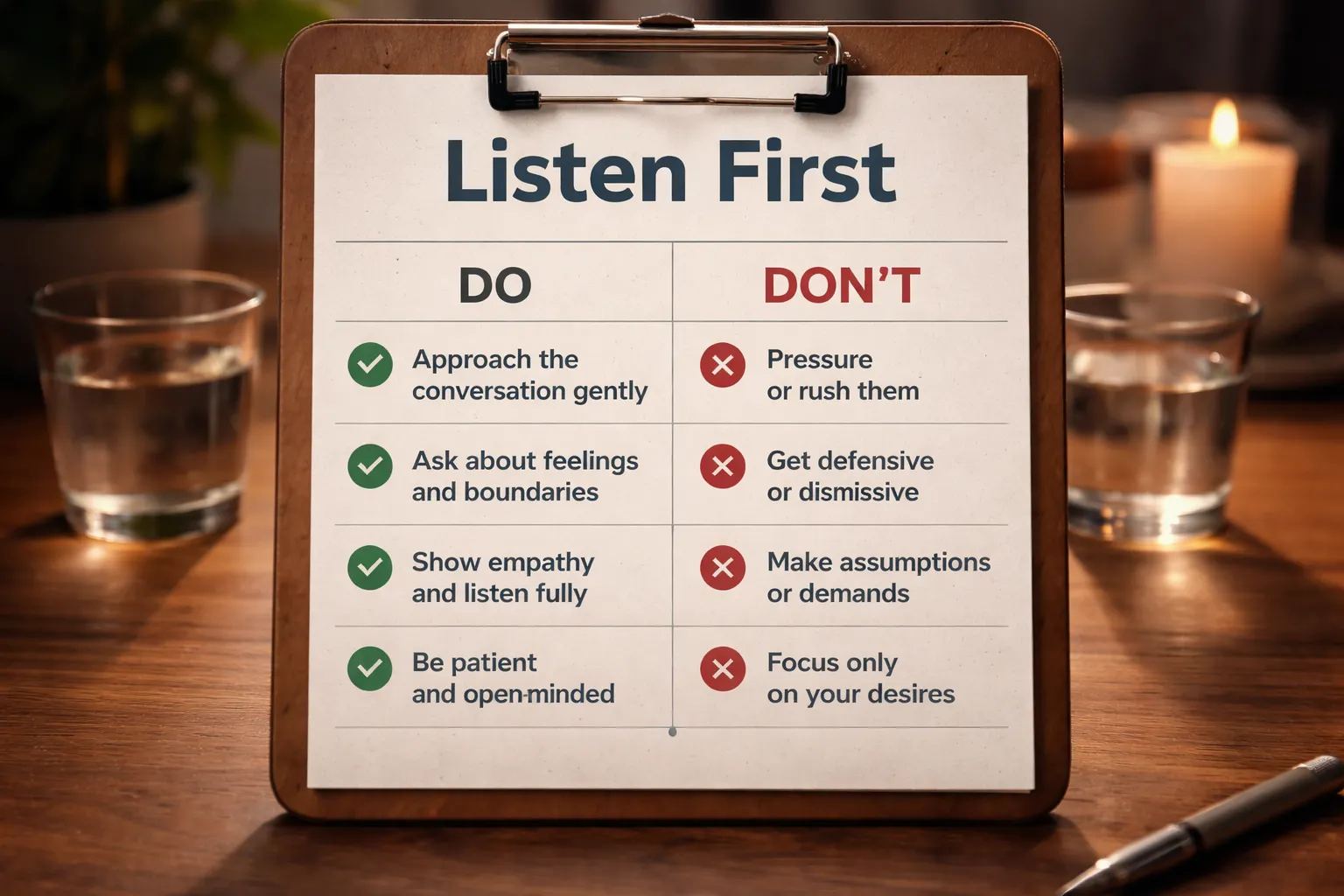
Common Reactions You Might Hear
Your partner’s first reaction sets the pace. Treat it as data, not a verdict.
- Interest. They lean in, ask details, or share a fantasy.
- Confusion. They ask what you mean, or they get stuck on labels.
- Jealousy. They picture you with someone else and feel panic or anger.
- Hurt. They hear “you are not enough,” even if you did not mean it.
- Fear of replacement. They worry you want an upgrade, not an experience.
- Disgust. They feel repelled or unsafe, and they want distance.
Expect mixed reactions. People can feel curiosity and fear at the same time.
Listen First, Then Speak
If you push for agreement, you turn the talk into a test. If you listen, you keep it safe.
- Reflect. “I hear you saying this feels scary.” “It sounds like you worry I will compare you.”
- Validate feelings. “That makes sense.” “I can see why that would hurt.”
- Ask open questions. “What part feels worst?” “What would you need to feel safe?” “What boundaries would matter most to you?”
- Confirm meaning. “When you say ‘no,’ do you mean no forever, or no right now?”
Stay specific. Focus on emotions, safety, and values. If you want to discuss why some couples enjoy it, save that for later, you can read /benefits-of-swinging-for-couples-why-some-relationships-thrive.html together when your partner feels calm.
What Not to Do
- Do not debate. You cannot logic someone into feeling safe.
- Do not persuade. Selling it makes you look invested in winning.
- Do not minimize. Avoid “it’s no big deal” or “everyone does it.”
- Do not rush. Deadlines create pressure.
- Do not use sex as leverage. Do not raise it during sex, right after sex, or after a fight.
- Do not treat jealousy as a flaw. It is a signal. Handle it with care.
If Your Partner Says “No”
Take the no at face value. Do not negotiate it down.
- Confirm the boundary. “Thanks for telling me. I will not push this.”
- De-escalate. Slow your tone, drop details, stop talking about logistics.
- Repair safety. “I choose you. I am not leaving. I want trust more than novelty.”
- Set a rule. Agree on whether the topic is closed forever, or closed for a set time.
If you later decide to stop pursuing non-monogamy, protect the relationship from resentment. Keep /how-to-stop-swinging-and-close-the-relationship-without-resentment.html on your list.
If Your Partner Says “Maybe”
Maybe means your partner needs time, structure, and control over the pace.
- Define what “maybe” covers. Research only, dirty talk only, a club visit only, or meeting people only.
- Pick one small next step. No profiles, no invites, no promises.
- Set constraints. Time limits, topics allowed, and a clear stop word like “pause.”
- Agree on boundaries early. Safer sex rules, alcohol limits, and what counts as cheating.
If feelings for others come up, plan for it now. Use /how-to-handle-feelings-for-another-couple-in-swinging.html as required reading before you meet anyone.
Next Step, Keep It Low Pressure
End the talk with an option, not a push.
- Read one article together this week, then stop.
- Set a second talk in seven days, 30 minutes max.
- If you ever try anything, plan a debrief routine in advance. Use How to Debrief After Swinging With Your Partner (A Simple Framework) as your template. Decide when you will talk, what you will cover, and how either of you can call a pause.
Boundaries, Consent, and Safer Sex: What You Need to Agree on Before Any Next Steps
Boundaries, Consent, and Safer Sex: What You Need to Agree on Before Any Next Steps
If you skip this part, you invite drama. Set rules before you set dates. Start with consent. You both get a clear yes. You both can say no at any time. No guilt. No bargaining. Then define boundaries you can follow under stress. What counts as sex. What acts stay off-limits. Where it can happen. How you handle alcohol and drugs. What information you share after. Add a safer sex plan you will not “figure out later.” Condoms, barriers, STI testing cadence, and what happens after a slip. Put it in writing. Keep it short. Revisit it after every talk. If you cannot agree, pause. Use a question list to stay structured.
- Consent rules: two yeses, one no, stop-anytime signal.
- Boundaries: acts, locations, partners, overnights, privacy.
- Safer sex: barriers, testing schedule, birth control, exposure plan.
- Exit plan: how you pause or stop without resentment.
Read our detailed guide: Boundaries, Consent, and Safer Sex: What You Need to Agree on Before Any Next Steps - How to Talk to Your Partner About Swinging (Without Pressure)
Low-Pressure Ways to Explore Together (If You Both Want To)

Start With Conversation Only
Keep the first phase verbal. No apps. No plans. No timelines.
Share fantasies and turn-ons as information, not a request. Use clear language. Stay specific.
- Green list: things you would enjoy.
- Yellow list: things you might try with limits.
- Red list: things you do not want.
Write your lists down. Compare them. Circle overlap. Treat every non-overlap as a stop, not a negotiation.
Try Baby Steps That Stay Reversible
Pick steps that build data without creating momentum you cannot control. Keep each step time-boxed.
- Erotica or porn debrief: watch or read separately, then share what worked and what did not. Focus on acts and dynamics, not performers.
- Flirting rules: agree on where flirting can happen, what counts as flirting, and what ends it. Define what you do if one of you feels flooded.
- Shared profile, no meetups: if you use apps, set the profile to “research only.” Do not exchange numbers. Do not schedule. Use it to learn what you both react to.
- Message drafts: write a first message together, then delete it. This shows you how you present as a couple.
Set a stop-anytime signal for these steps too. Treat it as binding.
Research Together Before You Show Up Anywhere
Do your homework as a pair. It reduces surprises and reduces pressure in the moment.
- Terminology: soft swap, full swap, same-room, separate-room, parallel play, voyeur, exhibitionist, unicorn, couple-only, single male policy.
- Etiquette basics: ask before touching, accept “no” once, do not negotiate boundaries, do not follow people, do not get drunk to cope.
- Event reality check: many parties have check-in rules, dress codes, consent policies, and no-phone areas. Some spaces ban intercourse. Some require proof of recent testing.
Keep notes on what sounds good and what sounds stressful. If you need a tighter framework for consent and communication, read Swinging Consent and Communication: Tips to Stay Safe and Aligned.
Choose One “First Experiment” and Keep It Light
Pick one small experiment. Define what “success” means. Define what “stop” looks like.
| Option | Lowest-pressure version | Hard stop if |
|---|---|---|
| Watching only | Go to a venue just to observe. Keep hands to yourselves. | Either of you feels trapped, jealous, or numb. |
| Flirting only | Talk with another couple, then leave together. | One of you starts “performing” to keep the peace. |
| Soft play | Kissing and touching with clothes on, same room only. | You lose track of your boundaries in the moment. |
| Same-room swap | Any intercourse stays off the table on attempt one. | You feel pressure to escalate to avoid disappointment. |
Decide in advance how you will leave. Use your exit plan. If you want a detailed stop plan, use How to Stop Swinging and Close the Relationship (Without Resentment).
Plan the Debrief Before You Do Anything
Debrief fast, then debrief again later. Do it sober. Keep it structured. Stick to facts and feelings.
- What felt good? Name the exact moment.
- What felt bad? Name the exact trigger.
- What surprised you? Good or bad.
- What boundary needs tightening? Acts, pace, alcohol, privacy, messaging.
- What do you need now? Reassurance, space, sex together, sleep, no talk.
- What is the next step? Repeat, smaller step, or pause.
If either of you feels worse after the debrief, pause. Do not schedule another step to “fix” the feeling. Use your stop-anytime rule and revisit when you both feel stable.
When to Pause or Get Support (Therapy, Coaching, and Red Flags)
When to pause
Pause if either of you feels anxious, numb, or sick after you talk. Pause if you argue in circles. Pause if you keep reopening the topic during conflict.
Use a clear rule. No new plans. No apps. No flirting. No invites. Set a date to revisit the conversation when you both feel calm.
Red flags that mean stop now
- Pressure: pushing for a yes, pushing for a timeline, or treating hesitation as a problem to solve.
- Threats: “If you loved me you would,” “I will cheat,” “I will leave,” “I will take sex off the table.”
- Emotional manipulation: guilt, shaming, silent treatment, scorekeeping, or using jealousy on purpose.
- Persistent boundary pushing: testing limits, “joking” about breaking rules, or asking again after you said no.
- Isolation: discouraging you from talking to a therapist, friend, or coach.
- Substance pressure: needing alcohol or drugs to get agreement or to “make it easier.”
If any of these show up, swinging is not the next step. Safety and consent are the next step.
If this conversation is surfacing deeper issues
Swinging talks often expose problems that already exist. Name them. Work on them first.
- Mismatched libido: you use swinging to avoid a hard talk about sex at home.
- Resentment: you want payback, leverage, or a “hall pass” that fixes old hurts.
- Insecurity: you want proof you are enough, or you fear you are replaceable.
- Trust damage: you have lies, secrecy, porn fights, or past cheating in the background.
- Conflict style problems: one of you shuts down, the other escalates.
Do not use new partners as a solution to old pain. If jealousy is already high, get tools first. You can start with How to Handle Jealousy in Swinging: Practical Tools That Work.
When to get support (therapy, coaching)
Get help if you cannot talk without spiraling, if you keep breaking agreements, or if one of you says yes and then crashes. Get help if you cannot tell the difference between curiosity and pressure.
A sex-positive therapist can help you build consent skills, repair trust, and set boundaries that hold. A coach can help with communication and planning, but therapy fits better when trauma, anxiety, depression, addiction, or betrayal sits in the mix.
What to look for in a sex-positive therapist
- They work with consensual non-monogamy and do not treat it as a disorder.
- They treat consent as central, not as a hurdle.
- They can name coercion, manipulation, and control patterns fast.
- They support either outcome, open, closed, or unsure.
- They help you set agreements, repair ruptures, and build a real stop rule.
If you decide to stop or close after trying, use a plan that prevents drift and resentment. See How to Stop Swinging and Close the Relationship (Without Resentment).
Safety note: coercion and intimate partner violence
If you fear your partner, do not negotiate. Do not disclose plans to leave. Do not attend therapy together if you face intimidation or violence at home.
- If you are in immediate danger, call local emergency services.
- US: National Domestic Violence Hotline, call 1-800-799-7233 or text START to 88788.
- UK: Refuge, call 0808 2000 247.
- Canada: Talk to a local provincial hotline or Victim Services in your area.
- Elsewhere: search “domestic violence hotline” plus your country.
Coercive control can look calm on the surface. Watch for monitoring your phone, controlling money, limiting friends, sexual pressure, and punishment for saying no.
How to keep the topic open without nagging
Set a mutual check-in schedule. Keep it short. Keep it optional.
- Pick one date, 7 to 14 days out.
- Limit the talk to 20 to 30 minutes.
- Each of you answers three items, what feels safe, what feels unsafe, what you need next.
- If either of you says pause, you pause. No debate.
- Do not bring it up between check-ins unless both of you agree to it.
If you want more context on what helps couples succeed long term, read Does Swinging Ruin Relationships? What Helps Couples Succeed.
FAQ
How do you bring up swinging without pressuring your partner?
Ask for a low stakes talk, not a decision. State your intent, curiosity, and respect for their no. Use a time limit. End with next steps, or a pause. Keep it off the table between check-ins unless you both agree.
What should you say in the first conversation?
Use clear points. What you want to explore. What you do not want. What you fear. What you need to feel safe. Ask your partner for the same. Do not negotiate in the first talk. Save rules for later.
What if your partner says no?
Accept it the first time. Ask what the no means, no forever, no right now, or no to a specific version. Do not relitigate. If you need closure, agree on a next check-in date, or stop the topic.
How do you know if your partner feels pressured?
Watch for short answers, people pleasing, shutdown, or sudden agreement without details. Ask directly if they feel free to say no. Offer an easy exit, like, “We can drop this.” Then honor it if they take it.
When should you stop the conversation?
Stop when either of you feels flooded, defensive, or numb. Stop if voices rise. Stop if anyone says pause. No debate. Set the next check-in within 7 to 14 days. Keep the talk to 20 to 30 minutes.
Should you set rules before you try anything?
Yes. Start with boundaries, safer sex, privacy, and communication. Keep rules simple and testable. Write them down. Review after each check-in. For scripts and examples, use /swinging-rules-and-boundaries-examples-scripts-and-best-practices.html.
How do you handle jealousy?
Name the trigger. Agree on limits that reduce it, like no repeat partners or no overnights. Add reassurance plans, like check-in texts. Do not use jealousy as a weapon. Review after each step and adjust fast.
How do you talk about swinging in a long distance relationship?
Decide if you only play together, or if solo is on the table. Set location rules, video call check-ins, and a stop word. Plan visits around connection first. Use /swinging-for-long-distance-couples-how-to-make-it-work.html for structure.
What if one of you wants to stop after starting?
Stop. Close the relationship cleanly. Do not keep “one last time” deals. Do a debrief, what worked, what harmed trust, what repairs you need. Use /how-to-stop-swinging-and-close-the-relationship-without-resentment.html for a step plan.
Does swinging ruin relationships?
It can if you use it to fix distance, conflict, or low trust. It tends to work better when you already communicate well and keep clear agreements. For factors tied to outcomes, read /does-swinging-ruin-relationships-what-helps-couples-succeed.html.
Should you see a therapist before swinging?
Consider it if you have betrayal history, ongoing resentment, sexual mismatch conflict, or frequent shutdown fights. Use a therapist who understands consensual non-monogamy. Go for skills and clarity, not permission.
Conclusion
You do not need to convince your partner. You need clear consent, clear limits, and a clear exit path.
- State your intent. You want an honest talk, not a decision tonight.
- Ask for a real answer. Yes, no, or not now. Treat each as valid.
- Set a pace. One step at a time. Stop if either of you feels pressured.
- Write agreements. Safer sex rules, boundaries, and what counts as a dealbreaker. Update them as you learn.
- Plan aftercare. Schedule reconnection time after any date or event. Use a simple structure. Read aftercare in swinging.
- Debrief fast. Talk within 24 to 48 hours. Share what worked, what hurt, and what changes next time. Use this debrief framework.
- Use a safety rule. Either of you can pause or stop at any time, no debate, no punishment.
Final tip. Make your next step small and reversible. Agree on one action, one boundary, and one stop word. If you move forward, keep your process tight with consent and communication tips, then follow a beginner plan in how to start swinging.
-
Swinging First Time Checklist: What to Do Before, During, and After
6 months ago -
How to Handle Jealousy in Swinging: Practical Tools That Work
6 months ago -
Swinging Rules and Boundaries: Examples, Scripts, and Best Practices
6 months ago -
Aftercare in Swinging: What It Is and Why It Matters
6 months ago -
Questions Couples Should Ask Before Swinging (Boundaries, Safer Sex, Goals)
6 months ago
-
- How do you bring up swinging without pressuring your partner?
- What should you say in the first conversation?
- What if your partner says no?
- How do you know if your partner feels pressured?
- When should you stop the conversation?
- Should you set rules before you try anything?
- How do you handle jealousy?
- How do you talk about swinging in a long distance relationship?
- What if one of you wants to stop after starting?
- Does swinging ruin relationships?
- Should you see a therapist before swinging?
-
-
- How do you bring up swinging without pressuring your partner?
- What should you say in the first conversation?
- What if your partner says no?
- How do you know if your partner feels pressured?
- When should you stop the conversation?
- Should you set rules before you try anything?
- How do you handle jealousy?
- How do you talk about swinging in a long distance relationship?
- What if one of you wants to stop after starting?
- Does swinging ruin relationships?
- Should you see a therapist before swinging?
-
-
How to Debrief After Swinging: Break Jealousy Loops
6 months ago -
How to Repair Trust After a Boundary Is Broken
6 months ago -
How to Debrief After Swinging: Fix Resentment Early
6 months ago -
Aftercare & Support in Swinging: Red Flags and Resources
6 months ago -
Swinging Consent and Boundaries: Safer Sex & Comfort
6 months ago
-
Swinging First Time Checklist: What to Do Before, During, and After
6 months ago -
Swinging vs Open Relationship: Key Differences Explained
6 months ago -
How to Handle Jealousy in Swinging: Practical Tools That Work
6 months ago -
Swingers Lifestyle Slang: Acronyms, Codes, and What They Mean
6 months ago -
Ethical Non‑Monogamy Terms: A Glossary of Common ENM Language
6 months ago