Questions Couples Should Ask Before Swinging (Boundaries, Safer Sex, Goals)

Swinging adds people, sex, and risk to your relationship. If you skip the talks, you will improvise under pressure. That leads to hurt feelings, broken trust, and unsafe choices.
This section gives you the core conversations to have before you meet anyone. You will learn how to set clear boundaries, agree on safer sex rules, and define your goals. You will also learn how to plan for jealousy, choose stop signals, and handle aftercare so you leave each experience on the same team.
- Boundaries: what is allowed, what is off-limits, what needs a check-in.
- Safer sex: condoms, testing, birth control, and what happens after an exposure.
- Goals: why you want this, what “success” means, and when to pause.
What Are the Questions Couples Should Ask Before Swinging?
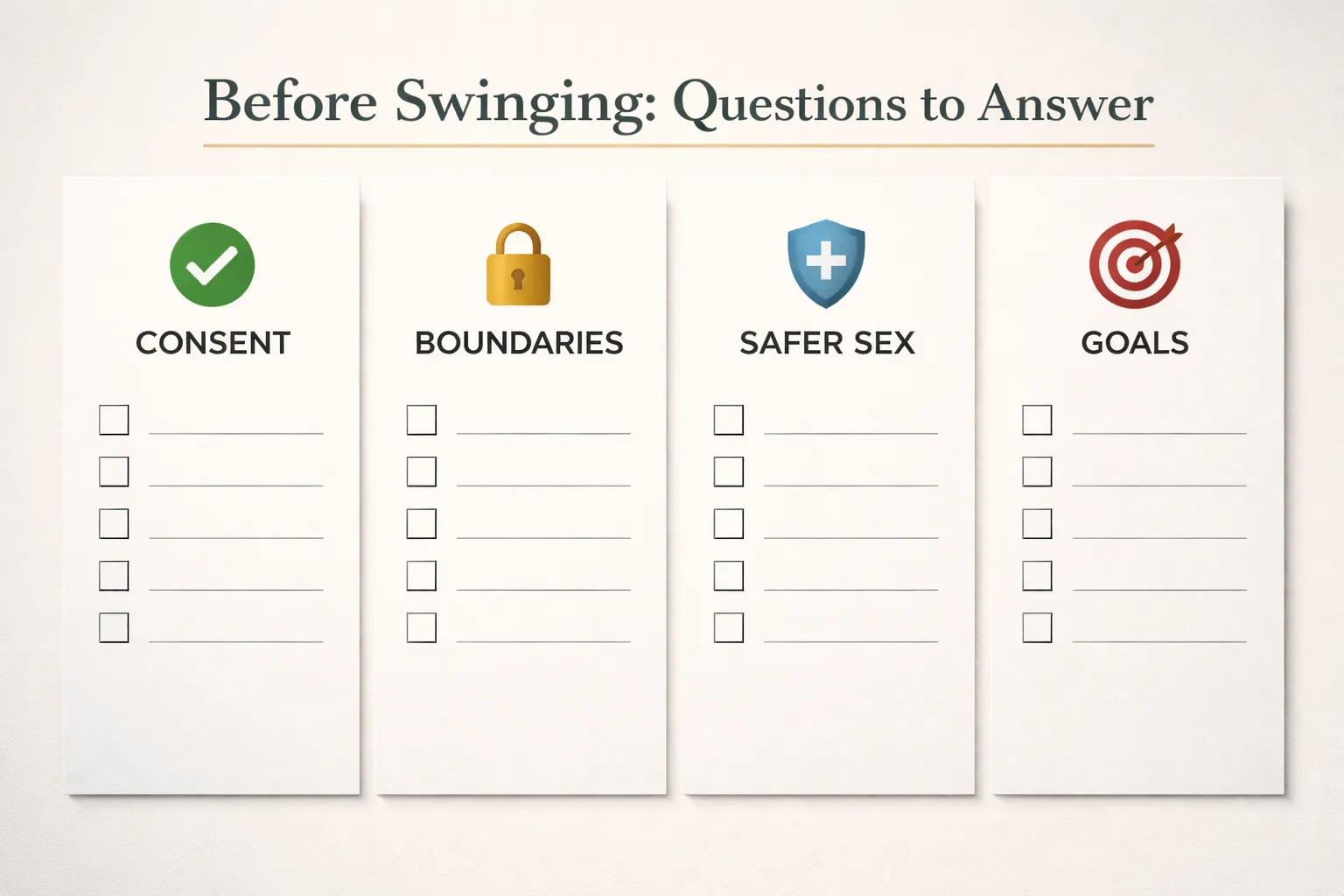
Before you swing, you need a clear pre-swinging conversation. You are building consent, boundaries, safer sex rules, and a shared goal. You are also setting the rules for what happens if either of you feels wrong mid-scene.
Definition, what you need to cover before swinging
- Consent: what each of you wants, what each of you does not want, and what needs a check-in.
- Boundaries: acts, people, places, and formats that are in-bounds or out-of-bounds.
- Safer sex: condoms, barriers, testing, birth control, and what you do after a risk.
- Goals: why you want this, what “good” looks like, and what makes you pause.
- Communication: how you signal discomfort, how you stop, and how you debrief after.
Core concepts that keep you safe and aligned
- Enthusiastic consent. You both want it. You both can say no without a penalty.
- Mutual benefit. You do this because it adds to your relationship, not because one person tolerates it.
- Ongoing communication. You check in before, during, and after. You adjust rules based on real outcomes.
- Right to pause or stop. Either of you can stop the night. No arguing. No bargaining.
- Privacy and respect. You agree on what you share, with whom, and when.
Questions couples should ask before swinging
| Topic | Questions to answer together |
|---|---|
| Motivation and goals |
|
| Relationship stability |
|
| Format and pacing |
|
| Boundaries and off-limits |
|
| Safer sex and health |
|
| Jealousy and emotional safety |
|
| Communication and stop signals |
|
| Logistics and privacy |
|
| Aftercare and debrief |
|
A quick readiness check
- You both want this for yourselves, not to fix a relationship problem.
- You can both name your top three boundaries without hesitation.
- You both accept that either person can stop the night at any time.
- You have a safer sex plan you will follow even when aroused.
- You have a plan to debrief, and to pause if the experience creates ongoing distress.
If you want a deeper look at what helps couples succeed long term, read /does-swinging-ruin-relationships-what-helps-couples-succeed.html. For a structured post-play talk, use /how-to-debrief-after-swinging-with-your-partner-a-simple-framework.html. If emotions attach to another couple, see /how-to-handle-feelings-for-another-couple-in-swinging.html.
Goals, Motivation, and Relationship Readiness Questions
What do we each want from swinging?
State your main goal in one sentence each. Keep it specific.
- Novelty: You want new experiences, new settings, new energy.
- Social: You want community, parties, friendships, shared norms.
- Erotic variety: You want different bodies, styles, and dynamics.
- Shared fantasy: You want a couple activity that turns you both on.
Then compare. If your goals do not overlap, you will fight about pace, rules, and “what counts.”
What are our must-haves and dealbreakers, and why?
List must-haves and dealbreakers in writing. Add a reason for each one. The “why” matters because it shows the need underneath.
- Must-have examples: condoms for all penetration, no overnight stays, no solo texting, stop word works every time.
- Dealbreaker examples: separate rooms, kissing, going down, fluid bonding, repeat dates with the same couple.
If you cannot explain a rule, you will not enforce it under pressure. For boundary templates and scripts, use /swinging-rules-and-boundaries-examples-scripts-and-best-practices.html.
Are we aligned on “together” play vs. separate play?
Define what “together” means. Many couples assume it means the same thing. It rarely does.
- Same room: you can see each other at all times.
- Same space: different areas, quick check-ins allowed.
- Separate: different rooms, no visual contact.
Pick a starting mode. Most couples handle risk better when they start with more connection, then loosen rules later if it feels stable.
What emotional outcomes are we hoping for vs. fearing?
Say your hoped-for outcomes out loud. Say your feared outcomes out loud. Do not debate them. Just record them.
- Hoping for: feeling closer, feeling excited, feeling desired, feeling proud of teamwork.
- Fearing: feeling left out, feeling compared, feeling replaced, feeling stuck with images you cannot unsee.
Then match each fear to a protection. Examples, agree on check-in signals, limit alcohol, pick same-room play, cap the time, leave together. If jealousy is your top fear, use /how-to-handle-jealousy-in-swinging-practical-tools-that-work.html. If feelings develop for another couple, use /how-to-handle-feelings-for-another-couple-in-swinging.html.
Are we using swinging to avoid a core relationship issue?
Screen for avoidance. Swinging can add stress. It rarely fixes existing problems.
- High risk signs: recent betrayal, unstable attachment, frequent fights, sexual mismatch with resentment, one partner “agrees” to stop conflict.
- Pressure signs: deadlines, threats, ultimatums, “prove you trust me,” “do it for me.”
If you see these signs, pause. Work on the base first. A stable relationship makes consent clearer and repair faster.
How will we define “success” after our first experience?
Define success as process, not performance. Use measurable criteria you can control.
Set a review window, 24 hours, 7 days, and 30 days. Plan aftercare before you play, not after. Use /aftercare-in-swinging-what-it-is-and-why-it-matters.html.
Boundaries, Consent, and “Rules” Questions (What’s Allowed, What’s Not)
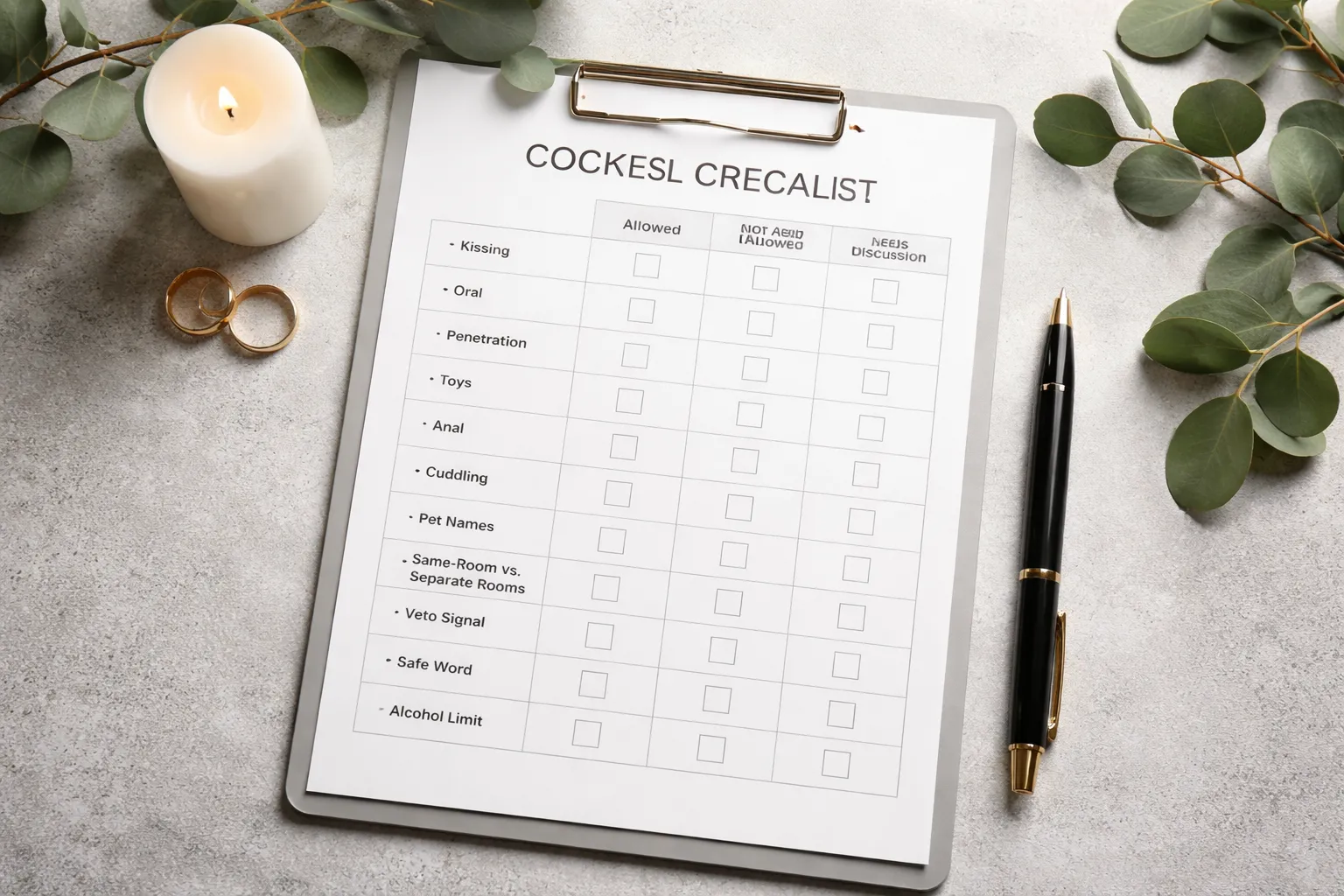
Boundaries, Consent, and “Rules” Questions (What’s Allowed, What’s Not)
Write your rules down. Keep them short. Use clear words. Define what you mean by “sex,” “play,” and “hookup.”
Decide what happens if a rule breaks. Pause, stop, leave, and review. Agree on this before you meet anyone.
Sex Acts: What Is Okay, What Is Not
Do not assume you agree because you both say “yes to swinging.” Couples split on details. Get specific.
- Kissing: Is kissing allowed, and what kind, peck, open-mouth, making out.
- Oral: Is giving allowed, receiving allowed, both, neither.
- Penetration: Is vaginal penetration allowed, and under what conditions.
- Condom use: Condom required for all penetration, always, no exceptions.
- Internal ejaculation: Allowed or not, even with condoms. Agree on zero tolerance for “accidents.”
- Toys: Toys allowed or not. Condom on toys. No sharing between partners without a new condom and cleaning.
- Anal: Allowed or not. If allowed, set extra safety steps and condom rules.
- Manual stimulation: Hands only rules, including boundaries around fingering.
- Photos and video: Allowed or not. If allowed, define who can record, store, and share.
Use plain language. “Penetration allowed only with condoms, no exceptions” beats vague rules like “be safe.” For scripts and examples, use /swinging-rules-and-boundaries-examples-scripts-and-best-practices.html.
Intimacy Markers: What Feels “Too Couple-Like”
Many conflicts come from intimacy signals, not sex acts. Decide which signals stay inside your relationship.
- Cuddling: Allowed during play, after play, or not at all.
- Kissing style: If you allow kissing, define whether “romantic kissing” counts as off-limits.
- Pet names: No “baby,” “babe,” “love,” or any specific words.
- Eye contact: Comfortable, limited, or a hard no during certain acts.
- Overnights: Allowed or never. If allowed, define where, and with whom.
- Dating behaviors: Dinner, gifts, long texting, and private chats. Decide what crosses the line.
- One-on-one time: Allowed or not, before or after group time.
Logistics: Same Room, Separate Rooms, Separate Encounters
Structure changes the risk of misunderstandings. Pick a format that matches your trust level and your experience.
- Same-room only: You see everything. You can step in fast. Privacy stays low.
- Separate rooms: More privacy. Higher chance of miscommunication. Stronger check-in plan required.
- Separate encounters: Highest autonomy. Highest emotional risk for many couples. Strong agreements needed on messaging, timing, and disclosure.
| Format | Pros | Common failure point | Rule to add |
|---|---|---|---|
| Same-room only | Fast course-correction | Pressure to perform | Either person can call a pause at any time |
| Separate rooms | More comfort and privacy | Assumptions about what happened | Time-box play, then regroup for a check-in |
| Separate encounters | More autonomy | Emotional fallout, secrecy patterns | Shared calendar, no hidden chats, full disclosure timeline |
Veto Policy: If You Use One, Make It Fair
A veto can protect you. It can also create resentment if you use it as control. Define when it applies and how you communicate it.
- Scope: Veto the person, the activity, or the whole event.
- Timing: Can you veto in advance only, or also in the moment.
- Method: Use one short phrase you both recognize. No explanations needed in public.
- After: You owe a debrief. You do not owe a justification in the moment.
- Limits: No veto as punishment. No veto to force monogamy by stealth.
Consent Changes in the Moment: Pause, Renegotiate, Stop
Consent can change fast. You need a shared protocol that works under stress.
- Pause: Stop hands and mouths. Step back. Breathe. Ask, “Are we still good.”
- Renegotiate: Name the change in one sentence. “No more penetration,” or “same room only now.”
- Stop: Get dressed. Leave the room. Reconnect as a couple.
Agree that any “no” ends that act. No bargaining. No persuasion. No sulking.
Safe Word, Stop Signal, and Check-In Cues
Loud rooms break normal communication. Use signals that work without privacy.
- Safe word: One word that means stop now. Pick a word you will not say during sex.
- Yellow cue: One word that means slow down and check in.
- Physical signal: Hand squeeze pattern, shoulder tap, or stepping in front of your partner.
- Exit cue: A simple phrase like “I need water,” that means you leave together.
- Check-in schedule: Every 10 to 15 minutes in separate-room settings, or after any escalation.
Alcohol and Substances: Set Limits That Protect Consent
Impairment undermines consent. It also increases rule breaks. Decide your limits before you arrive.
- Drink cap: Set a number. Many couples use zero to two drinks max.
- No new substances: Do not experiment on play nights.
- Hard stop rule: If either of you feels impaired, you do not play.
- Partner screening: Do not play with anyone who seems impaired, even if they say they are fine.
- Hydration and food: Eat first. Drink water. This reduces accidental overconsumption.
If you want guardrails that improve outcomes over time, use /does-swinging-ruin-relationships-what-helps-couples-succeed.html. For a step-by-step planning flow, use /how-to-start-swinging-for-beginners-your-step-by-step-guide.html.
Safer Sex, STI Testing, and Pregnancy Prevention Questions
Safer sex is not a vibe. It is a plan you follow every time. If you skip it once, you carry the risk home. Your rules should cover condoms, oral barriers, glove use, and what counts as “protected” for each act. You also need a testing rhythm that matches your activity, plus proof standards you both accept. Pregnancy prevention needs its own lane, even if you think it cannot happen. Decide what you do if a condom breaks, if someone discloses a new partner, or if test results come back positive. Put the answers in writing. Bring supplies. Leave if anyone pushes back.
Safer sex and barrier rules
- Which acts require a condom every time, vaginal, anal, oral, toys.
- Do you require condoms for oral sex, or dental dams, and in which situations.
- Do you allow condomless play with anyone, including “regulars” or “friends”.
- Who provides condoms and lube, and what brands and sizes you trust.
- Do you require glove use, especially with anal play or switching partners.
- Toy rules, condom on toys, cleaning steps, no sharing between partners without a fresh condom.
- No mixing rule, no switching from anal to vaginal without a new condom and cleaning.
STI testing, results, and disclosure
- How often will you test, based on how often you play.
- Which tests are required, HIV, syphilis, gonorrhea, chlamydia, hepatitis, plus any others you agree on.
- What counts as proof, clinic portal screenshot, lab report, date range you accept.
- How you handle window periods, and whether you avoid certain acts until retesting.
- Disclosure standard, what you must tell partners before play, and what you tell your spouse after.
- What happens after an exposure, pause rules, retesting timeline, partner notifications.
Pregnancy prevention and “what if” planning
- Primary birth control plan, and who is responsible for it.
- Backup plan, condoms even with other contraception, and when you use both.
- Emergency contraception plan, when you would use it, who buys it, where it is stored.
- Condom failure protocol, stop, replace, clean up, and decide next steps.
- Pregnancy outcome agreement, what you would do if pregnancy occurs, before you play.
Read our detailed guide: Safer Sex, STI Testing, and Pregnancy Prevention Questions - Questions Couples Should Ask Before Swinging (Boundaries, Safer Sex, Goals)
Logistics and Etiquette Questions (Finding Partners, Parties, and First-Time Planning)
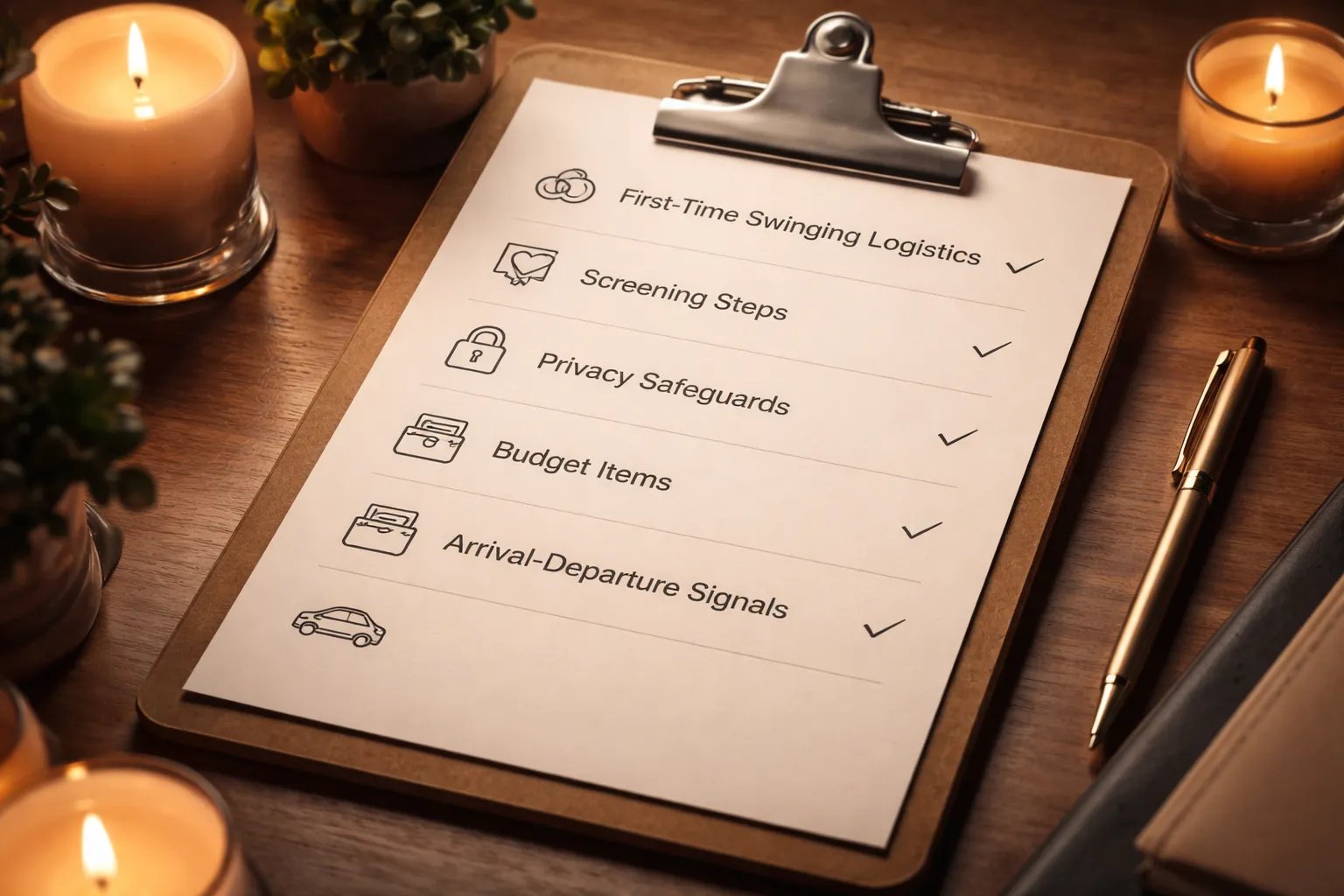
Where You Meet Others and How You Screen
Pick your lanes. Apps. Clubs. Private house parties. Each has different norms, costs, and risk.
- Apps and sites: You control pace. Expect more time screening. Expect flakes.
- Clubs: You get in-person vibe checks. You pay entry. You follow house rules.
- House parties: You rely on a host. You need clear invites, rules, and exit plans.
Set a screening process before you message anyone. Keep it consistent.
- Minimum profile standards: recent photos, clear couple status, location, age range, basic intent.
- First message filter: respectful tone, answers your questions, no pressure for fast meetups.
- Verification: video call or voice call, confirm names, confirm relationship status if relevant.
- Health logistics: testing window, condom expectations, pregnancy plan, what acts are on or off limits.
- Red flags: ignores boundaries, pushes alcohol, asks you to “keep it secret” in a controlling way, tries to separate you early.
Write your non-negotiables down. Use them. If someone debates them, you end contact.
How You Present as a Couple
Decide what you are offering and what you are not. Put it in your profile. Keep it short.
- Label your dynamic: couple only, same room only, soft swap only, full swap possible, or case by case.
- State your pacing: chat first, then drinks, then decide. No same-night pressure.
- State your safer sex baseline: condoms for penetration, barriers for oral as needed, testing cadence.
- State dealbreakers: no drugs, no single men, no separate play, no filming, no sleepovers, whatever applies.
Choose photos with intent. You control what you reveal.
- Face photos: decide yes or no. If yes, share them only after screening.
- Identifiers: avoid workplace logos, unique tattoos, street signs, your car plate, your home interior.
- Messaging tone: polite, direct, specific. No explicit content until consent is clear.
Keep your rules aligned with your messages. If you need help wording them, use scripts from Swinging Rules and Boundaries: Examples, Scripts, and Best Practices.
What “No” Looks Like
Agree on decline scripts. Use them the same way every time. Keep them short.
- Soft no: “Thanks, you seem great. We are not a match. Wishing you well.”
- Boundary no: “We do not do separate play. If that is needed, we should pass.”
- Timing no: “We are not meeting this week. We will reach out if our schedule opens.”
- Safety no: “We require condoms and recent test results. If that does not work, we are done here.”
Decide how you want others to decline you. You want clear, fast, respectful messages. No ghosting agreements help, but you cannot enforce them.
Set a rule for in-person exits. If either of you says, “We are done,” you leave. No debate. No explanations.
Privacy and Discretion
Privacy failures cause real damage. Plan for them.
- Face control: no face photos on public profiles if workplace risk is high.
- Separate accounts: use a dedicated email. Avoid linking phone contacts to apps if you can.
- Social media: do not add partners on personal accounts. Do not post location tags.
- Photos and video: decide your policy. Default to no recording. If you allow photos, set rules on storage and deletion.
- Location control: meet in public first. Avoid inviting anyone to your home early.
Discuss what happens if you run into someone you know. Agree on a cover line and a no-panic rule.
Budget, Time, and Safety Planning
Swinging costs money and time. Price it out before you start.
- Typical costs: app memberships, club entry, drinks, hotel rooms, condoms and barriers, rideshares.
- Childcare: plan it early. Use a sitter you trust. Build in buffer time.
- Overnights: decide yes or no. If yes, decide where, how long, and sleep rules.
- Transportation: set a safe ride home plan. No driving after drinking.
Protect your next day. Schedule downtime. If you plan aftercare, you are more likely to stay aligned. Use Aftercare in Swinging: What It Is and Why It Matters.
Arrivals, Departures, and First-Time Structure
First time goes better with structure. Decide the flow in advance.
- Arrival plan: arrive together. Stay sober enough to make decisions.
- Check-ins: set a time check every 20 to 30 minutes, or after any escalation.
- Stay together or separate: choose one rule for the first few meets. Same room reduces chaos.
- Signal to pause: agree on a phrase and use it. “Yellow” means slow down. “Red” means stop now.
- Signal to leave: pick a line that ends the night with no debate. “I am ready to go.”
- Departure: leave together. Do not negotiate in the doorway. Do not accept last-minute changes.
If one of you wants to stop swinging later, treat it as a valid call, not a failure. Keep a plan for closing the relationship in How to Stop Swinging and Close the Relationship (Without Resentment).
Communication, Jealousy, Aftercare, and Repair Questions
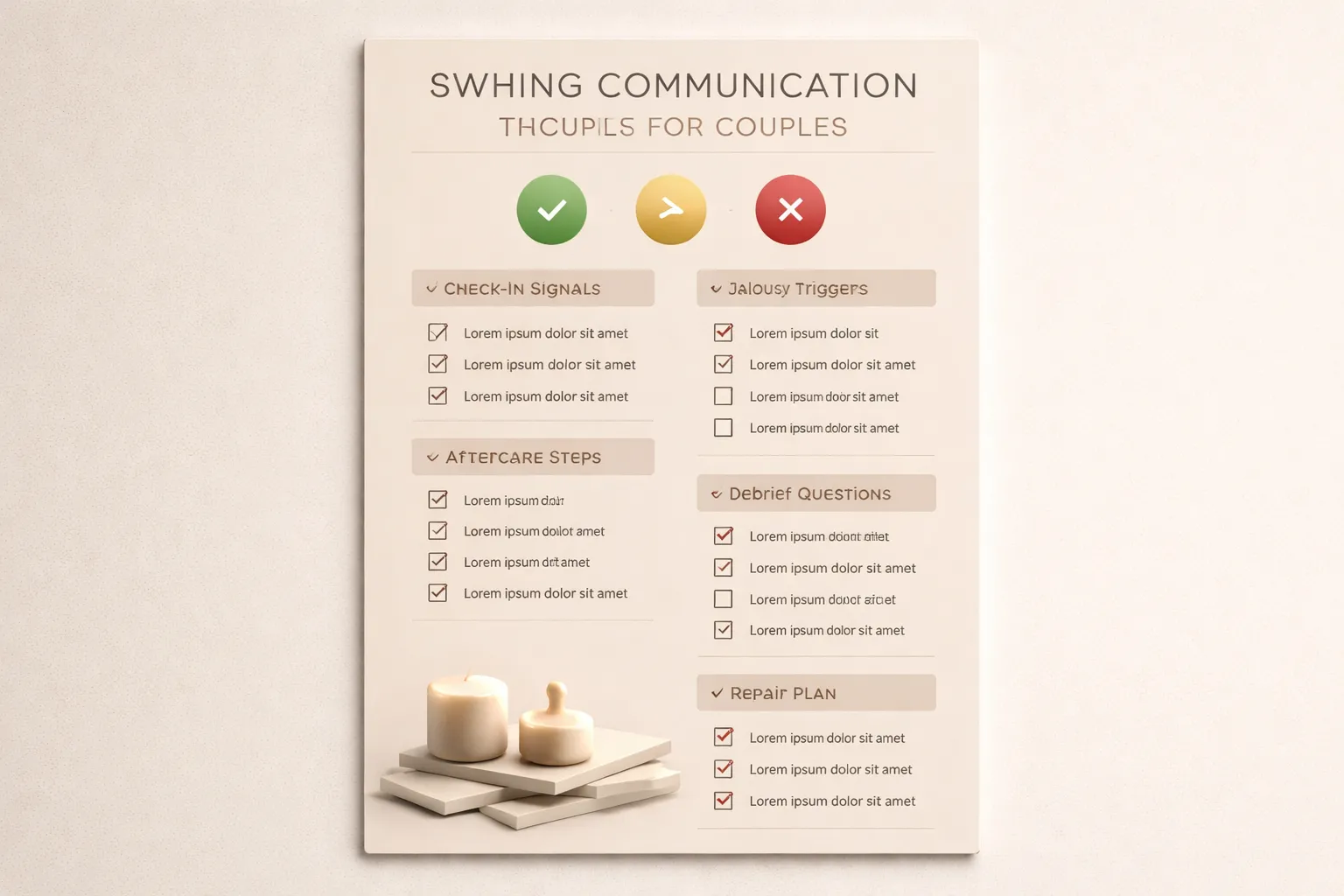
Check-ins During an Event
Plan check-ins before you go. Do not improvise under pressure.
- Timing: every 20 to 30 minutes, after any new escalation, and after any alcohol increase.
- Method: a short phrase plus a physical signal. Example phrases, “Green,” “Yellow,” “Red.”
- Privacy: step away to the bathroom, outside, or a quiet corner. No check-ins in front of others.
- If one feels off: pause all play. Get water. Breathe. Decide in two minutes, continue with limits, switch to watching, or leave.
- No debate rule: “Yellow” means slow down. “Red” means stop and leave together.
Write these signals into your rules. Use the same language every time. Keep it aligned with your plan in /swinging-rules-and-boundaries-examples-scripts-and-best-practices.html.
Jealousy Triggers and Reassurance Needs
Jealousy usually follows a pattern. Name your pattern before it hits.
- Known triggers: kissing, specific sex acts, certain positions, being left alone, partner orgasms, partner praise, flirting without you, phone numbers, repeat partners.
- Time triggers: long sessions, late nights, the ride home, the next morning.
- Status triggers: attention imbalance, one partner gets more offers, one partner feels like the “assistant.”
Decide what reassurance works for each of you.
- Words: short scripts you can use on-site. Example, “I choose you. We leave together.”
- Touch: hand on shoulder, hand holding, eye contact, a fixed cuddle break.
- Actions: you stay in the same room, you avoid private rooms, you cap time with others.
- Limits: you pause kissing, you avoid solo play, you keep clothing on.
If jealousy keeps recurring, treat it as data. Tighten the setup. Reduce intensity. Add aftercare. Do not push through it.
Mismatch Plan: One Wants to Continue, One Wants to Stop
A mismatch will happen. Decide the rule now.
- Default: the person who wants to stop wins. You stop. You leave together.
- No bargaining: no “five more minutes,” no “one last thing,” no door negotiations.
- Exit script: “We are done for tonight. Thanks.” Then move.
- Responsibility: the partner who wants to continue handles disappointment later, not in the venue.
- Recovery option: if it happens often, lower the intensity next time. Pick a lighter format, social only, no sex, or same-room only.
If one of you wants to stop swinging long-term, keep a clean closure plan in /how-to-stop-swinging-and-close-the-relationship-without-resentment.html.
Aftercare Plan
Aftercare prevents the worst fights. Treat it as part of the night, not an add-on.
- When: start in the car or as soon as you get home. Continue the next day.
- First 30 minutes: food, water, shower if wanted, clean-up, quiet time.
- Affection preferences: cuddling, space, sex, sleep, talking, silence. Pick what each of you needs.
- Decompression time: set a minimum window with no heavy debate. Example, “No deep processing until tomorrow at noon.”
- Digital boundary: no texting other partners until you both feel steady.
Write your aftercare steps down. Keep them simple. For deeper guidance, see /aftercare-in-swinging-what-it-is-and-why-it-matters.html.
Post-event Debrief Questions
Run the debrief within 24 hours. Keep it structured. Stop if either of you starts spiraling.
- What worked: what made you feel close, safe, and desired.
- What did not work: moments you felt ignored, rushed, pressured, or unsafe.
- Check-in quality: did you use signals, did they work, did you hesitate.
- Boundaries: did any rule feel too tight, too loose, unclear, or missing.
- Alcohol and substances: did they help, did they impair judgment, did they raise risk.
- Safer sex execution: did you follow your plan, did you run short on supplies, did you feel rushed.
- Next time changes: one to three specific changes. No long list.
- Emotional state: what you need in the next 48 hours to feel secure.
Repair Plan if a Boundary Is Crossed
Plan repair before you need it. A repair plan lowers panic and blame.
- Immediate stop: end the interaction. Leave together.
- Stabilize first: water, sleep, food. No interrogation while flooded.
- Accountability: the person who crossed the boundary states what happened, what rule they broke, and why it happened. No excuses.
- Apology: clear and specific. Name the impact. State the change.
- Consequences: pause swinging for a set time, reduce intensity, remove solo permissions, block contact with the other person if needed.
- Cooling-off period: set a timeline. Example, “Two weeks with no events, no messaging.”
- Rebuild steps: rewrite rules, practice exit scripts, add stricter check-ins, limit alcohol, choose lower-stakes settings.
- Escalation: if trust does not recover, stop swinging and switch to closure planning.
- In het kort: Agree on your “why” and your stop conditions before you start.
- In het kort: Set clear boundaries, then define what “pause” and “stop” mean in practice.
- In het kort: Use a safer sex plan you can follow every time, with no exceptions.
- In het kort: Decide how you handle alcohol, drugs, sleep, and transport.
- In het kort: Plan your debrief, aftercare, and a cooling-off option.
- In het kort: Revisit this checklist often, especially after any rule change or strong emotion.
Use this as your pre-swinging question checklist. Print it. Save it. Revisit it before events and after debriefs. If you cannot answer a line in one clear sentence, you are not ready to act on it.
Pre-swinging question checklist
| Area | Questions to answer together | Write your decision |
| Goals |
|
|
| Consent and communication |
|
|
| Boundaries |
|
|
| Safer sex |
|
|
| People and settings |
|
|
| Alcohol and substances |
|
|
| Logistics and safety |
|
|
| Aftercare and debrief |
|
|
| Repair plan |
|
|
If you want deeper guidance on consent and alignment, read Swinging Consent and Communication: Tips to Stay Safe and Aligned. For a step-by-step plan around timing and prep, use Swinging First Time Checklist: What to Do Before, During, and After. For a clean post-event review, use How to Debrief After Swinging With Your Partner (A Simple Framework).
Rule for revisiting: review this checklist after every new partner, new venue, new boundary, or any strong emotion. Keep your answers current. Keep your actions inside them.
FAQ
How do we know we are ready to swing?
You are ready when you both want it, you can say no without backlash, and you can follow a written boundary list. You can discuss condoms, testing, and stop words. If either of you feels pressured, wait.
What boundaries should we set first?
Start with hard lines: condoms, oral rules, penetration rules, no alcohol limit breaks, and a clear stop signal. Add logistics: same room or separate, who initiates, who can be touched, and when you leave. Write it down.
What is the safest sex setup for beginners?
Use condoms for all penetration. Use dental dams for oral if you want lower risk. Bring your own supplies. No condom switching between partners. Avoid sex with active sores. Plan testing and a re-test window after new partners.
How often should we test for STIs if we swing?
Test before starting, then on a schedule you can keep. Many couples choose every 3 months if they have new partners. Re-test after any condom failure or higher-risk contact. Use site-specific tests when relevant, oral and anal.
Should we play in the same room or separately?
Same room lowers surprises and speeds up check-ins. Separate rooms increase freedom but raise risk of crossed boundaries. If you try separate, start with short windows, set a return time, and require a yes text before any escalation.
How do we handle jealousy during or after?
Pause the scene. Use your stop signal. Leave if needed. After, debrief within 24 hours. Name the trigger, name the boundary you needed, then update your rules. If feelings target a specific couple, read /how-to-handle-feelings-for-another-couple-in-swinging.html.
What do we do if one of us wants to stop?
Stop. Do not negotiate mid-crisis. Agree on a cool-off period and close the relationship while you reset. Do a calm debrief later and decide next steps. For a clean exit plan, use /how-to-stop-swinging-and-close-the-relationship-without-resentment.html.
How do we avoid pressure from another couple?
Use scripts and repeat them. “No, we are not doing that.” Do not explain. Do not bargain. If they push, leave. Choose venues with clear consent culture. Avoid playing with people who drink heavily or ignore small no’s.
What should we tell a new couple before meeting?
Share your must-haves and must-nots. Share safer sex rules and testing cadence. Confirm the venue, timeline, and exit plan. Confirm whether you do same room, swap, or soft swap. Ask what they do when someone says stop.
What are common first-time mistakes?
- Drinking too much.
- Skipping condoms or assuming rules.
- No stop signal.
- No aftercare plan.
- Agreeing to separate rooms too early.
- Chasing another couple to “make it work.”
How do we keep goals aligned?
Pick one goal per event: exploration, novelty, threesomes, full swap, or just social. Set a “win condition” that does not require sex. Review after each event and adjust. For a full starter path, read /how-to-start-swinging-for-beginners-your-step-by-step-guide.html.
Does swinging help or hurt relationships?
It amplifies what you already do. If you communicate well and keep agreements, it can add novelty and bonding. If you avoid conflict or use it to fix problems, it can break trust fast. See /benefits-of-swinging-for-couples-why-some-relationships-thrive.html.
What should we do right after a swinging night?
Hydrate, shower if you want, and do basic aftercare. Then do a short check-in: what felt good, what felt bad, what needs a rule change. Book testing if needed. Update your checklist after any new partner, venue, boundary, or strong emotion.
Conclusion: Use These Questions to Protect Trust, Health, and Fun
These questions protect three things, trust, health, and fun. Ask them before you meet anyone. Repeat them after every new partner, venue, or boundary change. Treat your answers as a living agreement.
- Write it down. Keep a shared notes doc with your rules, hard stops, and safer sex plan. Update it after each night.
- Default to no when unsure. If either of you feels pressured, tired, or unclear, you pause. You can always decide later.
- Use one safe word and one stop signal. Make them simple. Use them once and you both stop.
- Set your testing cadence. Agree on a schedule, what tests you run, and what happens after a new partner.
- Debrief fast. Do a short check-in the next day, then a deeper talk within a week. Use a framework at /how-to-debrief-after-swinging-with-your-partner-a-simple-framework.html.
- Keep a first-time checklist. Pack supplies, confirm boundaries, plan exit logistics. Use /swinging-first-time-checklist-what-to-do-before-during-and-after.html.
- Handle feelings early. If attachment shows up, name it. Set limits before it grows. See /how-to-handle-feelings-for-another-couple-in-swinging.html.
Pick five questions from this guide. Answer them in writing this week. Then use your checklist before every meet. You will reduce risk, reduce conflict, and keep control of the pace.
-
How to Talk to Your Partner About Swinging (Without Pressure)
1 month ago -
Swinging Rules and Boundaries: Examples, Scripts, and Best Practices
1 month ago -
Swinging First Time Checklist: What to Do Before, During, and After
1 month ago -
How to Handle Jealousy in Swinging: Practical Tools That Work
1 month ago -
Swinging Consent and Communication: Tips to Stay Safe and Aligned
1 month ago
-
- What do we each want from swinging?
- What are our must-haves and dealbreakers, and why?
- Are we aligned on “together” play vs. separate play?
- What emotional outcomes are we hoping for vs. fearing?
- Are we using swinging to avoid a core relationship issue?
- How will we define “success” after our first experience?
-
- Boundaries, Consent, and “Rules” Questions (What’s Allowed, What’s Not)
- Sex Acts: What Is Okay, What Is Not
- Intimacy Markers: What Feels “Too Couple-Like”
- Logistics: Same Room, Separate Rooms, Separate Encounters
- Veto Policy: If You Use One, Make It Fair
- Consent Changes in the Moment: Pause, Renegotiate, Stop
- Safe Word, Stop Signal, and Check-In Cues
- Alcohol and Substances: Set Limits That Protect Consent
-
- How do we know we are ready to swing?
- What boundaries should we set first?
- What is the safest sex setup for beginners?
- How often should we test for STIs if we swing?
- Should we play in the same room or separately?
- How do we handle jealousy during or after?
- What do we do if one of us wants to stop?
- How do we avoid pressure from another couple?
- What should we tell a new couple before meeting?
- What are common first-time mistakes?
- How do we keep goals aligned?
- Does swinging help or hurt relationships?
- What should we do right after a swinging night?
-
-
- What do we each want from swinging?
- What are our must-haves and dealbreakers, and why?
- Are we aligned on “together” play vs. separate play?
- What emotional outcomes are we hoping for vs. fearing?
- Are we using swinging to avoid a core relationship issue?
- How will we define “success” after our first experience?
-
- Boundaries, Consent, and “Rules” Questions (What’s Allowed, What’s Not)
- Sex Acts: What Is Okay, What Is Not
- Intimacy Markers: What Feels “Too Couple-Like”
- Logistics: Same Room, Separate Rooms, Separate Encounters
- Veto Policy: If You Use One, Make It Fair
- Consent Changes in the Moment: Pause, Renegotiate, Stop
- Safe Word, Stop Signal, and Check-In Cues
- Alcohol and Substances: Set Limits That Protect Consent
-
- How do we know we are ready to swing?
- What boundaries should we set first?
- What is the safest sex setup for beginners?
- How often should we test for STIs if we swing?
- Should we play in the same room or separately?
- How do we handle jealousy during or after?
- What do we do if one of us wants to stop?
- How do we avoid pressure from another couple?
- What should we tell a new couple before meeting?
- What are common first-time mistakes?
- How do we keep goals aligned?
- Does swinging help or hurt relationships?
- What should we do right after a swinging night?
-
-
How to Debrief After Swinging: Break Jealousy Loops
1 month ago -
How to Repair Trust After a Boundary Is Broken
1 month ago -
How to Debrief After Swinging: Fix Resentment Early
1 month ago -
Aftercare & Support in Swinging: Red Flags and Resources
1 month ago -
Swinging Consent and Boundaries: Safer Sex & Comfort
1 month ago
-
Ethical Non‑Monogamy Terms: A Glossary of Common ENM Language
1 month ago -
How to Talk to Your Partner About Swinging (Without Pressure)
1 month ago -
Swinging Rules and Boundaries: Examples, Scripts, and Best Practices
1 month ago -
What Is the Swingers Lifestyle? A Beginner-Friendly Guide
1 month ago -
Swinging First Time Checklist: What to Do Before, During, and After
1 month ago