Rules, Boundaries, and Consent: The Foundation of the Swingers Lifestyle - What Is the Swingers Lifestyle? A Beginner-Friendly Guide

Swinging runs on rules, boundaries, and consent. Without them, you risk pressure, conflict, and harm. This section is part of our larger guide, What Is the Swingers Lifestyle? A Beginner-Friendly Guide.
You will learn how to set clear rules as a couple, define personal boundaries, and give and receive consent in real time. You will also learn common failure points, what to say when you need to pause or stop, and how to handle changes after you agree. Expect practical language you can use before, during, and after a swap, a play party, or an online chat.
What Is the Swingers Lifestyle? Definitions, Core Concepts, and Common Myths
Definition of Swinging
Swinging is a form of consensual non monogamy. You and your partner agree to sexual experiences with other people. You do this with clear rules, boundaries, and consent. Some couples keep it sexual only. Some allow dating. The label changes by community.
Swinging usually focuses on shared experiences. Many couples play in the same room, the same event, or the same night. Some play separately. Your agreements define what counts as swinging for you.
Who Participates
You will see many types of people. Most spaces center on couples. Many also allow singles. Some allow single men only with screening, limits, or higher fees. Some do not allow single men at all. Rules vary by venue and region.
- Couples: Married or not. Long term or new.
- Singles: Often welcomed as women, sometimes restricted as men.
- LGBTQ+ people: Present in many scenes, with different levels of inclusion depending on the event.
Assume nothing about access. Read the event rules before you show up.
Common Formats You Will See
- Social clubs: Member based venues. Some nights stay social. Some allow play in private areas.
- Play parties: Hosted events in clubs, rented spaces, or private homes. Rules often cover consent language, safer sex, and photography.
- Private meets: A planned meet with one couple or a small group. You set the rules in advance.
- Online communities: Apps, forums, and lifestyle sites used to vet, chat, and plan.
Each format changes the pace. Clubs and parties move fast. Private meets move slower but require more planning.
Key Terms Beginners See
- Lifestyle: A broad label for people who practice consensual non monogamy. Some use it to mean swinging only.
- Soft swap: Sexual play with limits, often no penetration. The exact limits differ. You must ask.
- Full swap: Sex that includes penetration. Many people still set limits on positions, condoms, and finishing.
- Play: Any sexual activity, from kissing to sex. People use the term to stay discreet.
- Vanilla: Sex that stays outside kink or outside group play. Some use it to mean monogamous dating norms.
Do not rely on labels alone. Confirm specifics. Use plain words. Repeat back what you heard.
Common Myths vs Reality
The lifestyle rewards clarity. You win by stating your limits early, confirming them often, and respecting a no without debate.
The Foundation: Consent, Boundaries, and Relationship Agreements
Consent basics
Consent is the core safety rule. You need it before, during, and after any sexual contact.
- Enthusiastic: You look for a clear yes. No silence. No shrug. No “fine.”
- Informed: You share key facts up front. Who is involved. What acts you want. Protection plans. Substance use.
- Specific: A yes to kissing is not a yes to groping. A yes to oral is not a yes to intercourse.
- Reversible: Anyone can change their mind at any time. You stop fast. You do not argue.
Use simple check-ins. “Still good?” “Same limits?” “Do you want to slow down?” Keep your voice calm. Respect the answer.
Boundaries vs rules vs preferences
People mix these terms. You should not. Clear labels prevent conflict.
- Boundary: A limit you place on your own body and choices. Example, “I do not do intercourse.” You enforce it by declining and leaving if needed.
- Rule: A limit you place on your relationship behavior. Example, “We only play in the same room.” Rules require both partners to follow them.
- Preference: A want, not a requirement. Example, “I prefer no kissing.” You can relax it without breaking trust if you talk first.
If you call a preference a rule, you create traps. If you treat a boundary like a preference, you create harm.
Creating relationship agreements
Agreements set your default plan. They reduce confusion when you feel excited, nervous, or rushed.
Write your agreement. Keep it short. Review it before events.
- What is on the table: List allowed activities. Be exact.
- What is off the table: List hard no items. State consequences. “If X happens, we stop and leave.”
- Why it matters: Name the reason in one line. Safety. Health. Emotional comfort. Privacy. This reduces debates later.
- How you will communicate: Decide how you signal “pause” and “stop.” Pick a phrase and use it every time.
- Aftercare plan: Decide what you do after. Talk in the car. Shower together. Food and water. No blame talk until you feel calm.
Common boundaries and limits you can use
- Touching: No touching below the waist. No breast touching. No touching without verbal ask each time.
- Kissing: No kissing at all. Kissing allowed only with condoms used for oral and intercourse.
- Oral sex: Oral allowed only with barriers. Oral allowed only with recent STI testing shared.
- Intercourse: No penetration. Penetration allowed only with condoms. No finishing inside.
- Condom rules: New condom for every partner and every act. No condom removal. No “just the tip.”
- Alcohol and substances: Two drink limit. No play if you feel impaired. No drugs at all.
- Privacy: No photos. No video. No phones in play spaces. No sharing names or workplaces.
- Location and logistics: Only at clubs. Only at vetted house parties. Only with exit access and your own transport.
- Partner selection: No friends. No coworkers. No exes. No single men. No couples with heavy pressure tactics.
Red flags that should stop the interaction
- Coercion: They push after you say no. They bargain. They “test” your limits.
- Guilt: “You led me on.” “You owe me.” “You are ruining the vibe.”
- Pressure: They rush you. They isolate you from your partner. They keep touching after you pull away.
- Consent by default: They assume consent because you are at a club, at a party, or flirting. That is not consent.
- Ignoring safer sex: They argue about condoms. They hide status. They dismiss testing.
- Boundary ridicule: They mock your limits or call them childish.
You do not need to justify your no. You do not need to “be nice.” You leave. You protect your relationship first.
Common Rules in Swinging (and How to Choose What Works for You)
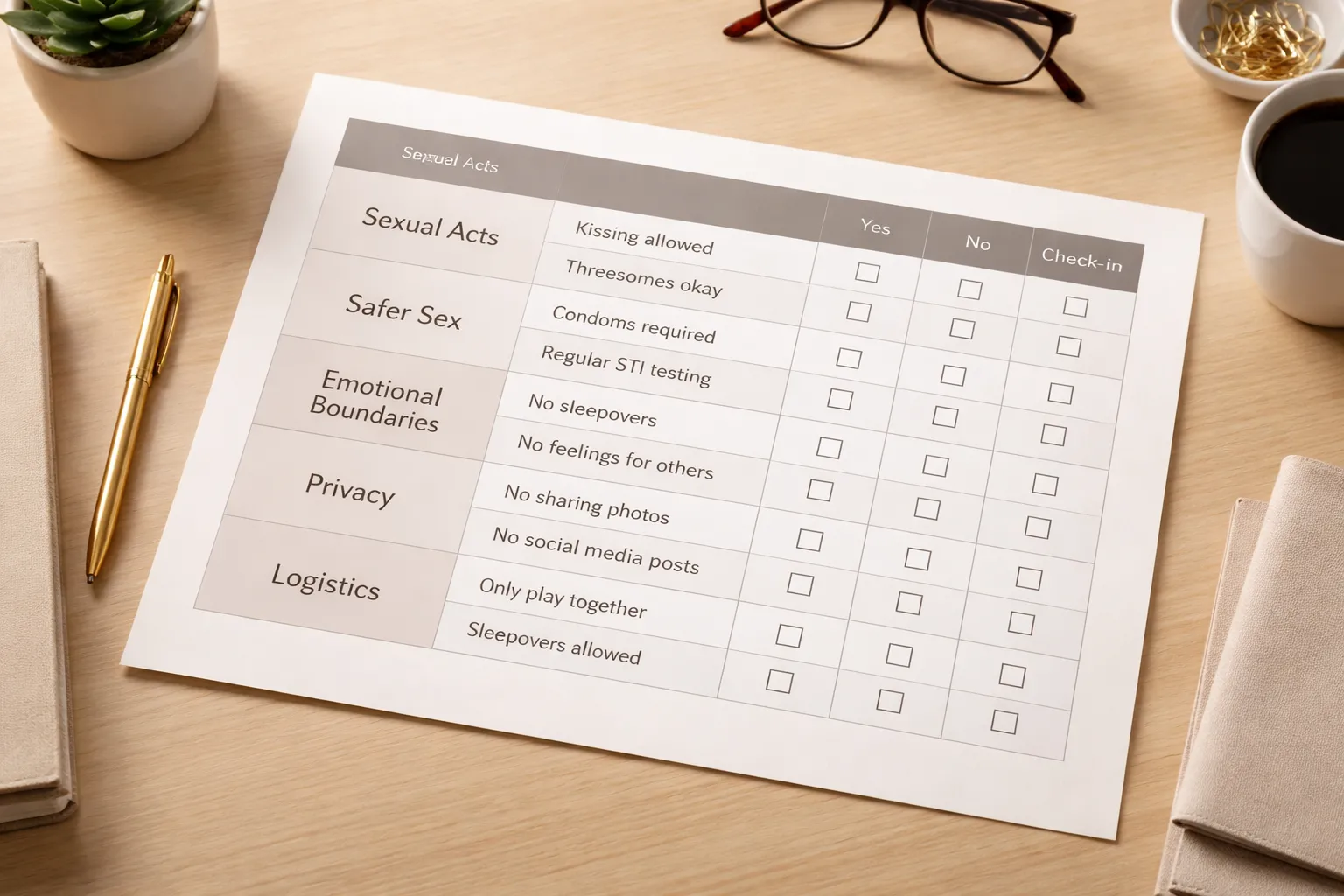
Start With Rule Categories, Not One-Off Scenarios
Rules work when they stay simple. Group them by category. Decide what you allow, what you do not, and what requires a check-in. Write it down. Use the same wording every time.
- Sexual acts: what you will do, what you will not do.
- Safer sex: condoms, barriers, testing, fluids, and what happens after a slip.
- Emotional boundaries: flirting style, repeat partners, overnights, and aftercare.
- Privacy: names, photos, social media, and discretion in public.
- Logistics: same-room rules, separate-room rules, time limits, and exit plans.
Common Sexual Act Rules
Most beginner rules focus on what happens physically. Keep the list short. Too many rules fail under pressure.
- Penetration rules: allowed or off-limits; condom required every time.
- Oral rules: allowed with barriers, allowed without, or not allowed.
- Kissing rules: yes, no, or only with your partner.
- Finish rules: where, with what protection, and with what clean-up plan.
- Substances: no heavy drinking; no drugs; stop if judgment drops.
Choose rules that protect your relationship, not rules that try to control other people. You control your actions. You do not control someone else’s choices.
Safer Sex Rules That Hold Up in Real Life
Many conflicts in swinging come from vague safer sex talk. Make it specific. Treat it like a checklist, not a vibe.
- Barrier use: condoms for penetration; barriers for oral if you require it.
- No exceptions: no “just the tip,” no “I am clean,” no “I do not like condoms.”
- Testing plan: what you test for, how often, and how you share results.
- Fluid rules: where fluids can go; what is off-limits; shower and sheet protocols.
- Break protocol: what you do if a condom breaks or a boundary gets crossed.
Use simple language when you negotiate. “Condoms every time. No debate.” You do not need to persuade. You need agreement.
Emotional Boundaries and Attachment Risk
Physical rules do not prevent emotional fallout. Clear emotional boundaries reduce surprises.
- Repeat partners: allowed, limited, or only together.
- Dating behavior: no one-on-one dinners; no daily texting; no pet names.
- Overnights: allowed, not allowed, or only as a couple.
- Aftercare: what you need when you get home, and when you will talk.
- Jealousy plan: what you do when one of you gets triggered.
Pick boundaries that match your real patterns. If one of you bonds fast, add friction. If one of you shuts down under stress, add breaks and check-ins.
Privacy Rules and Discretion
Privacy rules protect jobs, families, and friendships. They also prevent drama inside the community.
- Identity: first names only, or full names only after trust.
- Photos: no photos; no phones out; no face pics shared.
- Social media: no tagging; no public comments; no posting from events.
- Mutual friends: how you handle sightings, introductions, and silence.
The Veto and Safe Word, Use Them With Care
A veto means one partner can stop an interaction. A safe word signals an immediate stop. Both can help. Both can harm if you use them as control tools.
- When a veto helps: safety concerns, clear discomfort, consent doubt, intoxication, coercion, or panic.
- When a veto harms: you use it to punish; you use it to manage jealousy after you agreed; you use it to test loyalty.
- When a safe word helps: you need a fast stop without debate; you freeze under stress; you struggle to speak up.
- When a safe word harms: you use it to avoid honest rule-setting; you rely on it instead of checking in.
If you use a veto, set rules for it. “We stop. We leave. We talk later. No argument on site.” If you keep vetoing the same situation, you need a new agreement, not more vetoes.
Same-Room vs Separate-Room Agreements
This choice changes everything. It changes anxiety, arousal, and communication needs. Pick the structure that matches your comfort, not your fantasy.
- Same-room: easier check-ins; lower uncertainty; less freedom; more performance pressure for some people.
- Separate-room: more autonomy; stronger jealousy triggers for many beginners; higher need for clear stop signals and time limits.
If you try separate-room early, set tight guardrails. Location clarity. Time limits. A clear stop method. A plan to reunite fast.
Singles Policy and Couple-First Dynamics
Many swinger spaces center couples. Some allow singles with restrictions. Expect couple-first norms unless the event says otherwise.
- At many clubs: single men face higher screening; single women may enter more easily.
- In many couple settings: partners negotiate together; they expect you to respect the couple as a unit.
- Common couple-first rule: if one partner stops, both stop.
- Common etiquette: ask both partners; do not isolate one partner; do not pressure for “solo.”
If you want solo play, say it early. If you do not, say it early. Mixed signals create conflict.
How to Choose Rules That Work for You
Use a simple filter. Choose rules you can follow when aroused, tired, or social pressured.
- State your hard no list: acts or situations you will not do.
- Define your yes list: what you both want and feel good about.
- Add “check-in” items: allowed only after you confirm in the moment.
- Limit the list: start with fewer rules; add only what you will enforce.
- Set consequences: what you do if a rule gets broken, including leaving.
Revisit and Renegotiate Over Time
Your rules will change. Experience shows you what you can handle. Schedule a review. Treat it like maintenance.
- Before an event: confirm rules, safer sex, and stop signals.
- After an event: debrief within 24 to 72 hours.
- Use three buckets: keep, change, remove.
- Track patterns: repeated discomfort means the rule or the setting does not fit.
- Change one variable at a time: new act, new venue, or new structure, not all at once.
Renegotiation works best when you do it at home, sober, and calm. You set rules to protect trust. You keep them because trust is the point.
Communication Skills for Beginners: Before, During, and After Play
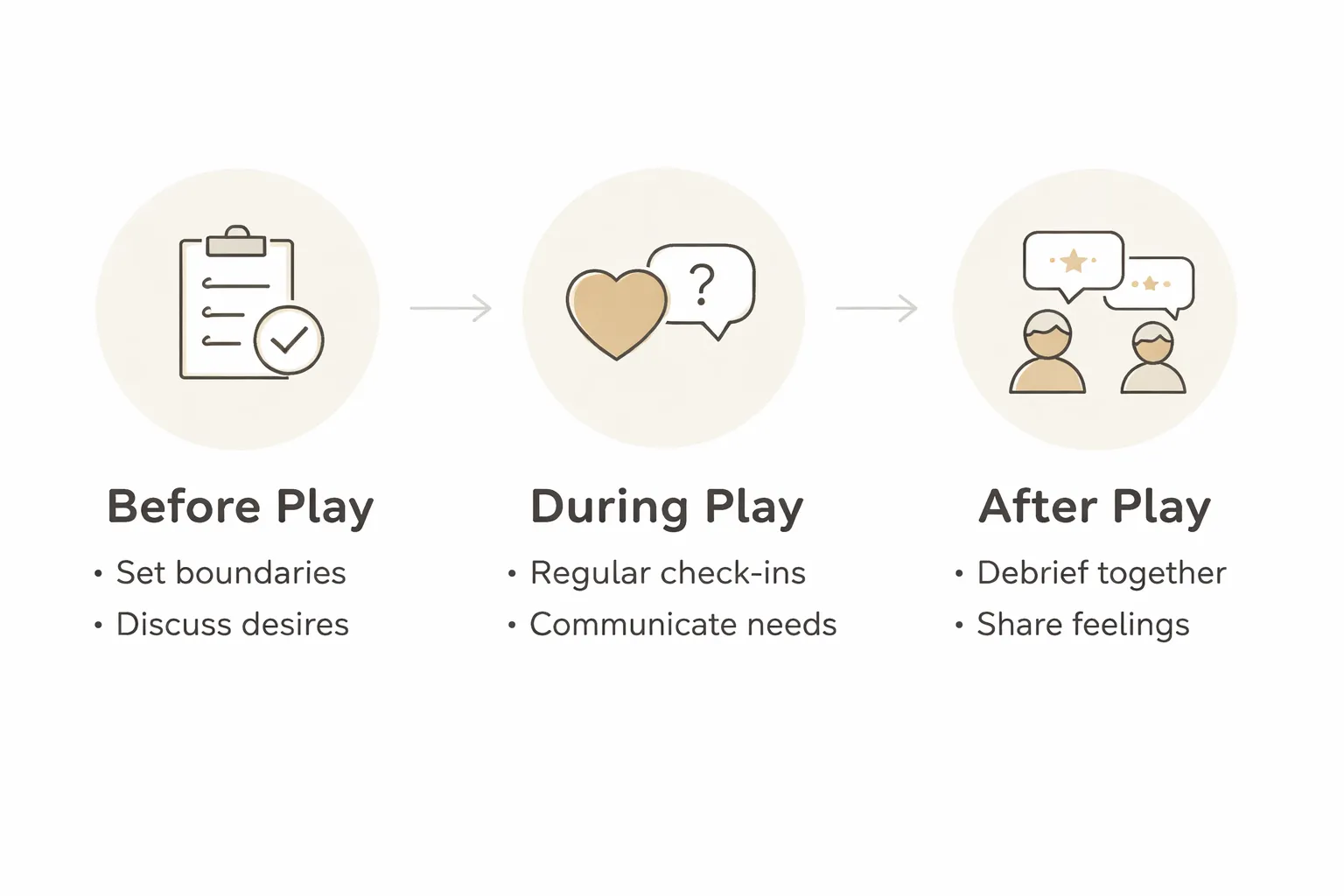
Good communication keeps play safe, fun, and drama-free. You need three phases, before, during, and after. Before play, you and your partner align on hard limits, soft limits, safer sex, and exit plans. Put your “yes, no, maybe” list in writing and keep it short. During play, you use clear words, fast check-ins, and pre-set stop signals. You watch for freezing, silence, and fawning, common stress responses that replace a clear “no.” You pause when anything feels off. After play, you debrief within 24 to 72 hours and log what worked and what did not. You change one variable at a time. This section covers the basics. The deep dive gives scripts, checklists, and examples.
Read our detailed guide: Communication Skills for Beginners: Before, During, and After Play - Rules, Boundaries, and Consent: The Foundation of the Swingers Lifestyle - What Is the Swingers Lifestyle? A Beginner-Friendly Guide
Safety and Etiquette: Health, Privacy, and Respect in Lifestyle Spaces
Safety and etiquette keep the lifestyle fun, private, and low risk. You need a simple health plan, clear privacy rules, and consistent respect for people and spaces. This section covers the basics, what to test before you go, what to do in the room, and what to avoid after. You will see the core habits that reduce STI risk, prevent misunderstandings, and protect identities in clubs, parties, and online groups. You will also get the baseline etiquette that experienced couples expect, including consent checks, clean exits, and how to handle rejection without drama. Use this as your quick start. The deep dive gives exact scripts, checklists, and real-world scenarios.
- Health: test cadence, sharing results, barrier use, and what to do after an exposure.
- Privacy: photos, phones, names, face rules, and how to protect your digital trail.
- Respect: consent checks, touch rules, rejection, and how to leave a scene clean.
- Space etiquette: club policies, house rules, hygiene basics, and handling alcohol and substances.
Read our detailed guide: Safety and Etiquette: Health, Privacy, and Respect in Lifestyle Spaces - Rules, Boundaries, and Consent: The Foundation of the Swingers Lifestyle - What Is the Swingers Lifestyle? A Beginner-Friendly Guide
Getting Started: A Step-by-Step Beginner Path to Exploring Swinging
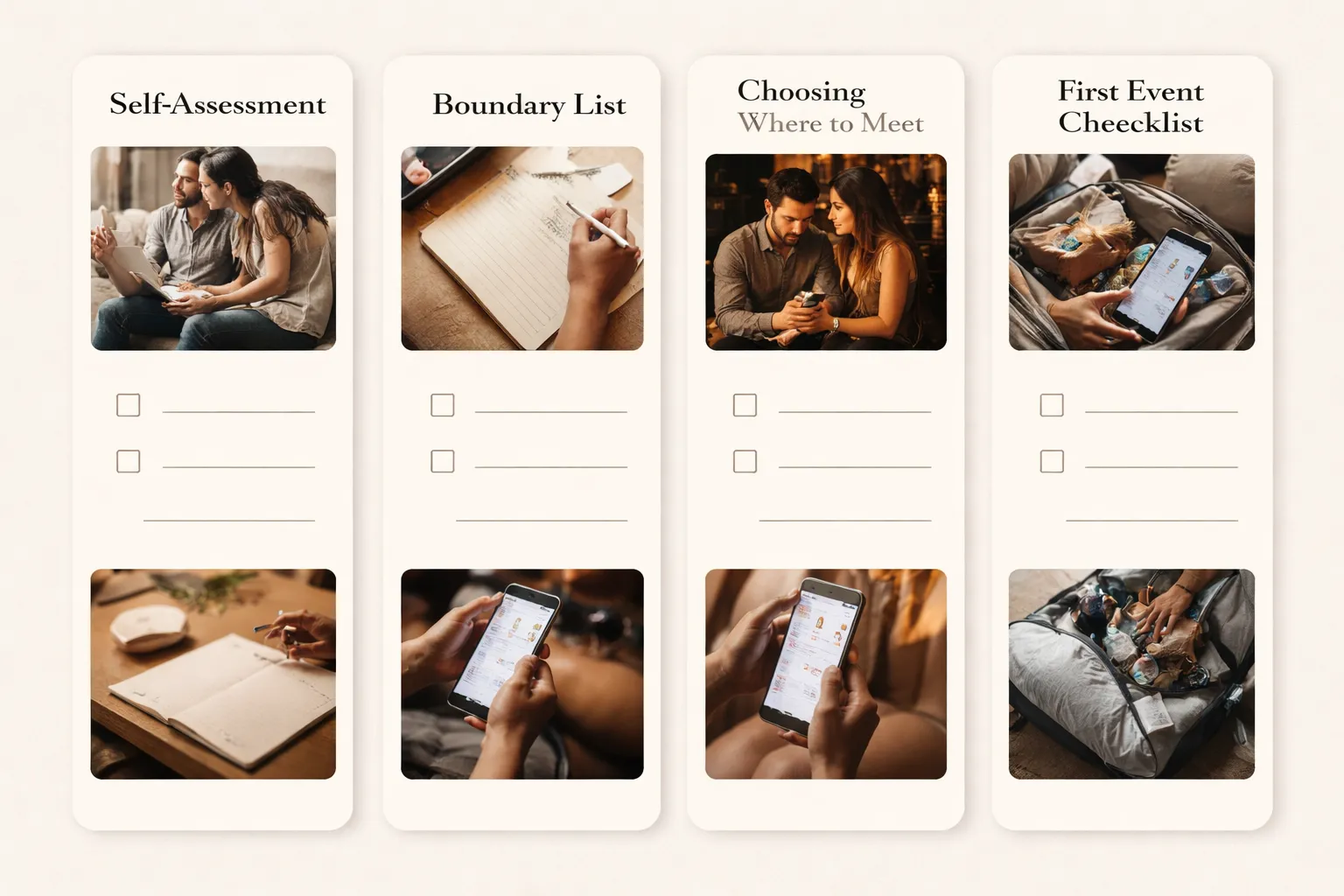
Self-assessment and couple alignment
Write down your goal. Keep it specific. Examples include social nights, soft swap, full swap, group play, or voyeurism only.
List your hard no items. Add your maybe items. Add your yes items. Use clear language.
- Hard no: acts, body parts, condom rules, drugs, public photos, overnight stays.
- Maybe: kissing, oral, separate play, group settings, certain genders, certain spaces.
- Yes: what you both want, with limits, with safer sex rules.
Agree on your stop signal. Use a word that never appears in dirty talk. Also agree on a check-in phrase for quick status updates.
Set your first boundary around alcohol. Decide your max drinks. Decide who stays fully sober. Stick to it.
Start small: talk, plan, test
Start with fantasy talk. Do not negotiate in the moment. Do it at home, clothed, and calm.
Create a one-page boundaries list. Share it. Update it after each step.
- Touch rules, kissing rules, condom rules.
- Play rules, same room only or separate rooms.
- Communication rules, who speaks, how you handle invites.
- Privacy rules, photos, names, social media, location sharing.
Do a non-sex social event first. Choose a meet and greet, a bar night hosted by a club, or a vetted community mixer. Aim to talk to people, not to play.
Run a debrief after. Use three points. What felt good. What felt off. What changes next time.
Where to meet people
Pick one channel. Learn it. Then add a second. More channels increases noise and risk.
- Vetted apps and sites: look for ID checks, clear reporting tools, and active moderation.
- Clubs: you get staff, house rules, and a controlled space. You also get strict etiquette.
- Private invites: only accept through trusted connections. Ask who else will attend and what the host enforces.
Prefer places with written rules on consent, condoms, and photography. Avoid spaces that push alcohol, ignore boundaries, or treat consent as optional.
How to vet compatibility and safety
Vet before you meet. Do not rely on chemistry in person. Use a simple screening flow.
- Profile check: clear face or partial-face policy, consistent details, recent activity, stated boundaries, stated safer sex rules.
- Messaging check: they answer questions, they respect limits, they do not pressure, they do not rush to private locations.
- Expectations check: confirm the plan, dress code, play intent, condoms, testing habits, and privacy rules.
- Reference check: ask for vouches from known community members or prior event hosts, where normal in your area.
Ask direct questions. Keep them short. Expect short answers.
- What are your hard no items.
- What is your condom rule for oral and penetration.
- When was your last STI test, and what did it include.
- Do you play together, separate, or both.
- What does a good night look like for you, and what ends it.
Set a first meet in a public place or at a club event. Do not start with a private home unless you have strong references.
Your first event checklist
Plan your logistics. Remove friction. You make better choices when you are not rushed.
- Before you go: confirm address, entry rules, dress code, consent policy, phone policy, and payment method.
- What to bring: condoms you trust, lube, wipes, mints, a small towel, cash, a cover-up, spare underwear.
- Health basics: shower, trim nails, avoid strong scents, pack any meds you need.
- Safety basics: charge your phone, set your ride plan, agree on your exit line.
Ask staff for a quick orientation. Learn the room layout. Learn where you can and cannot touch. Learn where you can and cannot have sex.
Use a simple pace rule. Talk first. Sit second. Flirt third. Touch last. Stop at any step if one of you tightens up or goes quiet.
Set clear leave triggers. Use them without debate.
- One of you feels pressured.
- Boundaries get tested or mocked.
- Alcohol or drugs change the room.
- You lose track of each other.
- You feel numb, anxious, or angry.
Debrief the same night if you can. Keep it factual. Write one change for next time. Then pause for a week before you escalate.
- In het kort: Consent is required for every act, every time. Silence is a no.
- In het kort: Boundaries are rules you do not debate in the moment. You stop when one gets hit.
- In het kort: Use simple signals. Use a safe word and a “pause” word.
- In het kort: Agree on leave triggers before you go. Then leave fast.
- In het kort: Debrief the same night. Write one change. Wait before you escalate.
Key Takeaways: The Non-Negotiables of Rules, Boundaries, and Consent
- Consent is active. You ask. You listen. You confirm again when things change.
- No consent, no play. If you do not get a clear yes, you stop.
- You can withdraw consent at any time. You do not explain. You do not negotiate.
- Boundaries beat chemistry. Attraction does not override your agreement.
- Make boundaries specific. Name acts, body parts, condoms, fluid rules, and sleeping rules.
- Use a two-word system. “Pause” means slow down and check in. Your safe word means stop now.
- Stay in visual range. You and your partner keep sight access. You avoid getting separated.
- Alcohol reduces signal quality. Set a hard limit. If the room gets sloppy, you leave.
- Leave triggers are pre-approved exits. Pressure, mocking, boundary pushing, isolation, or emotional shutdown means you go.
- Debrief while it is fresh. Stick to facts. What happened. What felt good. What felt off. What changes next time.
- Track patterns. If the same issue repeats twice, you change the plan or you stop going.
| Non-negotiable | What you do | What you avoid |
|---|---|---|
| Clear consent | Ask for a yes before each new act. | Assuming consent because someone agreed earlier. |
| Hard boundaries | Stop when a boundary appears. Reset or leave. | “Just this once” deals in the moment. |
| Signals | Use “pause” and a safe word. Practice them once. | Relying on hints, eye contact, or silence. |
| Exit plan | Agree on leave triggers and a meetup spot. | Arguing in public or waiting until it gets worse. |
| Debrief | Talk the same night. Write one change. | Replaying blame or escalating the next weekend. |
FAQ: Swinging Rules, Boundaries, and Consent (Beginner Questions)
Error: Invalid type for 'messages[1].content': expected one of a string or array of objects, but got a boolean instead.Conclusion: Build a Respectful, Enjoyable Experience Through Clear Agreements
Clear agreements keep you safe. They also keep the experience fun. You reduce stress when everyone knows the plan.
- Set your rules before you meet anyone. Talk about acts, protection, alcohol limits, and where you will play.
- Use simple boundaries. Use “yes,” “no,” and “maybe.” Write down hard no items.
- Confirm consent in the moment. Ask before each new step. Stop fast when you hear “no” or see hesitation.
- Pick one safe word and one stop signal. Use them without debate. End the action, then check in.
- Agree on exit rules. Decide how you leave, who pays, and how you handle follow up.
- Debrief within 24 hours. Share what worked, what failed, and what changes next time.
Final tip. Treat your rules like a checklist. Review it before every meetup. Update it after every debrief.
-
Safety and Etiquette: Health, Privacy, and Respect in Lifestyle Spaces - Rules, Boundaries, and Consent: The Foundation of the Swingers Lifestyle - What Is the Swingers Lifestyle? A Beginner-Friendly Guide
1 week ago -
Communication Skills for Beginners: Before, During, and After Play - Rules, Boundaries, and Consent: The Foundation of the Swingers Lifestyle - What Is the Swingers Lifestyle? A Beginner-Friendly Guide
1 week ago -
How Swingers Meet: Where to Find Community (Online and In-Person) - What Is the Swingers Lifestyle? A Beginner-Friendly Guide
1 week ago
-
- Start With Rule Categories, Not One-Off Scenarios
- Common Sexual Act Rules
- Safer Sex Rules That Hold Up in Real Life
- Emotional Boundaries and Attachment Risk
- Privacy Rules and Discretion
- The Veto and Safe Word, Use Them With Care
- Same-Room vs Separate-Room Agreements
- Singles Policy and Couple-First Dynamics
- How to Choose Rules That Work for You
- Revisit and Renegotiate Over Time
-
-
-
-
-
- Start With Rule Categories, Not One-Off Scenarios
- Common Sexual Act Rules
- Safer Sex Rules That Hold Up in Real Life
- Emotional Boundaries and Attachment Risk
- Privacy Rules and Discretion
- The Veto and Safe Word, Use Them With Care
- Same-Room vs Separate-Room Agreements
- Singles Policy and Couple-First Dynamics
- How to Choose Rules That Work for You
- Revisit and Renegotiate Over Time
-
-
-
-
-
Communication Skills for Beginners: Before, During, and After Play - Rules, Boundaries, and Consent: The Foundation of the Swingers Lifestyle - What Is the Swingers Lifestyle? A Beginner-Friendly Guide
1 week ago -
Safety and Etiquette: Health, Privacy, and Respect in Lifestyle Spaces - Rules, Boundaries, and Consent: The Foundation of the Swingers Lifestyle - What Is the Swingers Lifestyle? A Beginner-Friendly Guide
1 week ago -
How Swingers Meet: Where to Find Community (Online and In-Person) - What Is the Swingers Lifestyle? A Beginner-Friendly Guide
1 week ago -
What Is the Swingers Lifestyle? A Beginner-Friendly Guide
1 week ago -
Swinging vs Open Relationship: Key Differences Explained
1 week ago
-
What Is the Swingers Lifestyle? A Beginner-Friendly Guide
1 week ago -
Safety and Etiquette: Health, Privacy, and Respect in Lifestyle Spaces - Rules, Boundaries, and Consent: The Foundation of the Swingers Lifestyle - What Is the Swingers Lifestyle? A Beginner-Friendly Guide
1 week ago -
Questions Couples Should Ask Before Swinging (Boundaries, Safer Sex, Goals)
1 week ago -
Communication Skills for Beginners: Before, During, and After Play - Rules, Boundaries, and Consent: The Foundation of the Swingers Lifestyle - What Is the Swingers Lifestyle? A Beginner-Friendly Guide
1 week ago -
Swinging Rules and Boundaries: Examples, Scripts, and Best Practices
1 week ago