Swinging vs Open Relationships: Emotional Impact Explained

Rules do not prevent heartbreak. Emotions do. In swinging and open relationships, jealousy, compersion, and attachment drive most conflicts. You need to know what each setup triggers, and how to manage it.
This section is part of the larger guide, Swinging vs Open Relationship: Key Differences Explained. You will learn how emotional risks differ between swinging and open relationships, what jealousy usually signals, how compersion develops, and where attachment problems start. You will also get practical ways to set boundaries, communicate needs, and reduce fallout before it hits your primary relationship.
Swinging vs Open Relationship: Definitions, Overlap, and Key Emotional Assumptions
Working definitions
Swinging usually means partnered people seek sexual experiences with others. You often do it together. You often treat it as recreational sex. Your primary relationship stays central.
An open relationship usually means you and your partner allow outside sex, romance, or both. You often date separately. You often allow more autonomy. Your agreement can cover emotional bonds, not just sex.
Common structures you will see
- Same-room play, you stay in the same space. You keep high visibility. You reduce uncertainty. You also increase comparison and performance pressure.
- Separate-room play, you split up. You gain freedom and privacy. You also increase unknowns, which can spike jealousy and anxiety.
- Rules-based agreements, you set fixed limits. Examples include no kissing, no overnights, only together, no repeat partners. This can feel safer early on. It can also fail when real life does not match the rule list.
- Values-based agreements, you set priorities, then decide case by case. Examples include honesty, sexual health, respect, no deception, protect sleep and family time. This can scale better. It requires stronger communication and self-control.
Where they overlap in real life
Behaviors can look the same. Labels do not guarantee safety. You still need the same foundations.
- Consent, clear yes, clear no, no coercion, no surprise changes.
- Negotiation, what you allow, what you avoid, what you disclose, and when.
- Safer sex, testing cadence, barriers, contraception, and what happens after a risk. Use a written plan before you act. You can map this in your health agreement. See /safer-sex-health-agreements-before-any-next-steps-boundaries-consent-and-safer-sex-what-you-need-to-.html.
- Privacy, what stays between you two, what you share with friends, and how you protect third parties.
- Aftercare, time, reassurance, and repair. You need it in both models.
Key emotional assumptions that change the risk
Most conflict comes from hidden expectations. Swinging and open relationships often start with different emotional defaults.
- Attachment expectations. Swinging often assumes you will not form strong bonds with others. Open relationships more often accept that bonds can form and must get managed.
- Jealousy meaning. In swinging, jealousy often signals a boundary breach, a loss of control, or comparison in the moment. In open relationships, jealousy often signals fear of replacement, time loss, or emotional drift.
- Compersion pressure. Some couples expect compersion fast. That creates shame when you feel pain instead. Treat compersion as a possible outcome, not a requirement.
- Information needs. Swinging often leans toward shared visibility and shared stories. Open relationships often need stronger privacy rules and stronger disclosure timing. Mismatched detail levels cause fights.
- Time as the real currency. Sex is one variable. Time changes attachment. Open relationships usually require explicit scheduling limits. Swinging often underestimates time spillover from messaging, repeat meets, and travel.
Why two couples can do the same acts and feel different outcomes
Emotional impact tracks your agreement design, not the sex act.
| Factor | Often lower emotional load | Often higher emotional load |
| Visibility | Same-room, shared context | Separate-room, missing context |
| Repeat contact | One-off, low messaging | Ongoing chats, repeat dates |
| Disclosure | Agreed summaries, consistent timing | Late disclosures, detail mismatch |
| Primary care | Planned aftercare, protected couple time | No repair time, schedule drift |
| Agreement type | Clear values, simple limits | Long rule list, weak enforcement |
If you want lower fallout, define what counts as sex, what counts as a date, and what counts as an emotional line. Put it in writing. Revisit it after each experience.
Jealousy in Swinging vs Open Relationships: Triggers, Patterns, and What It Signals
Jealousy vs envy vs insecurity, use the right words
Most fights start with sloppy labels. Tight language lowers blame and speeds repairs.
- Jealousy, you fear losing access, priority, or safety. It points to protection and attachment needs.
- Envy, you want what your partner gets. Attention, pleasure, status, ease. It points to unmet wants and fairness.
- Insecurity, you doubt your worth or your place. It points to self-esteem, reassurance, and consistency.
Use one sentence. “I feel jealous about time.” “I feel envy about the attention you got.” “I feel insecure about my body.” Then ask for one specific change.
Typical jealousy triggers in swinging
Swinging runs on shared events, fast escalation, and public context. Triggers cluster around comparison and in-the-room exposure.
- Seeing your partner with others, touch, sounds, eye contact, orgasm cues. Your nervous system reacts before your logic.
- Performance anxiety, erections, stamina, orgasm timing, sexual skill. You compare in real time.
- Detail mismatch, you expected one thing, you saw another. A “soft swap” becomes explicit sex.
- Social status dynamics, who got chosen, who got ignored, attention from “higher status” partners, group validation.
- Uneven opportunity, one of you gets more offers. The other feels sidelined.
- Alcohol and pacing, lowered inhibition, blurred consent, lost check-ins.
In swinging, jealousy often signals a weak in-event plan. You need clearer limits, faster check-ins, and a clean exit script.
Typical jealousy triggers in open relationships
Open relationships run on ongoing contact. Triggers cluster around time, bonding, and uncertainty.
- Time allocation, dates take prime evenings, weekends, holidays. You feel deprioritized.
- Emotional intimacy, deep talks, pet names, inside jokes, daily texting. You read it as partnerhood.
- NRE, sudden energy shift, new plans, new libido. Your baseline feels replaced.
- Secrecy and delay, late disclosures, “I forgot to mention,” hidden chats. You lose trust fast.
- Fear of replacement, talk of “real connection,” future plans, meeting friends, merging routines.
- Rule drift, small exceptions become a pattern. Your agreements stop predicting behavior.
In open relationships, jealousy often signals an attachment and trust load. You need predictable routines, disclosure standards, and clear emotional lines.
How context changes intensity
| Context | What it tends to trigger | What helps |
|---|---|---|
| Present in the room | Sensory overload, comparison, immediacy | Pre-set signals, pacing, opt-out plan, post-play couple time |
| Not present | Imagination spirals, uncertainty, fear of hidden bonding | Clear update windows, transparency rules, consistent follow-through |
| Planned play | Boundary clarity, event-based stress | Simple agreements, shared intent, short debrief |
| Ongoing dating | Resource competition, NRE effects, identity threats | Calendar rules, reassurance rituals, explicit priority language |
What jealousy signals, boundary issue vs communication or attachment issue
Do not treat every jealous feeling as a rule problem. Diagnose first.
- It is a boundary issue when a clear agreement got broken, or when you never defined the line. Fix it by naming the line, setting a consequence, and changing the plan.
- It is a communication issue when facts arrive late, details differ, or updates feel selective. Fix it with tighter disclosure timing, shared definitions, and shorter feedback loops.
- It is an attachment issue when you feel unsafe even with clean behavior. Fix it with predictable connection, reassurance you can trust, and reduced ambiguity around time and priority.
Track patterns. If the same trigger hits after “perfect” rule-following, stop adding rules. Build stability instead. If jealousy follows ambiguity and exceptions, tighten definitions and enforce them. If jealousy follows secrecy, treat it as a trust breach and repair it before more dating or play.
Compersion and Positive Emotions: How They Develop (and When They Don’t)
What Compersion Is (and Isn’t)
Compersion means you feel genuine positive emotion when your partner feels joy, excitement, or connection with someone else. It can sit next to jealousy. It does not need to replace it.
Compersion is not a rule you force on yourself. It is not proof you are “good at” non-monogamy. It is not a demand you place on your partner. Forced positivity usually backfires. It turns real feelings into secrecy and performance.
Why It Shows Up Differently in Swinging vs Open Relationships
In swinging, compersion often grows from shared novelty. You see your partner turned on. You feel included. You reconnect fast after the event. Clear start and stop points lower uncertainty.
In open relationships, compersion has to survive time. It has to survive scheduling, sleepovers, and emotional bonding. That adds comparison pressure and resource stress. You can feel happy for your partner and still feel loss around time, attention, or status.
- Swinging: more shared context, more co-presence, faster repair cycles.
- Open: more independent dating, more unknowns, more chances for attachment activation.
Prerequisites That Make Compersion Possible
Compersion tracks safety. If your nervous system reads “stable,” positive emotions show up more often. If it reads “threat,” they do not.
- Trust you can verify. Words match behavior over time.
- Transparency. You know what is happening and what is planned. You do not learn key facts after the fact.
- Clear agreements. You can state boundaries in one sentence. Both of you enforce them.
- Secure attachment behaviors. You respond. You repair quickly. You do not punish honesty.
- Adequate reassurance. You get consistent time, affection, and check-ins. You do not have to beg for basics.
Common Blockers
- Shame. You judge your jealousy, then hide it. The emotion grows.
- Comparison. You track attractiveness, sexual skill, novelty, or “who matters more.”
- Unmet needs. You lack quality time, affection, or sexual connection at home.
- Unclear agreements. You rely on vibes. You fight after each exception.
- Uneven costs. One partner gets freedom, the other carries childcare, housework, or social risk.
- Oversharing. You hear details that spike images and rumination. You call it “transparency,” but it functions as self-harm.
How Couples Cultivate Compersion Without Forcing It
You build conditions. You do not chase a feeling.
- Pre-brief. Confirm plans, safer sex, overnights, and communication windows. End with what you need to feel secure.
- Reassurance rituals. Use repeatable actions, not speeches. A short text on arrival, a check-in time, a goodnight, a next-day coffee.
- Debriefs with structure. Share what matters, then stop. Cover safety, feelings, and logistics. Skip sexual play-by-play unless both of you want it.
- Celebrate outcomes, not details. You can say “I’m glad you had fun” and “I missed you” in the same minute.
- Protect your core relationship time. Put it on the calendar first. Treat it as non-negotiable.
- Set a detail level agreement. Decide what you share by default, what you share on request, and what stays private.
When Compersion Doesn’t Develop
Sometimes it stays rare. That does not mean you failed. Some people feel neutral instead of joyful. Neutral can be stable and healthy.
Compersion also does not develop when the structure keeps triggering threat. If you keep revising rules but still feel unsafe, stop optimizing the rulebook. Fix the foundation, trust repair, clear agreements, and reliable reassurance. Then reassess.
Attachment and Emotional Bonding: Managing Love, NRE, and “Catching Feelings”
Attachment changes the risk profile fast. Swinging often limits bonding through clear time boxes and couple-first norms. Open relationships allow deeper connection, so emotions can scale. You need a plan for love, New Relationship Energy (NRE), and “catching feelings” before they show up.
- Define the lane. Decide what you allow, casual sex, dating, romance, or love. Write it down.
- Track NRE signs. Sleep loss, constant texting, neglecting your partner, rule pushing, secrecy.
- Use attachment-aware habits. Keep predictable check-ins, repair fast, and protect core time together.
- Set escalation rules. Overnights, trips, holidays, meeting friends, and “I love you” need prior consent.
- Use data. Log time, spending, and communication. If your baseline drops, adjust access and frequency.
Read our detailed guide: Attachment and Emotional Bonding: Managing Love, NRE, and “Catching Feelings” - Emotional and Relationship Impact: Jealousy, Compersion, and Attachment - Swinging vs Open Relationship: Key Differences Explained
Relationship Impact Over Time: Trust, Intimacy, Communication, and Stability
Trust Mechanics Over Time
Trust does not come from rules. It comes from repeatable behavior. Track it.
- Transparency: Share what you agreed to share, every time. Names, locations, spend, sexual health updates, and schedule changes. Keep the same reporting standard for both partners.
- Predictability: Use fixed windows for dates, play, and downtime. Protect shared time first, then add outside time.
- Repair after rupture: When you break an agreement, act fast. State what happened, why it happened, what you will change, and how you will prevent repeats. Add a temporary boundary, then review after 2 to 4 weeks.
Swinging often relies on shared experiences and fast debriefs. Open relationships often rely on clear calendars, consistent updates, and longer-term emotional management.
Communication Styles That Hold Up
Use structured communication. Stop relying on vibes.
- Check-ins: Weekly, 20 to 30 minutes. Same agenda each time. Logistics, feelings, sex, health, time, money, next week.
- Debriefs: After play or dates, keep it short. Facts first, then feelings, then any request. Do it within 24 hours.
- Meta-communication: Talk about how you talk. Set rules for hard talks. No yelling, no threats, no ultimatums, no texting conflict.
- Conflict repair: Use clean steps. Name the issue, own your part, state your need, propose a change, set a review date.
If you need a baseline for agreements, pacing, and safety, use a beginner roadmap. Link: Getting Started Safely (Beginner Roadmaps for Swinging and Open Relationships).
Intimacy Outcomes: Novelty vs Closeness
Novelty can boost desire. It can also drain connection. The difference is what you protect at home.
- ENM increases connection when: you keep high-quality couple time, you share sexual health responsibility, you stay honest about attachment shifts, and you stop comparisons.
- ENM decreases connection when: you cancel shared plans for outside partners, you hide details to avoid discomfort, you let resentment stack, or you use outside sex to escape conflict.
- Swinging pattern: more shared sexual novelty, less ongoing emotional entanglement, fewer calendar collisions.
- Open relationship pattern: more scheduling load, higher attachment risk, more frequent boundary renegotiation.
Common Long-Term Stressors
- Mismatched libido: one partner wants more outside sex, the other wants more home sex. Track frequency for both. Fix the home gap first.
- Unequal opportunities: one partner gets more matches, attention, or dates. Expect this. Set time caps, budget caps, and fairness rules based on time and care, not body count.
- Shifting life stages: jobs, kids, health, aging parents. Your capacity changes. Reduce outside activity before your relationship starts failing.
- Resource drift: time, money, and emotional energy move away from the core. Log all three for 30 days. Compare to your baseline month.
Red Flags vs Healthy Friction
Friction is normal. Patterns that break consent are not.
- Red flags: secrecy, lying by omission, phone hiding, private accounts, broken safer sex agreements, pressure for access, guilt trips, threats of leaving to force consent, repeated boundary testing, and punishment after honest disclosure.
- Healthy friction: jealousy you name early, discomfort you talk through, slower pacing, renegotiating rules, temporary pauses, and clear requests for reassurance.
- Resentment buildup signs: scorekeeping, sarcasm, withdrawal, reduced home sex, and repeated “fine” conversations. Treat these as data points, not personality traits.
| Metric to Track | What to Log | Action Trigger |
|---|---|---|
| Time | Hours per week for couple time, outside time, solo time | If couple time drops 20 percent for 2 weeks, cut outside time and reset schedule |
| Communication | Check-ins done, debriefs done, unresolved conflicts | If you skip 2 check-ins, pause new connections until you complete one |
| Sexual health | Testing dates, barrier use, partner changes, exposures | If an agreement breaks, stop outside sex until you retest and renegotiate |
| Money | Outside dating spend, travel, hotels, memberships | If spend exceeds the cap, freeze discretionary dating costs for a month |
| Emotional load | Stress score 1 to 10 after dates, jealousy spikes, sleep loss | If stress stays above 7 for 2 weeks, reduce frequency and add reassurance routines |
Choosing the Best Fit: Emotional Readiness, Boundaries, and Safer Transitions
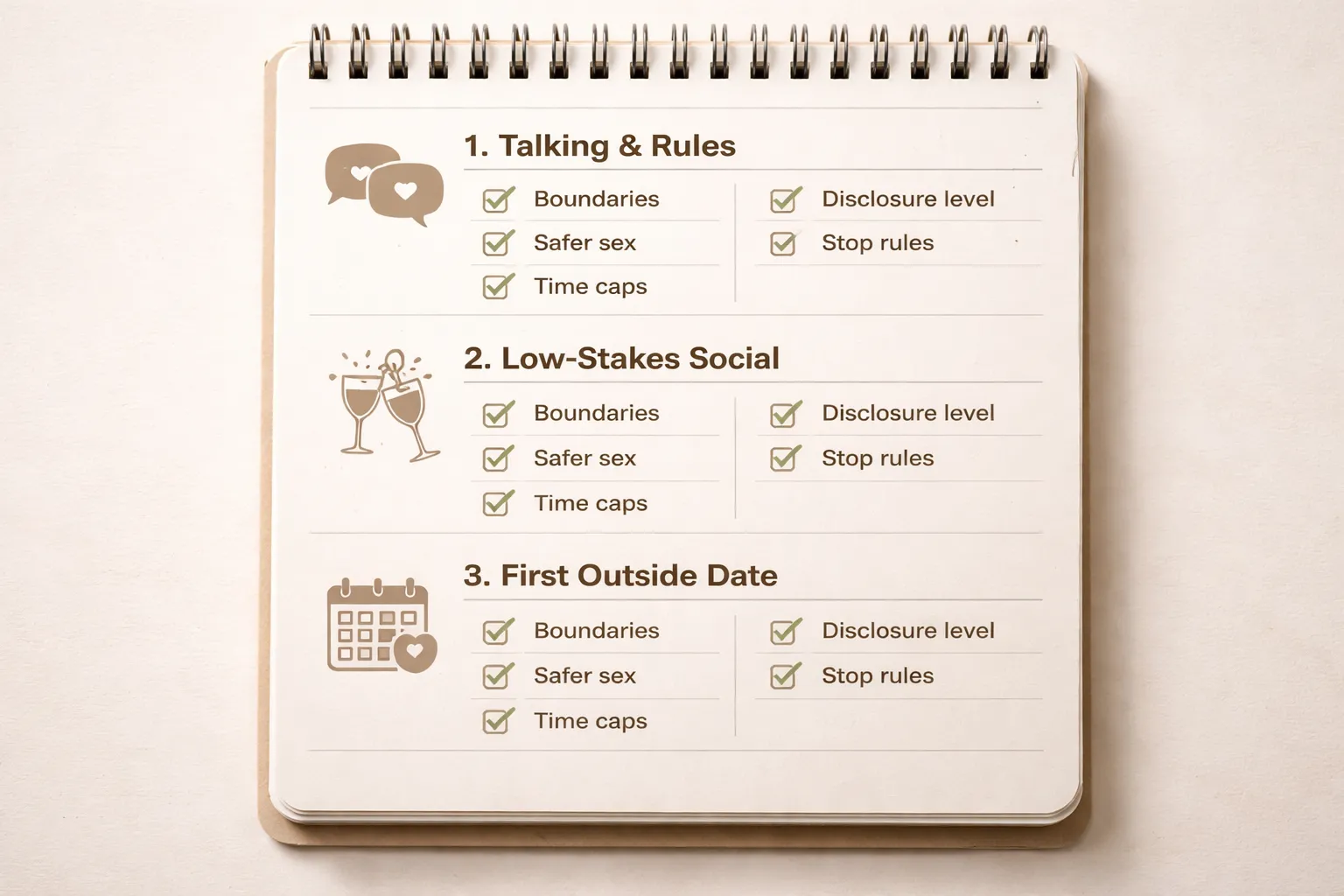
Self-assessment: motivation, bandwidth, attachment needs
Check your motive first. Growth motives hold up under stress. Avoidance motives break fast.
- Growth motives: sexual variety, shared adventure, honest exploration, learning new skills.
- Avoidance motives: saving a failing relationship, revenge, testing commitment, escaping conflict, fixing low libido by outsourcing it.
Rate your emotional bandwidth. Use a simple weekly scorecard. Track it, do not debate it.
- Sleep quality after dates, 1 to 10.
- Jealousy intensity, 1 to 10.
- Rumination time, minutes per day.
- Conflict frequency, count per week.
- Reassurance needed, low, medium, high.
Name your attachment needs. Secure attachment needs consistency. Anxious attachment needs reassurance. Avoidant attachment needs space. You can work with any style, but you must plan for it.
Boundary design: hard limits, flexible agreements, privacy vs secrecy
Separate hard limits from flexible agreements. Hard limits protect safety and consent. Flexible agreements manage comfort.
- Hard limits examples: condoms for all penetration, no sex with close friends, no dating coworkers, no sleepovers, no drugs during dates.
- Flexible agreements examples: number of dates per month, which days stay reserved, how much flirting happens in public, how fast you escalate.
Define privacy. Privacy means you keep personal details appropriate. Secrecy means you hide key facts your partner needs to consent.
- Privacy: no sharing explicit play-by-play, no sharing identifying details about others.
- Secrecy: hiding meetups, hiding messages, lying about safer sex, hiding emotional involvement.
Write your minimum disclosure rules. Decide what your partner must know before sex, after sex, and within a week. Keep it specific.
Transition paths: what changes emotionally
Monogamy to swinging. You keep the couple as the primary unit. You reduce ambiguity by doing it together. You still face jealousy, but you get more shared context.
- Start with clear event rules, time limits, and safer sex steps.
- Use the same aftercare routine every time.
Monogamy to open relationship. You add autonomy. Autonomy increases uncertainty. Uncertainty triggers attachment stress faster than shared play.
- Expect stronger reactions around texting, solo dates, and overnights.
- Plan for calendar conflicts and uneven opportunities.
Swinging to open relationship. This feels different because you shift from shared sexual novelty to separate romantic or ongoing bonds. Many couples can handle sex. Fewer can handle love, time spend, and priority questions.
- Compersion often drops when time and emotional energy move away from the couple.
- Jealousy often shifts from sex to replacement fears and scheduling fights.
Set expectations before you start: feelings, time, disclosure
Expect feelings. You cannot contract them away. You can set behavior rules around them.
- Define what counts as a problem, crushing, bonding, love.
- Decide what actions are allowed if feelings grow, dates, overnights, gifts, future planning.
- Set a rule for early disclosure, for example, tell your partner within 72 hours of noticing romantic attachment.
Expect time pressure. Time becomes the main currency. Protect it like money.
- Set a weekly couple baseline, for example, two protected nights.
- Cap outside time at the start, then adjust after 30 days.
- Use a shared calendar. No last-minute swaps unless both agree.
Expect disclosure friction. Too little creates anxiety. Too much creates mental images you cannot unsee.
- Pick a disclosure level, minimal, moderate, detailed.
- Pick a check-in cadence, next morning, weekly, both.
- Decide what stays private to protect third parties.
| Topic | Decide this before first outside sex |
|---|---|
| Safer sex | Barrier rules, testing schedule, what breaks the agreement, what stops all activity |
| Time | Date caps, overnights, protected couple time, calendar rules |
| Disclosure | What you tell, when you tell it, what stays private, how you handle messages and photos |
| Emotions | Early warning signs, reassurance routines, rules if feelings deepen |
| Exit ramps | Pause conditions, renegotiation process, how you return to monogamy if needed |
Safer transitions: start small, measure, adjust
Use stepwise exposure. You reduce shock. You learn your triggers early.
- Week 1 to 2, talk only. Define rules. Practice disclosure and reassurance.
- Week 3 to 4, low-stakes social settings. No sex. Debrief.
- Month 2, limited physical steps with clear caps. Stop if stress stays high.
- Month 3, review the agreement and tighten weak points.
Use a stop rule. If either of you says stop, you stop. Then you debrief within 48 hours and decide the next step together.
When to seek support
Get outside help when patterns repeat. Do it early, not after a rupture.
- Therapist or coach experienced in ENM: attachment triggers, conflict cycles, sexual shame, trauma history, compulsive behavior.
- Community education: workshops, books, discussion groups, consent training, safer sex refreshers.
- Agreement review: quarterly review, after any boundary break, after any new partner becomes ongoing.
Seek immediate support if you see coercion, ongoing lying, repeated agreement breaks, panic symptoms, or loss of basic functioning like sleep and work focus.
- In het kort: Swinging tends to put stress on logistics, boundaries, and in-the-moment consent.
- In het kort: Open relationships tend to put stress on attachment, time, and ongoing emotional equity.
- In het kort: Your risk rises when rules stay vague, check-ins stop, or you keep secrets to avoid conflict.
- In het kort: Your stability improves when you set clear agreements, track emotions early, and repair fast after slips.
- In het kort: Get help fast if you see coercion, repeated lying, repeated boundary breaks, or panic and sleep loss.
Key takeaways you can use
- Define the goal before you act. Swinging often centers on shared experiences. Open relationships often include independent dating. Mixed expectations create conflict fast.
- Match the structure to your attachment needs. If you need predictability, you will do better with tight plans, clear limits, and frequent reassurance. If you need autonomy, you will do better with flexible scheduling and clear privacy rules.
- Expect different jealousy triggers. In swinging, triggers often come from real-time comparison, performance pressure, and public settings. In open relationships, triggers often come from time allocation, emotional bonding, and repeated contact.
- Protect your primary bond with time budgets. Put shared time on the calendar first. Track how many nights, weekends, and holidays go to others. Adjust before resentment builds.
- Use consent scripts, not vibes. Agree on what counts as a yes, a no, and a pause. Reconfirm during play. You reduce regret and conflict. See Swinging Etiquette & Safety: Rules, Boundaries & Scripts.
- Make safer sex a written agreement. Decide condom rules, testing cadence, and what happens after a slip. Treat this as non-negotiable. See Safer Sex: Health Agreements Before Any Next Steps.
- Measure impact, not intent. A boundary break can still harm trust even if you meant well. Name the breach, pause new partners, and repair with actions.
- Review agreements on a schedule. Do a quarterly review, plus any time you add an ongoing partner or break a rule. Small updates prevent big blowups.
- Do not outsource emotional labor. Your partner should not carry all planning, reassurance, and cleanup. Split tasks. Split check-ins. Split aftercare.
- Use early warning signs. Watch for rumination, checking phones, avoidance, anger spikes, and loss of focus at work. Treat these as signals to slow down.
Emotional impact comparison
| Area | Swinging | Open relationship |
|---|---|---|
| Main emotional load | In-the-moment jealousy, comparison, performance pressure | Attachment strain, fear of replacement, long-term insecurity |
| Most common friction | Boundary drift during events, mismatched pacing | Time imbalance, secrecy, uneven emotional investment |
| Trust risk | Rule breaks in high-arousal settings | Ongoing omissions, parallel relationships, hidden escalation |
| What helps most | Clear rules, exit plans, aftercare, debriefs | Scheduling rules, transparency levels, regular check-ins |
| When to pause | Panic during meetups, repeated consent confusion | Sleep loss, persistent anxiety, repeated lying, loss of functioning |
Relationship impact you should plan for
- Swinging can tighten the couple unit. You often act as a team. That can build closeness. It can also increase pressure if one of you keeps saying yes to avoid conflict.
- Open relationships can widen the relationship system. You manage more feelings, more time, and more negotiation. That can build honesty skills. It can also expose weak conflict habits.
- Equity matters more than equality. You do not need identical freedoms. You need agreements that feel fair to both of you and work in real life.
- Repair speed predicts long-term stability. Apologize fast. State the new rule. Add a safeguard. Follow through.
FAQ
Which tends to trigger more jealousy, swinging or open relationships?
Open relationships often trigger more jealousy. Ongoing outside dating can create stronger attachment threats. Swinging often keeps sex tied to the couple and limited to events. Your outcome depends on rules, reassurance, and how fast you repair after a trigger.
Which setup is harder emotionally?
Open relationships usually demand more emotional labor. You manage schedules, privacy, new partners, and feelings over time. Swinging often concentrates stress into shorter windows. Your difficulty level rises when you avoid hard talks or skip debriefs.
Do open relationships usually include romantic love?
Sometimes. Many couples allow emotional connection, others ban it. You need a clear definition of “romance” in your rules, like dating, sleepovers, daily texting, gifts, and meeting friends. Ambiguity creates conflict faster than the romance itself.
Does swinging reduce the risk of attachment?
It can. One-off encounters and shared contexts can limit bonding. Attachment still happens if you repeat partners, add private messaging, or hide details. If you want lower risk, set rules for frequency, communication, and whether you see the same person again.
What boundaries prevent the most emotional damage?
- Truth rules: no lies, no “forgetting,” no secret chats.
- Safer sex rules: condoms, testing cadence, stop rules.
- Time rules: curfews, overnights, date frequency.
- Communication rules: what you share, when you share it.
What do you do if a boundary gets broken?
Stop the outside contact. Share the full facts. Name the breach in one sentence. Apologize once, then act. Set a new rule and a safeguard. Track follow-through for weeks. Use a structured repair plan, see repair and rebuilding trust after a boundary break.
How often should you debrief after a play date or date?
Debrief within 24 hours. Keep it short. Cover feelings, what worked, what hurt, and one change for next time. Repeat a second check-in at 7 days to catch delayed reactions. If you skip debriefs, resentment builds and rules drift.
Do you need equal freedom for it to feel fair?
No. You need agreements that feel fair and work with your lives. Match freedom to comfort, time, health, and parenting load. Revisit fairness after real-world trials. If one person carries more risk or stress, adjust the rules or slow down.
Which relationship style is more stable long term?
Neither wins by default. Stability tracks your conflict skills. Repair speed matters more than structure. Couples who apologize fast, update rules, and follow through tend to do better. If you stonewall, punish, or keep secrets, both models fail.
What warning signs mean you should pause?
- Frequent rule “exceptions” that only benefit one person
- Escalating anxiety, sleep loss, or panic after dates
- Hidden messaging or deleted history
- Sex becomes a bargaining chip at home
- Debriefs turn into blame or interrogation
Can you switch from swinging to open, or the other way?
Yes. Treat it as a new agreement, not a small tweak. Write new rules, then test for 30 to 60 days. Start narrower than you think you need. Expand only after calm debriefs. If the switch increases conflict, step back and reset.
How do you measure “fair” rules without guessing?
Use simple metrics. Track time spent, money spent, emotional fallout days, and rule breaches. If one person pays more in stress, your system is not fair yet. Aim for balanced impact, not identical permissions. Update rules based on outcomes.
Conclusion: Building Emotional Safety in the Relationship Style You Choose
Conclusion: Building Emotional Safety in the Relationship Style You Choose
Swinging and open relationships can work. They fail when you ignore emotional cost. Your rules should protect trust first, access second.
Pick one habit that keeps you honest. Run a weekly check-in with numbers. Keep it short. Keep it calm. Write the results down.
- Conflict minutes: total minutes of arguments linked to non-monogamy.
- Recovery days: days until you both feel normal again after dates or events.
- Rule breaches: count, type, and what triggered each one.
- Sleep and focus: average hours slept, missed work, or dropped routines.
- Connection time: hours of planned time you protect for each other.
Set one hard stop. If recovery days rise for two weeks, pause outside partners for one week. Use that week to repair, then renegotiate rules. Do not add new partners until the numbers stabilize.
Emotional safety comes from repeatable behavior. Keep agreements simple. Track impact. Adjust fast.
-
Swingers Lifestyle Guide: Safety, Etiquette, and Consent
1 month ago -
Swinging Consent and Boundaries: Safer Sex & Comfort
1 month ago -
How to Debrief After Swinging: Break Jealousy Loops
1 month ago -
How to Debrief After Swinging: Fix Resentment Early
1 month ago -
Swinger Lifestyle for Beginners: Communication & Consent
1 month ago
-
-
- Self-assessment: motivation, bandwidth, attachment needs
- Boundary design: hard limits, flexible agreements, privacy vs secrecy
- Transition paths: what changes emotionally
- Set expectations before you start: feelings, time, disclosure
- Safer transitions: start small, measure, adjust
- When to seek support
- Key takeaways you can use
- Emotional impact comparison
- Relationship impact you should plan for
-
- Which tends to trigger more jealousy, swinging or open relationships?
- Which setup is harder emotionally?
- Do open relationships usually include romantic love?
- Does swinging reduce the risk of attachment?
- What boundaries prevent the most emotional damage?
- What do you do if a boundary gets broken?
- How often should you debrief after a play date or date?
- Do you need equal freedom for it to feel fair?
- Which relationship style is more stable long term?
- What warning signs mean you should pause?
- Can you switch from swinging to open, or the other way?
- How do you measure “fair” rules without guessing?
-
-
- Self-assessment: motivation, bandwidth, attachment needs
- Boundary design: hard limits, flexible agreements, privacy vs secrecy
- Transition paths: what changes emotionally
- Set expectations before you start: feelings, time, disclosure
- Safer transitions: start small, measure, adjust
- When to seek support
- Key takeaways you can use
- Emotional impact comparison
- Relationship impact you should plan for
-
- Which tends to trigger more jealousy, swinging or open relationships?
- Which setup is harder emotionally?
- Do open relationships usually include romantic love?
- Does swinging reduce the risk of attachment?
- What boundaries prevent the most emotional damage?
- What do you do if a boundary gets broken?
- How often should you debrief after a play date or date?
- Do you need equal freedom for it to feel fair?
- Which relationship style is more stable long term?
- What warning signs mean you should pause?
- Can you switch from swinging to open, or the other way?
- How do you measure “fair” rules without guessing?
-
How to Debrief After Swinging: Break Jealousy Loops
1 month ago -
How to Repair Trust After a Boundary Is Broken
1 month ago -
How to Debrief After Swinging: Fix Resentment Early
1 month ago -
Aftercare & Support in Swinging: Red Flags and Resources
1 month ago -
Swinging Consent and Boundaries: Safer Sex & Comfort
1 month ago
-
Ethical Non‑Monogamy Terms: A Glossary of Common ENM Language
1 month ago -
How to Talk to Your Partner About Swinging (Without Pressure)
1 month ago -
Swinging Rules and Boundaries: Examples, Scripts, and Best Practices
1 month ago -
What Is the Swingers Lifestyle? A Beginner-Friendly Guide
1 month ago -
Swinging First Time Checklist: What to Do Before, During, and After
1 month ago