Swinging vs Open Relationships: Safe Beginner Guide

Swinging and open relationships can both work, or both fail. The difference comes down to structure, boundaries, and risk control. This section helps you choose safely.
This is a sub chapter of our larger guide, Swinging vs Open Relationship: Key Differences Explained. Here you will learn the core definitions, the practical tradeoffs, and the safety steps you need before you try either setup. You will also learn what to agree on first, how to reduce STI risk, and how to avoid the most common beginner mistakes.
If you want a deeper safety checklist on condoms, testing windows, and pregnancy prevention, read Swinging Questions: Safer Sex, STI Testing & Pregnancy.
Swinging vs Open Relationship: Key Differences Explained
Definitions: Swinging, Open Relationships, Non Monogamy
Non monogamy is the umbrella. You and your partner agree that sex, dating, or relationships with others can happen. You set rules and consent upfront.
Swinging usually means partnered sexual experiences with other people. Many couples swing together. Many keep emotions out of it. It often happens at parties, clubs, or with other couples you know.
An open relationship usually means you and your partner can have sex with others, often separately. Some open couples allow dating. Some allow relationships. The rules vary more than in swinging.
Typical Goals: Novelty vs Flexible Relationship Structures
- Swinging goals: new sex, shared erotic experiences, low time cost, clear boundaries.
- Open relationship goals: sexual variety, personal autonomy, sometimes romantic connection, long term flexibility.
- Reality check: both models can include repeat partners. Both can lead to emotional attachment. Your rules do not control your feelings.
Emotional Boundaries: “No Feelings” vs “Feelings Allowed”
Many swingers use a “no feelings” rule. They aim for sex without romance. This can reduce complexity, but it does not remove jealousy or insecurity. You still need check ins and aftercare.
Many open relationships allow feelings, or they accept that feelings can happen. That demands more communication. It also increases risk of mismatched attachment, time conflict, and comparison.
- If you ban feelings: define what counts as “feelings.” Kissing, texting daily, dates, sleepovers, pet names, gifts.
- If you allow feelings: define what you protect. Your primary time, holidays, family visibility, emotional labor, financial boundaries.
Logistics: Together vs Separate, Events vs Apps, Frequency
Swinging logistics often run on planned settings. You meet people at clubs, parties, hotel takeovers, or through swinger websites. Many couples play together in the same room. Frequency often clusters around events and weekends.
Open relationship logistics often run on individual schedules. You meet people through dating apps, social circles, or community events. You may date separately. Frequency can be higher, because it does not depend on both partners being free at the same time.
- Time load: swinging can be simpler to schedule. open dating can feel like a second job.
- Privacy load: swinging often stays in sex positive spaces. open dating can touch your everyday life faster.
- Communication load: open relationships usually need more ongoing updates.
Key Differences at a Glance
| Topic | Swinging | Open Relationship |
| Main focus | Sex with others, often as a couple | Sex, dating, sometimes relationships, often separately |
| Typical setting | Events, clubs, house parties, couple networks | Apps, dating, social circles, ongoing connections |
| Emotional rule | Often “no romance,” but feelings still happen | Often “feelings allowed,” or managed openly |
| Scheduling | Shared calendar, fewer sessions | Separate calendars, more frequent logistics |
| Jealousy triggers | Seeing your partner with someone else | Time, attention, texting, repeat dates |
| Common risk | Assuming sex only means low emotional impact | Drifting into unequal freedom or unequal effort |
Common Misconceptions That Cause Problems
- “Open means no rules.” Open only works with clear agreements. You still need consent, boundaries, and follow through.
- “Swinging means cheating.” Cheating is breaking your agreement. Swinging is consent based.
- “If we love each other, jealousy will not happen.” Jealousy is common. Plan for it with limits, check ins, and repair talks.
- “Condoms fix STI risk.” Condoms reduce risk, they do not remove it. Oral sex, skin contact, and testing timing still matter.
- “Same rules feel fair.” Fair means workable for both of you. Some couples need different limits based on comfort, safety, or life constraints.
Who Each Model Tends to Fit Best
Swinging often fits you if you want shared experiences, clear sexual boundaries, and low ongoing entanglement. You prefer planned nights over continuous messaging. You do well with direct rules and quick debriefs.
Open relationships often fit you if you value autonomy and you can manage time, communication, and emotional complexity. You handle ambiguity. You can say no, set limits, and keep your primary relationship maintained while dating.
- If you have limited time: swinging can be easier to contain. open dating can expand fast.
- If you get attached fast: swinging with firm limits may feel safer. open dating may require stronger guardrails.
- If you avoid conflict: both will expose it. open setups punish avoidance quicker.
Beginner Readiness Checklist: Values, Motivation, and Dealbreakers
Clarify your why, and name your fears
Your motive predicts your outcome. Write your top 3 reasons. Then write your top 3 fears. Keep it specific.
- Better reasons: you want more novelty, you want shared erotic experiences, you want dating autonomy, you want to explore bisexuality, you want community.
- Risky reasons: you want to fix a dead bedroom, you want revenge, you want leverage, you want to stop a breakup, you want permission to cheat.
- Common fears to name: abandonment, replacement, loss of status, STI risk, public exposure, losing time together, emotional attachment, unequal options.
If your why depends on your partner changing, you are not ready. If your why depends on secrecy, you are not ready.
Personal and relationship health signals
You need a stable base. Non-monogamy adds load. It does not remove existing stress.
- Trust: you keep agreements. You tell the truth fast. You do not hide “small” things.
- Conflict style: you can disagree without threats, insults, stonewalling, or yelling. You can return to the topic within 24 to 72 hours.
- Repair: you apologize without “but.” You change behavior, not just tone.
- Stability: housing, money, and schedules feel mostly predictable. If life feels chaotic, dating will amplify it.
- Emotional regulation: you can self-soothe. You do not outsource calm to your partner.
Track facts for 30 days. Missed plans, hidden messages, frequent blowups, or constant reassurance requests signal low readiness.
Jealousy vs envy vs insecurity, label it correctly
People mix these up. Wrong label leads to wrong fix.
| What you feel | How it shows up | What to do next |
|---|---|---|
| Jealousy | Fear of losing your bond, time, or priority | Talk about time, attention, and reassurance. Set scheduling rules. Define what “primary” means in practice. |
| Envy | You want the experience your partner gets | Ask for access, opportunity, or a parallel plan. Reduce “one person gets all the fun” patterns. |
| Insecurity | Shame, comparison, body anxiety, performance fear | Limit detail that triggers spirals. Get support, therapy, or coaching. Build skills before adding harder situations. |
Use a debrief rule. Describe one feeling, one trigger, one request. Skip accusations.
Non-negotiables and soft boundaries
Non-negotiables protect your core. Soft boundaries guide learning. Do not treat them as the same.
- Non-negotiables examples: condoms for penetration, no sex with close friends or coworkers, no dating exes, no lying by omission, no sleepovers, no bringing partners to your home, no shared finances with others.
- Soft boundaries examples: slow pacing, limited texting during couple time, no overnights for 90 days, caps on dates per week, alcohol limits, public discretion.
Write your rules in plain language. Add enforcement. State what happens after a breach, pause, counseling, full stop.
Build your health plan before your first meet. Use your safer sex agreement, testing cadence, and disclosure rules. Link it to your actual risk tolerance. See Safer Sex: Health Agreements Before Any Next Steps.
Beginner readiness checklist
- You can say no without panic or punishment.
- You can hear no without sulking, pressuring, or scorekeeping.
- You can talk about sex, money, time, and boundaries without escalation.
- You can keep private things private. You avoid “venting” to friends who will take sides.
- You can handle asymmetry. One of you may get more attention, faster.
- You have time for dates and for your primary relationship. You schedule both.
- You agree on what counts as cheating in your new structure.
- You agree on communication, what gets shared, when, and how much detail.
- You have an exit plan. You know how to pause without threats.
When to pause
Pause when your situation reduces consent, clarity, or capacity.
- Pregnancy and postpartum: sleep loss and body recovery change everything. Revisit after stability returns.
- Active infidelity recovery: if trust repair is not solid, new partners add noise. Stabilize first.
- Coercion or “agreeing to keep you”: if one person fears abandonment, consent fails. Stop.
- Untreated addiction or escalating mental health symptoms: fix the base problem before adding risk.
- Frequent boundary breaches: if you cannot follow small agreements, you will fail bigger ones.
Use a pause script. “We stop new connections for 30 days. We keep communication open. We reassess with clear criteria.”
Getting Started Safely: Roadmap for Swinging (Beginner Steps)

Step 1: Choose your style
Start with a format that reduces risk. You can always expand later.
- Soft swap, kissing and touching, no penetration. Lower STI and emotional risk for many beginners.
- Full swap, sex included. Higher STI exposure, higher chance of mismatched expectations.
- Same-room, you stay in the same space. More visibility, easier to pause, harder to focus.
- Separate-room, you split up. More privacy, more trust required, stronger need for clear exit plans.
Pick one setting for your first few experiences. Keep it stable. You will learn faster.
Step 2: Set event and app boundaries
Write your first rules like a checklist. Keep them narrow. Make them testable.
- Sex acts, on the table and off the table for now. Example, oral yes, penetration no.
- Protection, condoms for all penetration. Barriers for oral if you want lower risk. No exceptions.
- Testing, what you require and how recent it must be. Decide how you treat gaps and unknowns.
- Substances, set limits. If alcohol makes you sloppy, skip it. Consent fails fast when judgment drops.
- Overnights, yes or no. If yes, define check-ins and end times.
- Photos and privacy, no faces, no posting, no sharing details outside the couple.
- Communication, what you disclose and when. Decide if you share messages, and how often you check in.
- Stop signal, one word that ends the interaction. No debate. You leave.
Use plain language. Avoid vague rules like “be respectful.” Replace them with actions you can follow.
If you need a framework for consent and check-ins, use your shared terms from /enm-communication-terms-consent-check-ins-conflict.html.
Step 3: Vetting and matching
Most bad first experiences come from mismatch, not malice. Vet for fit.
- Match goals, soft swap vs full swap, same-room vs separate-room, and pace.
- Confirm relationship structure, you want people who agree on rules inside their own couple.
- Discuss safer sex, condoms, barriers, testing habits, and what happens after a slip.
- Check communication style, fast replies do not equal safety, clear replies do.
- Screen for pressure, anyone who pushes your limits early will push later.
On apps, move from chat to a short call. Then set a public meet. Do not negotiate your core rules in the heat of the moment.
Step 4: First meetups
Run your first meetup like a controlled test. Keep variables low.
- Meet in public first, coffee or a bar you can leave quickly. Do not start at a private home.
- Set a time box, example, 60 to 90 minutes. Short meetings reduce pressure.
- State the plan, what you will do tonight, and what you will not do.
- Agree on an exit plan, a phrase and a reason that ends the date. Example, “We are heading out. Thanks for meeting.”
- Keep pacing slow, one step at a time. Stop after each step and confirm.
- Protect your next day, leave time for sleep and a calm debrief. Avoid scheduling this before a big workday.
- Plan aftercare, food, water, a quiet ride home, and a short reconnect talk.
If anything feels off, stop. Use your pause script. You already decided that consent fails when fear, pressure, or instability enters.
Step 5: Debrief and iterate
Debrief within 24 hours. Keep it structured. Write changes down.
- Facts, what happened, in order. No blame language.
- Body signals, stress, nausea, shutdown, excitement, calm. Treat these as data.
- Boundaries, which rules held, which rules bent, and why.
- Jealousy and attachment, name the trigger, then pick one action to reduce it next time.
- Next-step decision, repeat, pause for 30 days, or change the format.
Update your agreement. Keep it short. If you needed multiple “exceptions,” your rules did not fit reality.
Getting Started Safely: Roadmap for Open Relationships (Beginner Steps)
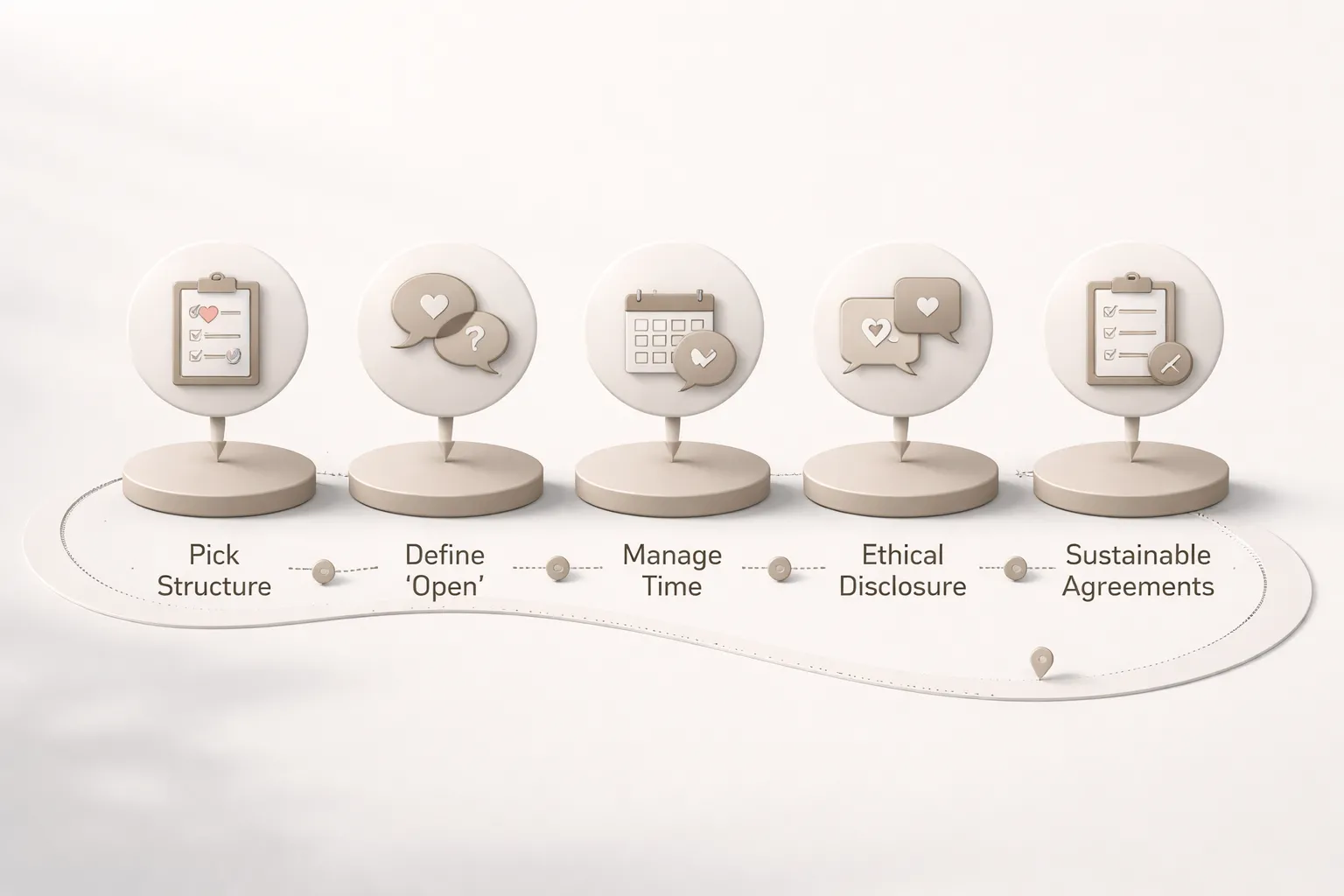
Step 1: Pick a structure
Decide how you will meet others. Keep the first version simple.
- Date together. You meet partners as a couple. You share context and pace. You limit privacy.
- Date separately. Each of you dates on your own. You need stronger trust and clearer reporting rules.
- Casual only. Sex, flirting, and light connection. No building a second relationship.
- Ongoing partners. Repeat partners, routines, and deeper bonds. You need more time and clearer expectations.
Write your choice in one sentence. Add what you will not do in one sentence.
Step 2: Define what “open” means for you
Use a checklist. Agree on each item in plain language.
- Sex-only or dating. Sex without dates, dates without sex, or both.
- Overnights. Allowed, limited, or not allowed.
- Emotional connection. Allowed, allowed with limits, or treated as a stop sign.
- Kissing and intimacy. What counts as sex for you, what counts as cheating for you.
- Location rules. Home allowed or not. Hotels only or not.
- Alcohol and substances. What is allowed before sex. What cancels plans.
- Safer sex basics. Condoms, dental dams, gloves, and lube. No exceptions.
- Testing. How often you test, what you test for, and what happens after an exposure risk.
- Pregnancy prevention. Method, backups, and what you will do if a failure happens.
Step 3: Time and attention management
Time causes more damage than sex. Protect your primary relationship first.
- Set a weekly minimum. One planned date night that you do not cancel for other partners.
- Use a shared calendar. Put dates in the calendar before you confirm with someone new.
- Cap the pace. Limit new dates per week. Limit late nights. Limit messaging during couple time.
- Define response norms. When you reply to your partner during dates, and when you do not.
- Aftercare window. Reserve 30 to 90 minutes after a date to reconnect, debrief, and sleep.
If you tend to overbook, treat this like travel planning. Book early, block time, and stick to the plan.
Step 4: Introduce new partners ethically
Tell the truth early. Do not recruit people into your rules after they get attached.
- Disclose your status upfront. Say you are in an open relationship, before flirting turns sexual.
- State your structure. Together or separate dating, casual or ongoing, and any hard limits.
- Set expectations. How often you can meet, what you can offer, and what you cannot.
- Consent and privacy. Ask what they want shared, what stays private, and how you store messages and photos.
- Respect their boundaries. Do not pressure them into secrecy, threesomes, or “being chill.”
If you want community-based options, use a clear code of conduct. Your safety improves when norms are explicit.
Step 5: Build sustainable agreements
Use agreements you can follow on your worst day. Keep them observable.
- Schedule check-ins. Weekly for the first two months. Then every two weeks.
- Use a fixed agenda. Feelings, logistics, boundaries, health, next steps.
- Track key data. Number of dates, sleep loss, stress, jealousy triggers, and repair time.
- Renegotiate fast. If a rule breaks twice, replace it with a rule you will follow.
- Repair first. Apologize, name the impact, set one concrete change, then pause new dates if needed.
| Topic | Beginner default | Change trigger |
|---|---|---|
| New partners | 1 new person at a time | Hiding, rushing, or constant conflict |
| Overnights | Pause for 30 days | Sleep loss, distance, or anxiety spikes |
| Health | Condoms, testing schedule | Any exposure risk or unclear consent |
| Time | Weekly couple date, shared calendar | Cancelled plans or resentment |
| Communication | Short debrief, then rest | Interrogations, shutdown, or spirals |
If you want a safer on-ramp with clearer venue rules and less ambiguity, start with a structured social setting. See the guide at Swinger Lifestyle Guide: Finding Community & Staying Safe.
Safety 101: Consent, Communication, Privacy, and Sexual Health
Most blowups come from four gaps, consent, communication, privacy, and sexual health. Fix these early and you cut risk fast. You need shared rules, clear signals, and a plan for what happens when someone freezes or changes their mind. You also need a tight privacy setup, phones, photos, names, and what you share with friends. Health needs the same structure, testing cadence, condom rules, and what counts as a dealbreaker. Swinging often adds venue policies and social norms. Open relationships often add ongoing emotional and messaging boundaries. The details matter, because your rules fail under stress if they are vague. Use the checklist mindset and you stay calm when things get real.
- Consent: define yes, no, and stop words, agree on who can ask whom, and stop on the first hesitation.
- Communication: set a pre-brief and a short debrief, name hard limits, and track triggers and aftercare needs.
- Privacy: agree on names, face photos, location sharing, and what gets posted or saved.
- Sexual health: align on testing frequency, barrier use, birth control, and what happens after a scare.
Read our detailed guide: Swinging vs Open Relationships: Safety & Key Differences
Common Beginner Mistakes (and How to Avoid Them)

Moving Too Fast: Skipping Conversations and Jumping Into Experiences
The most common mistake is treating your first experience like a test you have to pass. You book the date. You go to the party. You “figure it out” in the moment. Then you get surprised by jealousy, pressure, or regret.
Slow down on purpose. Talk first. Your first “yes” should be to a conversation, not to a person.
- Do a pre-brief. Decide what “good” looks like tonight. Name your hard limits. Agree on a stop word or signal.
- Start with lower-stakes steps. Try flirting only. Or a club visit with no play. Or a coffee meet before anything sexual.
- Plan aftercare. Decide how you will reconnect after. This matters even if you think you will be “fine.”
- Give yourselves permission to leave. You never owe anyone a follow-through. Leaving is a win if it protects trust.
Rule Overload vs No Rules: Finding Workable, Values-Based Agreements
Beginners often swing between extremes. You either create a long list of rules that collapses under real life. Or you say “no rules” and hope vibes will do the job. Both create stress.
A better approach is fewer agreements that match your values. Make them clear. Make them doable. Make them reviewable.
- Pick your “why.” Are you doing this for novelty, connection, bisexual exploration, or shared adventure? Your agreements should protect that goal.
- Use a small set of core agreements. Examples: barrier use always, no sleepovers, no solo dates, or no repeat meets without a check-in.
- Define what counts. “No sex” means what, exactly? Oral? Hands? Toys? Kissing? Spell it out.
- Set a review date. Agree to revisit after the first event, and again after one month. You are allowed to update your plan.
Unclear Boundaries: Vague “Don’t Catch Feelings” (and Why It Backfires)
“Don’t catch feelings” sounds simple. It is also unrealistic. Feelings happen. Attraction happens. Attachment can happen. When your only boundary is “don’t feel,” you set yourselves up for secrecy and shame.
Instead, make boundaries about behavior and honesty. You can’t control emotions. You can control choices.
- Replace vague rules with specific actions. Examples: no daily texting, no private emotional venting to a partner, no one-on-one overnights, or no “relationship talk” with new partners.
- Define emotional red flags early. If you notice hiding, deleting messages, or prioritizing someone else, that is your cue to pause.
- Agree on disclosure. Decide what you share about crushes and connection, and when you share it. A weekly check-in works for many couples.
- Make room for reality. If feelings grow, the plan is not panic. The plan is a conversation and a reset.
Poor Partner Selection: Red Flags to Avoid
Who you choose matters more than the label you use. Many bad experiences come from picking unsafe people, not from swinging or open relationships themselves.
Look for partners who respect consent, move at your pace, and communicate clearly. Walk away fast from pressure.
- Coercion. Any pushing, guilt, or “come on, you said you were open-minded” is a hard no.
- Secrecy. If they hide a spouse, dodge questions about agreements, or “can’t be seen,” you risk drama and harm.
- Boundary-pushing. They test small limits to get bigger ones. They “forget” condoms. They keep trying after you say no.
- Love-bombing. Instant intensity, rushing exclusivity, or trying to isolate you from your partner is a warning sign.
- Bad consent habits. They touch without asking. They drink too much. They dismiss safer-sex conversations.
Choose slow, respectful, and consistent. A good match will make safety feel easy, not awkward.
Not Debriefing: How Resentment Builds Without Structured Check-Ins
Skipping the debrief is how small discomfort turns into big resentment. You try to “be chill.” You avoid bringing it up. Then your brain fills in the blanks with worst-case stories.
Debriefing is not a trial. It is maintenance. Do it even after a great night.
- Do a short same-day check. Ask: “Are you okay?” “Anything feel off?” “What do you need tonight?” Keep it gentle.
- Do a deeper 24–72 hour debrief. Emotions can arrive late. Make space for that.
- Use a simple structure. Share: one good thing, one hard thing, one boundary tweak, one aftercare request.
- Track triggers and patterns. Jealousy often has a specific cause. Maybe it is being left alone, certain acts, or secrecy around texting.
- End with reassurance. Say what you appreciated. Confirm you choose each other. Make the next plan together.
Key Takeaways: Choosing a Path and Starting Safely
- In het kort: Choose the structure that matches your values. Start slow. Keep talking. Protect your bond.
- Know what you want. Swinging is often about shared sexual experiences. Open relationships can include separate dating and feelings. Pick the one that fits your goals.
- Start with clear boundaries. Decide what is on the table. Decide what is off limits. Set rules for safer sex, texting, sleepovers, and repeats.
- Go slower than you think. Try a low-stakes step first. Flirting at a party. A soft swap. A date with a hard stop time. Build comfort over time.
- Make consent the standard. No pressure. No “just this once.” You can pause anytime. You can change your mind mid-scene or mid-date.
- Plan for aftercare. Decide how you will reconnect. Cuddles. A shower together. A quiet ride home. A check-in the next morning.
- Debrief with a simple structure. Share one good thing. Share one hard thing. Share one boundary tweak. Share one aftercare request.
- Expect delayed feelings. You may feel fine at first. Emotions can arrive late. Make space for that without blame.
- Track triggers and patterns. Jealousy is often specific. It might be being left alone. Certain acts. Secrecy around texting. Name the real cause.
- Keep communication clean. Say what you need. Ask direct questions. Avoid mind reading. Confirm agreements in plain language.
- Protect your privacy and safety. Use protection. Test regularly. Share STI status. Use separate messaging if needed. Do not overshare about others.
- End talks with reassurance. Say what you appreciated. Confirm you choose each other. Make the next plan together.
- Get help early if you feel stuck. If conflict loops, consider a sex-positive therapist or coach. Do it before resentment builds.
FAQ: Swinging vs Open Relationships for Beginners
Is swinging the same as an open relationship?
No. Swinging usually means sex with others, often together, and often with clear limits. Open relationships vary more. They can include dating, emotional bonds, or separate partners. Your rules define what “open” means for you.
Which is better for beginners?
If you want shared experiences and clear boundaries, swinging can feel simpler. If you want more freedom and solo connections, open relationships may fit better. Start with the option that matches your values, jealousy triggers, and time limits.
Do you have to date in an open relationship?
No. Some open relationships are sex-only. Others include dating and emotional intimacy. Decide what you allow before you start. Be specific about sleepovers, repeated partners, and whether romance is okay.
Do swingers fall in love with other people?
Most swinging is designed to avoid romantic entanglement. But feelings can happen. Talk about what to do if emotions grow. Agree on check-ins, pacing, and when to pause. Do not ignore early attachment signs.
Can you do swinging without swapping?
Yes. Many couples do soft swap, separate-room play, or same-room only. Some only watch or flirt. You choose what feels safe. Consent can change at any moment. “No” must always be easy to say.
Can an open relationship still be monogamous emotionally?
Yes. Some couples keep emotional exclusivity while allowing sex with others. But emotional lines are blurry. Define what counts as “emotional cheating” for you. Clarify texting, pet names, daily check-ins, and dates.
What rules should you set first?
Start with safer sex, privacy, and communication. Decide condom use, testing frequency, and STI disclosure. Set boundaries for sleepovers, repeat partners, and messaging. Plan how you will pause if either of you feels overwhelmed.
How do you handle jealousy?
Expect it sometimes. Name the trigger. Ask for reassurance, not punishment. Use check-ins after every experience. Start small and go slow. If jealousy turns into control or panic, pause and talk before you continue.
How do you stay safe with new partners?
Use barriers, test regularly, and share STI status. Avoid alcohol-heavy first meets. Meet in public first if solo. Use separate messaging if needed. Protect identities and do not overshare about other people without permission.
What if one partner wants it more than the other?
Do not “compromise” with pressure. Go at the speed of the slower partner. Try smaller steps, like flirting or a club visit. If it keeps feeling one-sided, pause. A therapist or coach can help early.
When should you stop or pause?
Pause if trust drops, anxiety spikes, boundaries get “tested,” or talks become fights. Stop if consent is unclear or you feel coerced. Take a break and reconnect. Agree on a reset plan before you try again.
Conclusion: Your Next Safe Step (Pick One Small Action)
Conclusion: Your Next Safe Step (Pick One Small Action)
You do not need to decide everything today. You need one safe next step. Keep it small. Keep it mutual. Keep it clear.
If trust has dipped, anxiety has spiked, or boundaries have been “tested,” pause. If consent feels unclear or you feel pushed, stop. Take a break and reconnect before you try again. Agree on a reset plan first.
Your one small action: Schedule a 20-minute check-in this week. Use a timer. Each of you answers the same three questions.
- What feels exciting right now?
- What feels scary or off-limits right now?
- What is one tiny step we both feel good about this month?
End the talk by choosing one simple “yes” and one clear “no.” Then stop there. That is progress.
-
Swingers Lifestyle Guide: Safety, Etiquette, and Consent
1 month ago -
Swinging vs Open Relationships: Emotional Impact Explained
1 month ago -
Swinging Consent and Boundaries: Safer Sex & Comfort
1 month ago -
How to Debrief After Swinging: Break Jealousy Loops
1 month ago -
How to Debrief After Swinging: Fix Resentment Early
1 month ago
-
- Definitions: Swinging, Open Relationships, Non Monogamy
- Typical Goals: Novelty vs Flexible Relationship Structures
- Emotional Boundaries: “No Feelings” vs “Feelings Allowed”
- Logistics: Together vs Separate, Events vs Apps, Frequency
- Key Differences at a Glance
- Common Misconceptions That Cause Problems
- Who Each Model Tends to Fit Best
-
-
- Moving Too Fast: Skipping Conversations and Jumping Into Experiences
- Rule Overload vs No Rules: Finding Workable, Values-Based Agreements
- Unclear Boundaries: Vague “Don’t Catch Feelings” (and Why It Backfires)
- Poor Partner Selection: Red Flags to Avoid
- Not Debriefing: How Resentment Builds Without Structured Check-Ins
- Key Takeaways: Choosing a Path and Starting Safely
-
- Is swinging the same as an open relationship?
- Which is better for beginners?
- Do you have to date in an open relationship?
- Do swingers fall in love with other people?
- Can you do swinging without swapping?
- Can an open relationship still be monogamous emotionally?
- What rules should you set first?
- How do you handle jealousy?
- How do you stay safe with new partners?
- What if one partner wants it more than the other?
- When should you stop or pause?
-
- Definitions: Swinging, Open Relationships, Non Monogamy
- Typical Goals: Novelty vs Flexible Relationship Structures
- Emotional Boundaries: “No Feelings” vs “Feelings Allowed”
- Logistics: Together vs Separate, Events vs Apps, Frequency
- Key Differences at a Glance
- Common Misconceptions That Cause Problems
- Who Each Model Tends to Fit Best
-
-
- Moving Too Fast: Skipping Conversations and Jumping Into Experiences
- Rule Overload vs No Rules: Finding Workable, Values-Based Agreements
- Unclear Boundaries: Vague “Don’t Catch Feelings” (and Why It Backfires)
- Poor Partner Selection: Red Flags to Avoid
- Not Debriefing: How Resentment Builds Without Structured Check-Ins
- Key Takeaways: Choosing a Path and Starting Safely
-
- Is swinging the same as an open relationship?
- Which is better for beginners?
- Do you have to date in an open relationship?
- Do swingers fall in love with other people?
- Can you do swinging without swapping?
- Can an open relationship still be monogamous emotionally?
- What rules should you set first?
- How do you handle jealousy?
- How do you stay safe with new partners?
- What if one partner wants it more than the other?
- When should you stop or pause?
-
How to Debrief After Swinging: Break Jealousy Loops
1 month ago -
How to Repair Trust After a Boundary Is Broken
1 month ago -
How to Debrief After Swinging: Fix Resentment Early
1 month ago -
Aftercare & Support in Swinging: Red Flags and Resources
1 month ago -
Swinging Consent and Boundaries: Safer Sex & Comfort
1 month ago
-
Ethical Non‑Monogamy Terms: A Glossary of Common ENM Language
1 month ago -
How to Talk to Your Partner About Swinging (Without Pressure)
1 month ago -
Swinging Rules and Boundaries: Examples, Scripts, and Best Practices
1 month ago -
What Is the Swingers Lifestyle? A Beginner-Friendly Guide
1 month ago -
Swinging First Time Checklist: What to Do Before, During, and After
1 month ago