How to Debrief After Swinging With Your Partner (A Simple Framework)

Sex ends. Impact stays.
A debrief is the talk you have after swinging to lock in what worked, surface what hurt, and set the next boundary before resentment builds. Skip it and you rely on guesses. Guesses create fights, shutdowns, and rule creep.
This framework solves three common problems. You forget details and argue about what happened. You avoid hard points and carry tension into daily life. You make changes in the moment, then regret them later.
You will learn a simple, repeatable debrief that takes 15 to 30 minutes. You will cover facts, feelings, triggers, wins, and next steps. You will leave with clear yeses and nos for the next time, or a clean pause if you need it.
What is how to debrief after swinging with your partner?
Definition
Debriefing after swinging is a structured check-in you do after play.
You use it to process emotions, confirm consent, and align on boundaries.
You cover what happened, what you felt, what worked, what hurt, and what you want next time.
You keep it short and repeatable. You aim for clarity, not perfection.
What a debrief is not
- Not an interrogation. You do not cross-examine your partner for details to calm anxiety.
- Not a blame session. You do not argue your way to a winner and a loser.
- Not a performance review. You do not score bodies, sex acts, or compare partners.
- Not a rule dump. You do not add ten new restrictions while you feel raw.
- Not therapy. You do not try to solve years of insecurity in one talk.
If jealousy shows up, treat it as data. Use tools and language that lower threat and build safety. See /how-to-handle-jealousy-in-swinging-practical-tools-that-work.html.
When to debrief
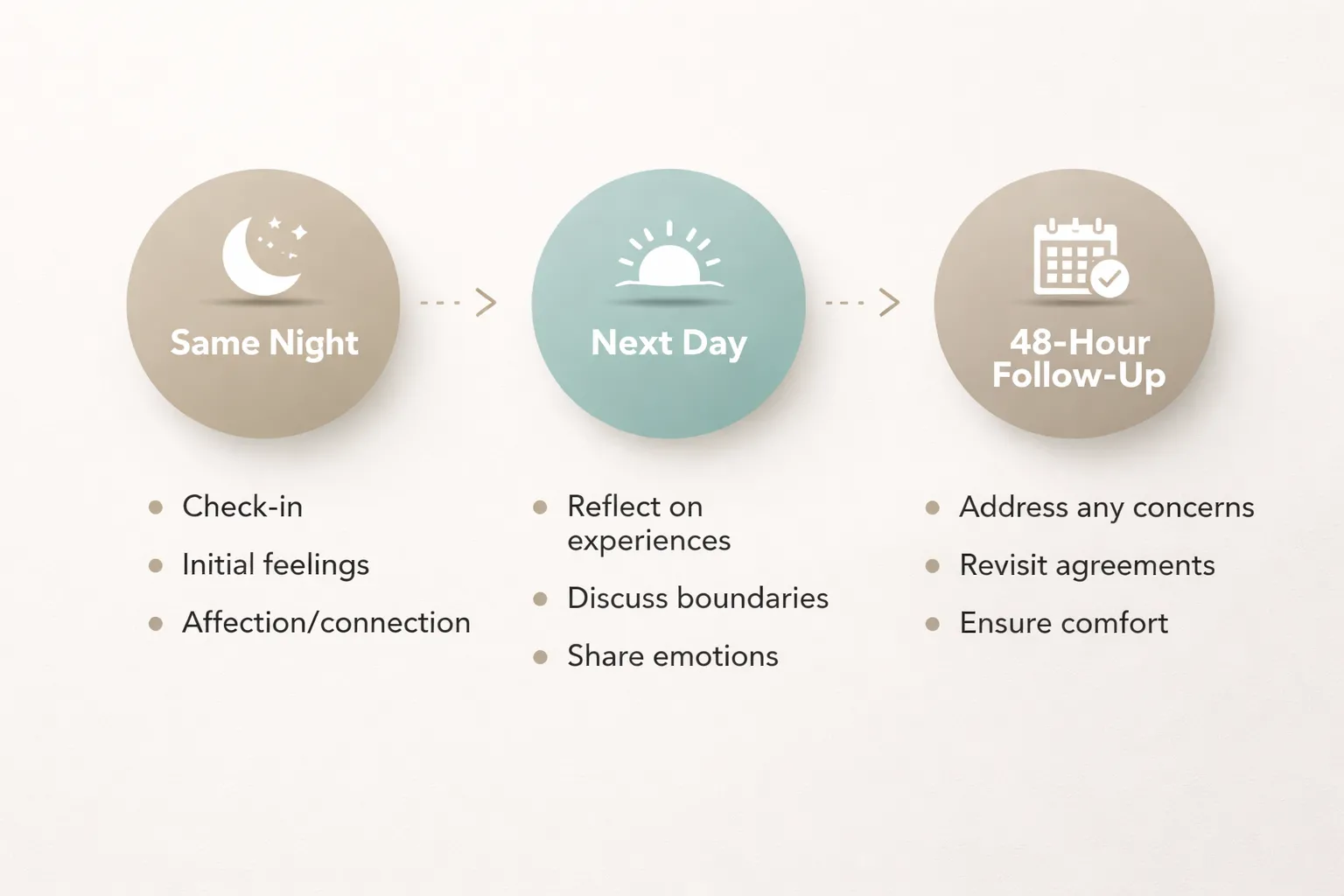
Timing changes the quality of the conversation. Use three windows.
| Time | Best for | Keep it to |
|---|---|---|
| Same night | Safety, reassurance, quick consent check, sleep without tension | 5 to 10 minutes |
| Next day | Clear recall, calmer emotions, practical boundary updates | 15 to 30 minutes |
| 48-hour follow-up | Delayed feelings, jealousy spikes, second thoughts, deeper meaning | 10 to 20 minutes |
Do the same-night version even if you plan a full talk later. It prevents distance and guessing.
Save rule changes for the next-day or 48-hour talk. Write them down and add them to your shared boundaries list. See /swinging-rules-and-boundaries-examples-scripts-and-best-practices.html.
Outcomes to aim for
- Reassurance. You confirm you are good, you are chosen, and you are safe.
- Clarity. You leave with clear yeses, nos, and maybes for next time.
- Learnings. You name triggers, limits, and conditions that help you feel steady.
- Reconnection. You end with a small action that restores closeness, touch, time, or aftercare.
A good debrief produces decisions. It reduces repeats of the same conflict.
Before you talk: set the conditions for a calm, honest debrief
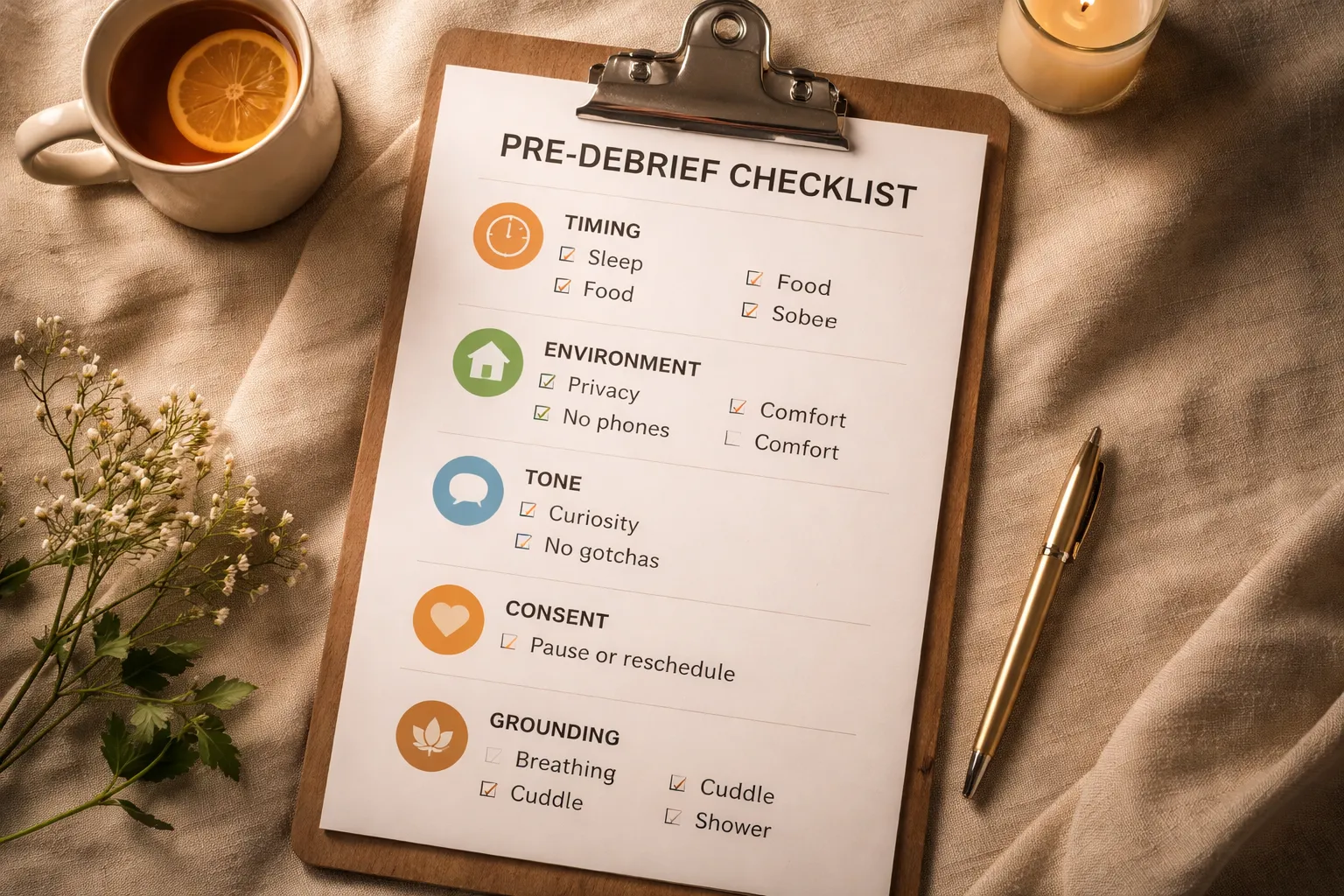
Timing: pick a window your body can handle
Do not debrief when you are depleted. You will fight about tone instead of facts.
- Sleep: If either of you is tired, schedule the debrief for the next day. Pick a time you can both show up.
- Hydration and food: Drink water first. Eat something simple. Low blood sugar makes small comments land like threats.
- Sobriety: Debrief sober. Alcohol and other substances distort memory, inflate confidence, and drop empathy. If you drank, wait until you are clear headed.
If you need same night reassurance, keep it short. Confirm you are okay. Save the analysis for later. For more prep and pacing, see your first time checklist.
Environment: protect privacy and attention
- Privacy: No roommates, kids, or friends nearby. No shared walls if you worry about being overheard.
- No phones: Put devices on silent, face down, and out of reach. No scrolling. No “quick reply”.
- Comfort: Sit somewhere soft. Have water nearby. Keep the lights low if that helps you stay regulated.
Tone agreement: curiosity first
Set the rules before content. Keep the goal simple. Understand what happened, then decide what changes.
- Curiosity first: You each describe your experience. You do not argue the other person’s feelings.
- No gotchas: No cross examination. No loaded questions. No “you said you were fine”.
- One topic at a time: Do not stack issues. Finish one, then move to the next.
- Use clean language: “I felt”, “I noticed”, “I needed”. Avoid labels and character attacks.
If jealousy is in the room, name it early and treat it like a signal, not a verdict. Use tools from how to handle jealousy in swinging.
Consent to debrief: either partner can pause
Debriefing needs consent. If one of you feels flooded, you will not get truth. You will get survival answers.
- Ask for a yes: “Do you have bandwidth to talk for 20 minutes?”
- Either person can pause: Use a clear phrase. “Pause. I am getting overwhelmed.”
- Reschedule with a time: Do not leave it open ended. Pick a specific time within 24 to 72 hours.
- Keep a minimum: Even if you delay, do a short check in. Confirm care, safety, and sleep plan.
If you struggle to start these talks without pressure, use the structure in how to talk to your partner about swinging.
Quick grounding: a 2-minute reset before you start
Take two minutes to bring your nervous system down. You will speak cleaner and listen better.
- Breathing: Inhale through your nose for 4. Exhale for 6. Repeat 8 to 10 cycles.
- Cuddle: Sit hip to hip. One hand on chest, one on back. Match breathing for one minute.
- Shower: Warm water for two minutes. Focus on sensation. No replaying the night.
Then begin. If you need more support for the emotional come down, read aftercare in swinging.
The Simple Debrief Framework (7 steps you can reuse every time)
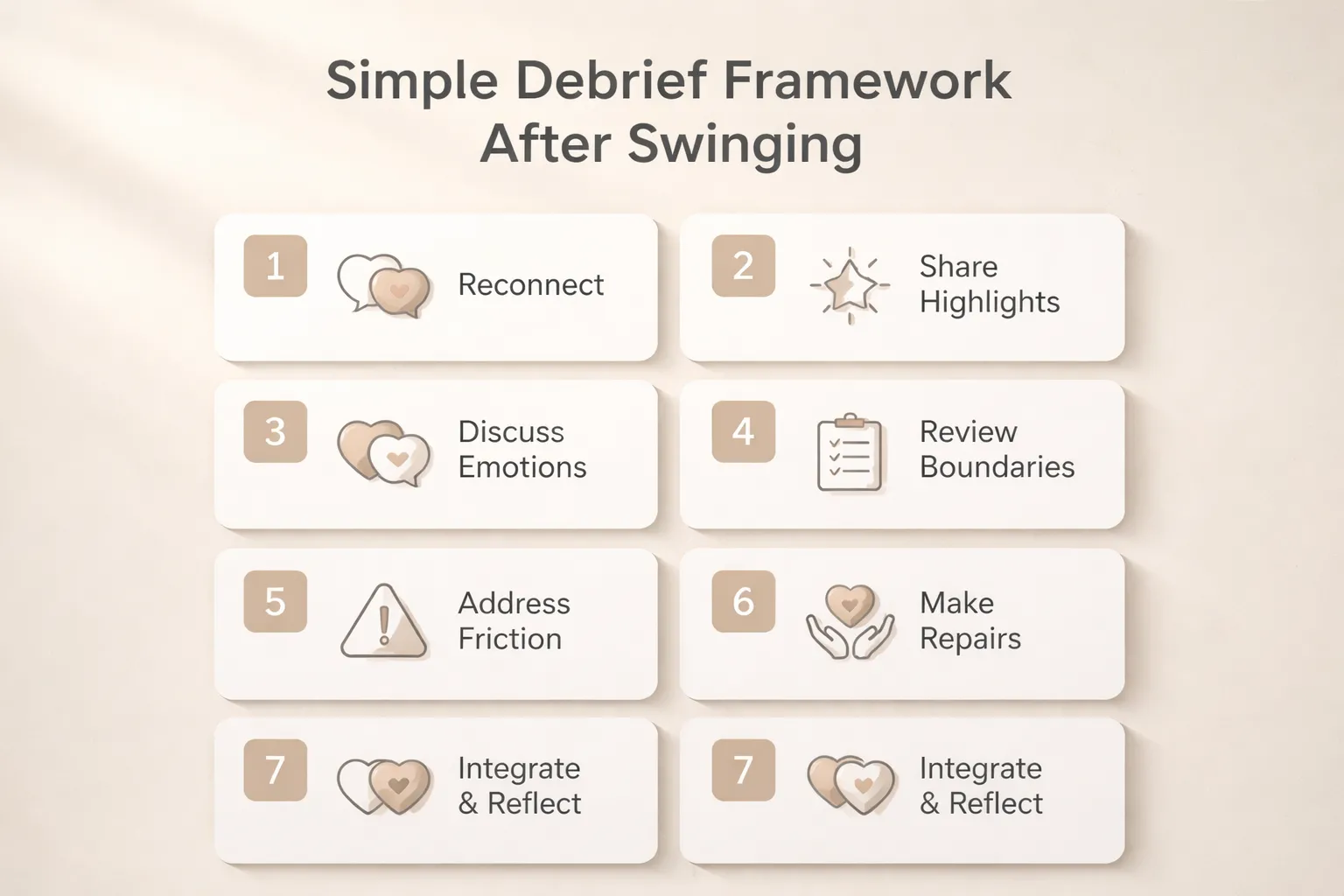
Step 1, Reconnect first
Start with safety. Make it clear you are a team.
- 30 second reset: Hold hands, eye contact, slow breathing.
- Say the signal: “We’re good.” “I’m with you.” “I love you.”
- Affection first: Cuddle, kiss, or sit close before details.
- Set the container: “10 minutes now, then sleep.” Or “We talk tomorrow at 3.”
If one of you feels shaky, delay the play by play. Do reassurance only.
Step 2, Highlights
Lock in what worked. This builds trust and repeatable wins.
- Each share 3 highlights. Keep them short.
- Include bonding moments. “When you checked in.” “When you squeezed my hand.”
- Name what you want again. “I want more slow kissing with you first.”
Do not correct your partner’s highlights. Let them have their experience.
Step 3, Body and emotions scan
Report. Do not debate.
- Body: Tired, wired, relaxed, tense, sore, hungry, nauseous.
- Emotions: Happy, proud, anxious, jealous, sad, embarrassed, numb.
- Intensity: Rate each big feeling 0 to 10.
Use “I feel” statements. Skip “because you.” Save causes for later.
Step 4, Consent and boundaries review
Confirm what stayed inside your agreement. Catch surprises fast.
- Green: What was clearly within rules.
- Yellow: What felt unclear in the moment.
- Red: What crossed a line.
Use facts. Time, place, who did what. Keep tone neutral. If you need to update your agreements, capture it and move on. If you are newer, review your baseline rules in this beginner guide.
Step 5, Friction points
Name the hard parts with gentle language. Focus on triggers, not blame.
- Jealousy: “I felt a spike when I saw X. I need help with Y next time.”
- Insecurity: “I compared myself. I need reassurance about Z.”
- Awkward moments: “I got overwhelmed when the pace changed.”
- Stuck thoughts: “I keep replaying one scene. I need grounding.”
One issue at a time. No pile on. If feelings are about another couple, read how to handle feelings for another couple in swinging.
Step 6, Repairs and requests
Turn friction into action. Repairs come before rule changes.
- Apology: “I’m sorry I did X. Next time I will do Y.”
- Reassurance: “You matter most. I choose you.”
- Request: “During play, check on me every 15 minutes.”
- Support: “If I freeze, I want you to pause and hold me.”
Make requests specific. Avoid mind reading. If you need a longer plan, tie it to your aftercare routine.
Step 7, Integrate
Decide what happens next. Keep it simple and clear.
Schedule the next debrief. Put it on the calendar. If you swing long distance, build this into your routine, see swinging for long distance couples. When you do this well, you protect the parts that make some couples thrive, see benefits of swinging for couples.
Common debrief pitfalls (and better alternatives)
Pitfall: Assuming you know what your partner felt
You will guess wrong. Guessing turns the debrief into debate.
Use open questions. Then mirror back what you heard.
- Ask: “What felt good?” “What felt off?” “What do you want more of next time?”
- Clarify: “When you say ‘weird,’ do you mean jealous, unsafe, or disconnected?”
- Reflect: “I heard you felt left out when I stayed in that room longer.”
Pitfall: Scorekeeping or comparisons
Scorekeeping kills teamwork. Comparisons create a winner and a loser.
Move the focus to needs and boundaries. Name the next-step rule.
- Replace: “You got more attention than me.”
- With: “I need more check-ins when we split up.”
- Set: “If one of us feels off, we reunite within 5 minutes.”
If jealousy shows up, treat it as information. Use practical tools from how to handle jealousy in swinging.
Pitfall: Debriefing while intoxicated or exhausted
Alcohol, weed, and no sleep lower accuracy and raise defensiveness. You will misread tone. You will escalate faster.
Do a short safety check. Then schedule a real follow-up.
- Now: “Are you safe with me?” “Do you need touch or space?” “Any urgent boundary fixes for tonight?”
- Later: Put a 30 to 45 minute debrief on the calendar within 24 to 48 hours.
- Rule: No big decisions at 1 a.m.
Pitfall: Making it all negative
A debrief that feels like a trial makes you avoid the next one.
Use a simple ratio. Two positives before one hard thing.
- Positive: “I liked how you checked in with me at the bar.”
- Positive: “I felt proud of us leaving when we said we would.”
- Hard thing: “I felt disconnected when we stopped texting after the split.”
Pitfall: Over-sharing explicit details that trigger
Details can help. Details can also spike images you cannot unsee.
Agree on your detail level before you trade play-by-play.
| Detail level | What you share |
| Low | High-level summary, emotions, and any boundary issues. |
| Medium | Key moments, safer-sex info, and what you want next time. |
| High | Explicit specifics, only if both of you want it. |
- Script: “Do you want high-level or details?”
- Stop word: Use one word that ends detail sharing fast.
Pitfall: Avoiding hard topics to “keep peace”
Silence does not remove the problem. It stores it.
Use a time-boxed check-in so the talk stays contained.
- Set the timer: 15 minutes.
- Order: one issue, one request, one boundary update.
- Close: “What is one small change we try next time?”
- Schedule: If you need more, book a second block.
If you struggle to raise the topic without pressure, use the scripts in how to talk to your partner about swinging.
Reconnection and aftercare: closing the loop so you feel secure again
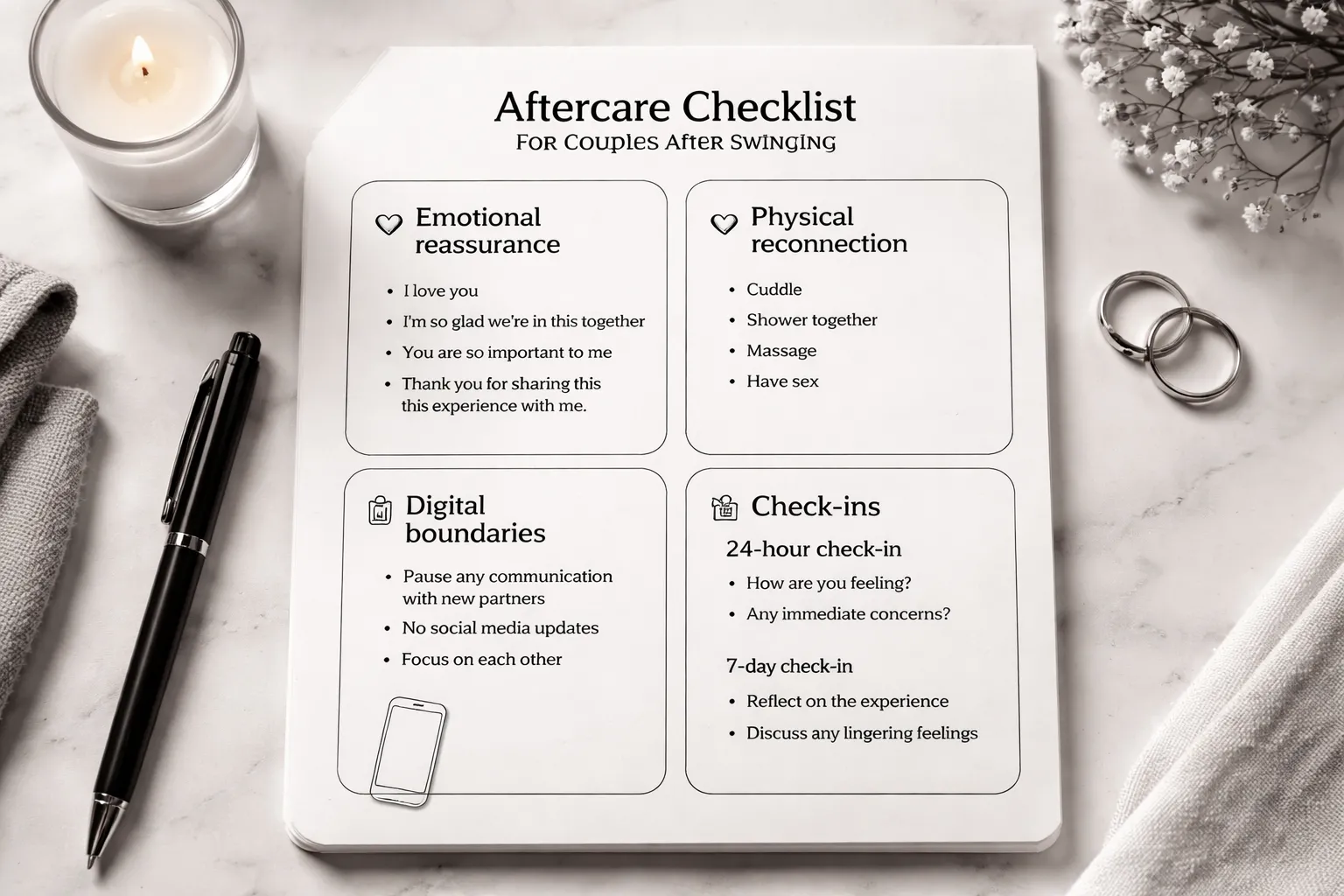
Emotional aftercare: reassurance, gratitude, validation
You need closure. You also need safety. Do both on purpose.
Start with reassurance. Keep it direct.
- Commitment: “I choose you. I am here.”
- Security: “We are okay. We can handle this.”
- Priority: “You come first. Our relationship comes first.”
Add gratitude. Name actions, not traits.
- “Thank you for checking in with me during the night.”
- “Thank you for stopping when I looked overwhelmed.”
- “Thank you for following our safer sex rules.”
Validate feelings without debating facts.
- “I get why that hit you.”
- “That makes sense. I hear you.”
- “I can see you felt left out.”
If you need repair, keep it clean and specific.
- “I am sorry I missed your cue. Next time I will check in at the bar every 30 minutes.”
- “I should not have agreed to that. Next time I will say no and look at you first.”
If you want a deeper guide, read aftercare in swinging.
Physical reconnection: cuddle, shower, slow intimacy or rest
Your nervous system may stay activated after a high intensity night. Reconnection helps it settle.
- Low effort: water, food, clean sheets, lights low, phones away.
- Touch: hold hands, cuddle, spoon, feet touching in bed.
- Reset: shower together, wash hair, slow breathing.
- Intimacy: slow sex if both want it, or no sex and sleep.
Use consent here too. Ask once. Accept the answer.
- “Do you want to be held or do you want space?”
- “Do you want to shower together or solo?”
- “Do you want sex, cuddles, or sleep?”
Digital and social aftercare: messages, privacy, pace
Post event texting can trigger insecurity fast. Set a pace you both can tolerate.
- Message window: agree on a time to send follow ups, or agree to wait until morning.
- Content rule: keep it polite and brief if one of you feels raw.
- Visibility: decide what you share with each other, screenshots, read together, or summaries only.
- Privacy: do not share names, photos, or details outside your agreements.
If you need structure, add this to your rules list in swinging rules and boundaries.
Simple script for follow up.
- “Thanks for tonight. We got home safe. We will reach out after we debrief.”
24-hour and 7-day check-ins: what to revisit after feelings settle
Do a short check in the next day. Do a second check in one week later. Timing matters because feelings change after sleep, food, and distance.
| Timing | What to cover | Output |
|---|---|---|
| Within 24 hours | big feelings, triggers, any regret, what helped, what hurt | one comfort request, one boundary update |
| 7 days | lingering jealousy, comparisons, trust, desire to repeat or pause | decision for next step, go again, adjust, or take a break |
Keep both check ins time boxed. Use the one issue, one request, one boundary update format from the debrief.
If you skipped key questions before the event, add them now and write your answers. Use questions couples should ask before swinging as your template.
When to take a break: signs you need more time or support
Take a break when the cost outweighs the benefit. Do not push through.
- You cannot sleep or eat after events.
- You replay scenes and feel stuck.
- You start checking phones, tracking, or testing each other.
- You feel dread before the next plan.
- You need alcohol or drugs to get through it.
- You keep breaking agreements, then apologizing.
- You argue for days after every meet.
- One partner agrees to avoid conflict.
Call a pause with a clear time frame and a clear goal.
- “We pause for 30 days. We focus on sleep, intimacy, and trust. We revisit on date night.”
If you decide to close the relationship, use how to stop swinging and close the relationship without resentment.
When the debrief reveals bigger issues (jealousy loops, boundary breaks, or resentment)
Some debriefs do not lead to clarity. They expose a pattern. Jealousy that repeats and escalates. Boundaries that “slip” and then get minimized. Resentment that shows up as shutdown, sarcasm, or scorekeeping.
Track the signals. Treat them as data. If you keep rehashing the same fight after each meet, you do not have a debrief problem. You have a trust and alignment problem.
- Jealousy loop: a trigger, a story, a protest, then a new rule that fails.
- Boundary break: a clear agreement, a violation, then a repair that never fully lands.
- Resentment: one partner keeps “agreeing” but stops feeling safe to say no.
Pause. Set a time frame. Set a goal. Tighten consent and communication rules. Use a written agreement, and review it before any meet. If you need a baseline, use Swinging Consent and Communication: Tips to Stay Safe and Aligned.
Read our detailed guide: When the debrief reveals bigger issues (jealousy loops, boundary breaks, or resentment) - How to Debrief After Swinging With Your Partner (A Simple Framework)
- In het kort: Debrief within 24 hours, then again after a few days.
- In het kort: Start with facts, then feelings, then needs.
- In het kort: Name wins and misses, then set one rule change.
- In het kort: Log boundaries, triggers, and aftercare so you can spot patterns.
- In het kort: End with a clear next step, pause, repeat, or plan.
Key takeaways: the debrief checklist you can screenshot
- Timing: Debrief within 24 hours. Do a second check in 48 to 72 hours.
- Setup: Phones off. No alcohol. Set a 20 to 40 minute timer.
- Goal: Pick one goal, clarity, repair, or next time planning.
- Step 1. Facts: What happened, in order. Keep it neutral. No mind reading.
- Step 2. Body check: Stress level 0 to 10. Jealousy 0 to 10. Safety 0 to 10.
- Step 3. Feelings: Name 1 to 3 feelings each. Use short labels.
- Step 4. Needs: Name 1 need each, reassurance, space, clarity, affection, or sleep.
- Step 5. Wins: What worked. What you want to repeat.
- Step 6. Friction: What felt off. Use one concrete example.
- Step 7. Boundaries: What boundaries held. What boundaries bent. What boundaries broke.
- Step 8. Consent: Any moment you felt pressured, frozen, or confused. Write it down.
- Step 9. Triggers: What set you off, texts, positions, attention, rooms, alcohol, or pacing.
- Step 10. Repair: Apology if needed. One request. One agreement.
- Step 11. Aftercare: What helps tonight, touch, food, shower, cuddle, solo time, or sleep.
- Step 12. Next step: Choose one, pause, repeat same rules, or adjust rules before the next meet.
| Write down | Keep it simple |
|---|---|
| Top 3 positives | Short phrases |
| Top 3 stress points | One example each |
| One boundary to tighten | Clear rule, clear action |
| One boundary to relax | Only if both want it |
| One aftercare plan | Tonight and tomorrow |
| One decision | Next meet date or pause length |
Tip: If you keep finding consent gaps or mixed signals, tighten your rules and write them down. Use Swinging Consent and Communication: Tips to Stay Safe and Aligned as your baseline.
FAQ
How soon should you debrief after swinging?
Debrief the same night if you both feel steady. Keep it short. If either of you feels flooded, sleep first and debrief within 24 hours. Set a time. Do not let it drift for days.
What if one of us wants to talk and the other does not?
Set a minimum check-in. Ten minutes. One feeling, one need, one next step. If you need more, schedule it. If you keep avoiding, pause play. Use a clearer script from How to Talk to Your Partner About Swinging (Without Pressure).
How do we handle jealousy during the debrief?
Name it fast. No blame. Say what triggered it, what you needed, and what you want next time. Then pick one rule change. If you need a baseline, use Swinging Consent and Communication: Tips to Stay Safe and Aligned.
What counts as a consent gap?
Any moment you felt unsure, pressured, rushed, or unclear. Any rule you bent without a clear yes. Any new act you did not pre-approve. Treat it as a stop sign. Tighten rules and write them down before the next meet.
Should we debrief with the other couple too?
Only if you both want it. Keep it simple. Confirm boundaries, safer sex, and future contact. Do not process your relationship in a group chat. Handle your emotions with your partner first.
How do we decide whether to pause or keep going?
Use one rule. If either of you feels unsafe or resentful, pause. Pick a length and a condition to restart. Example, two weeks plus a written rules update. If you proceed, set the next date and the exact boundaries.
What if the night was great but we feel weird the next day?
Expect a drop. Sleep, eat, hydrate. Do your aftercare plan. Then do a second debrief in 24 to 48 hours. Track what changed, triggers, and what support helped. Adjust your pace.
How do we debrief without turning it into a fight?
Use structure. One positive, one hard moment, one request. Speak in first person. No mind reading. No scorekeeping. If voices rise, stop for 20 minutes and return. If fights repeat, pause play.
What topics should we always cover?
Cover consent, boundaries, and safer sex first. Then emotions, highlights, and misses. End with one rule to tighten, one boundary to relax only if both want it, one aftercare plan, and one decision on next steps.
Any quick checklist we can use?
Use the Swinging First Time Checklist: What to Do Before, During, and After. Add a debrief note: what worked, what hurt, what changes. Keep it written and shared.
Conclusion: make debriefing part of your swinging routine
Make debriefing part of your swinging routine. It protects consent, boundaries, and trust. It also makes your next night smoother.
Set a fixed time. Debrief within 24 hours. Keep it short, 20 to 30 minutes. If one of you feels raw, do a 5 minute check in now and book the full talk for tomorrow.
- Use the same framework every time. Start with consent, boundaries, and safer sex. Then emotions. Then highlights and misses. End with one rule to tighten, one boundary to relax only if both want it, one aftercare plan, and one decision on next steps.
- Write it down. Keep a shared note with three lines, what worked, what hurt, what changes. This cuts repeat mistakes and stops memory fights.
- Act on one change. Pick one adjustment you can execute next time. Small, specific, and measurable.
If you are long distance, do the debrief on video and share the note. If feelings linger for another couple, name it early and set a pause rule. Use clear language and no pressure, the same skills you use when you first talk about swinging.
-
Questions Couples Should Ask Before Swinging (Boundaries, Safer Sex, Goals)
1 week ago -
Swinging Rules and Boundaries: Examples, Scripts, and Best Practices
1 week ago -
How to Talk to Your Partner About Swinging (Without Pressure)
1 week ago -
Swinging First Time Checklist: What to Do Before, During, and After
1 week ago -
Swinging Consent and Communication: Tips to Stay Safe and Aligned
1 week ago
-
- How soon should you debrief after swinging?
- What if one of us wants to talk and the other does not?
- How do we handle jealousy during the debrief?
- What counts as a consent gap?
- Should we debrief with the other couple too?
- How do we decide whether to pause or keep going?
- What if the night was great but we feel weird the next day?
- How do we debrief without turning it into a fight?
- What topics should we always cover?
- Any quick checklist we can use?
-
-
- How soon should you debrief after swinging?
- What if one of us wants to talk and the other does not?
- How do we handle jealousy during the debrief?
- What counts as a consent gap?
- Should we debrief with the other couple too?
- How do we decide whether to pause or keep going?
- What if the night was great but we feel weird the next day?
- How do we debrief without turning it into a fight?
- What topics should we always cover?
- Any quick checklist we can use?
-
-
Communication Skills for Beginners: Before, During, and After Play - Rules, Boundaries, and Consent: The Foundation of the Swingers Lifestyle - What Is the Swingers Lifestyle? A Beginner-Friendly Guide
1 week ago -
Safety and Etiquette: Health, Privacy, and Respect in Lifestyle Spaces - Rules, Boundaries, and Consent: The Foundation of the Swingers Lifestyle - What Is the Swingers Lifestyle? A Beginner-Friendly Guide
1 week ago -
Rules, Boundaries, and Consent: The Foundation of the Swingers Lifestyle - What Is the Swingers Lifestyle? A Beginner-Friendly Guide
1 week ago -
How Swingers Meet: Where to Find Community (Online and In-Person) - What Is the Swingers Lifestyle? A Beginner-Friendly Guide
1 week ago -
What Is the Swingers Lifestyle? A Beginner-Friendly Guide
1 week ago
-
What Is the Swingers Lifestyle? A Beginner-Friendly Guide
1 week ago -
Safety and Etiquette: Health, Privacy, and Respect in Lifestyle Spaces - Rules, Boundaries, and Consent: The Foundation of the Swingers Lifestyle - What Is the Swingers Lifestyle? A Beginner-Friendly Guide
1 week ago -
Questions Couples Should Ask Before Swinging (Boundaries, Safer Sex, Goals)
1 week ago -
Rules, Boundaries, and Consent: The Foundation of the Swingers Lifestyle - What Is the Swingers Lifestyle? A Beginner-Friendly Guide
1 week ago -
Swinging Rules and Boundaries: Examples, Scripts, and Best Practices
1 week ago