How to Handle Jealousy in Swinging: Practical Tools That Work

Jealousy shows up in swinging because your brain tracks risk. It scans for loss of attention, loss of status, and loss of safety. Sex with others can trigger all three. This reaction does not mean you are broken. It means your attachment system and threat system are doing their jobs.
You will learn why jealousy spikes in certain moments, what jealousy usually points to, and how to separate a normal signal from a real boundary problem. You will also learn the first tools to use before, during, and after a play situation so you can stay grounded, communicate fast, and protect your connection. If you want a deeper reset after a hard night, use a clear debrief plan. Read How to Debrief After Swinging With Your Partner.
What Does “How to Handle Jealousy in Swinging” Actually Mean?
Definition, What You Are Actually Managing
How to handle jealousy in swinging means you can notice jealousy fast, name what it is, and respond in a way that protects consent and your bond. You do not try to erase the feeling. You manage the meaning you give it and the actions you take next.
In swinging, jealousy often shows up as a mix of three states. Each needs a different tool.
- Jealousy, you fear losing attention, priority, or security with your partner.
- Envy, you want what your partner has, attention, ease, pleasure, or confidence.
- FOMO (some call it “swenvy”), you feel left out of an experience happening near you.
If you label the feeling wrong, you pick the wrong fix. Jealousy needs reassurance and clear agreements. Envy needs wants and requests. FOMO needs inclusion choices and pacing.
Common Triggers Unique to Swinging
Some triggers come from the setup, not from a broken relationship. You still need to treat them as real signals.
- Attention imbalance, your partner gets more interest, more touch, or more time.
- Comparison, you track bodies, skills, stamina, sounds, or how “wanted” each of you looks.
- Chemistry mismatch, your partner clicks fast with someone while you feel nothing with anyone.
- Rejection, you get a no from a couple, or you watch your partner get a yes.
- Rule friction, you see something that feels “too far” even if no rule got broken.
- Public visibility, a group space can add pressure, shame, and urgency.
Most of these triggers get worse when you skip consent check-ins or rely on vague rules. Tight, simple agreements help. So does a shared plan for pauses, exits, and aftercare. If you need a framework, review Swinging Consent and Communication: Tips to Stay Safe and Aligned.
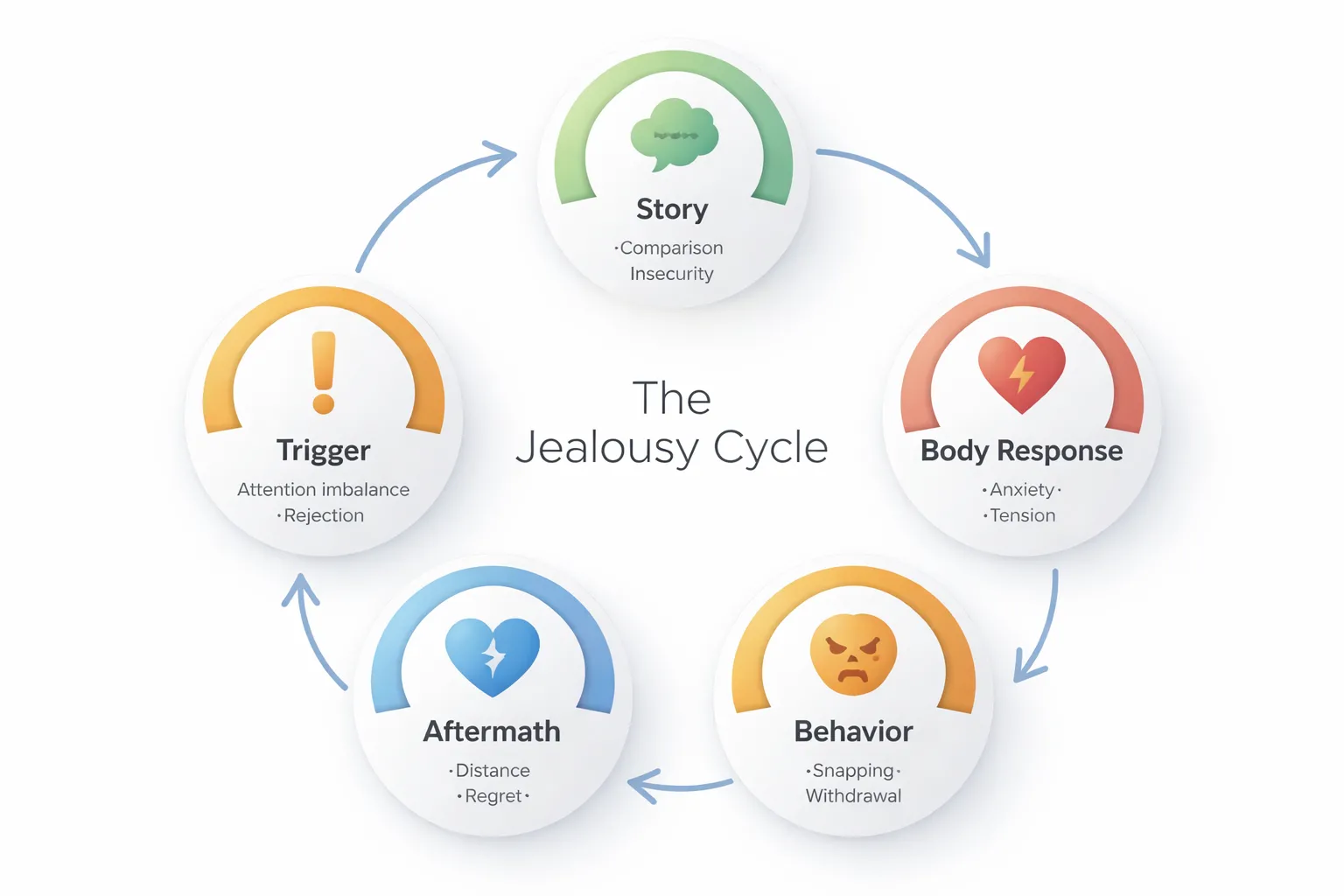
The Jealousy Cycle You Need to Interrupt
Jealousy runs in a predictable loop. You handle it by interrupting the loop early, before it drives your behavior.
| Stage | What happens | What to do |
| Trigger | You see or hear something that hits a fear or a need. | Name the trigger in one sentence. “I saw X. It hit Y.” |
| Story | Your brain fills gaps fast. “I am being replaced.” “They like them more.” | Replace certainty with data. Ask for one check-in, not a debate. |
| Body response | Heart rate up, tight chest, heat, nausea, dissociation. | Ground for 60 to 90 seconds. Slow exhale. Feel feet. Drink water. |
| Behavior | You cling, freeze, criticize, compete, shut down, or push for control. | Use a pre-agreed signal. Take a pause. Reduce stimuli. Move to a quieter spot. |
| Aftermath | Shame, resentment, spirals, or a hangover effect the next day. | Debrief with facts, feelings, needs, and one change for next time. |
“Handling” jealousy means you keep the problem small. You stop it from turning into blame, rule policing, or silent resentment. Done well, this supports the upside many couples report, more honesty, more teamwork, and stronger trust. See Benefits of Swinging for Couples: Why Some Relationships Thrive.
Spot Your Triggers and Patterns Before They Blow Up the Night
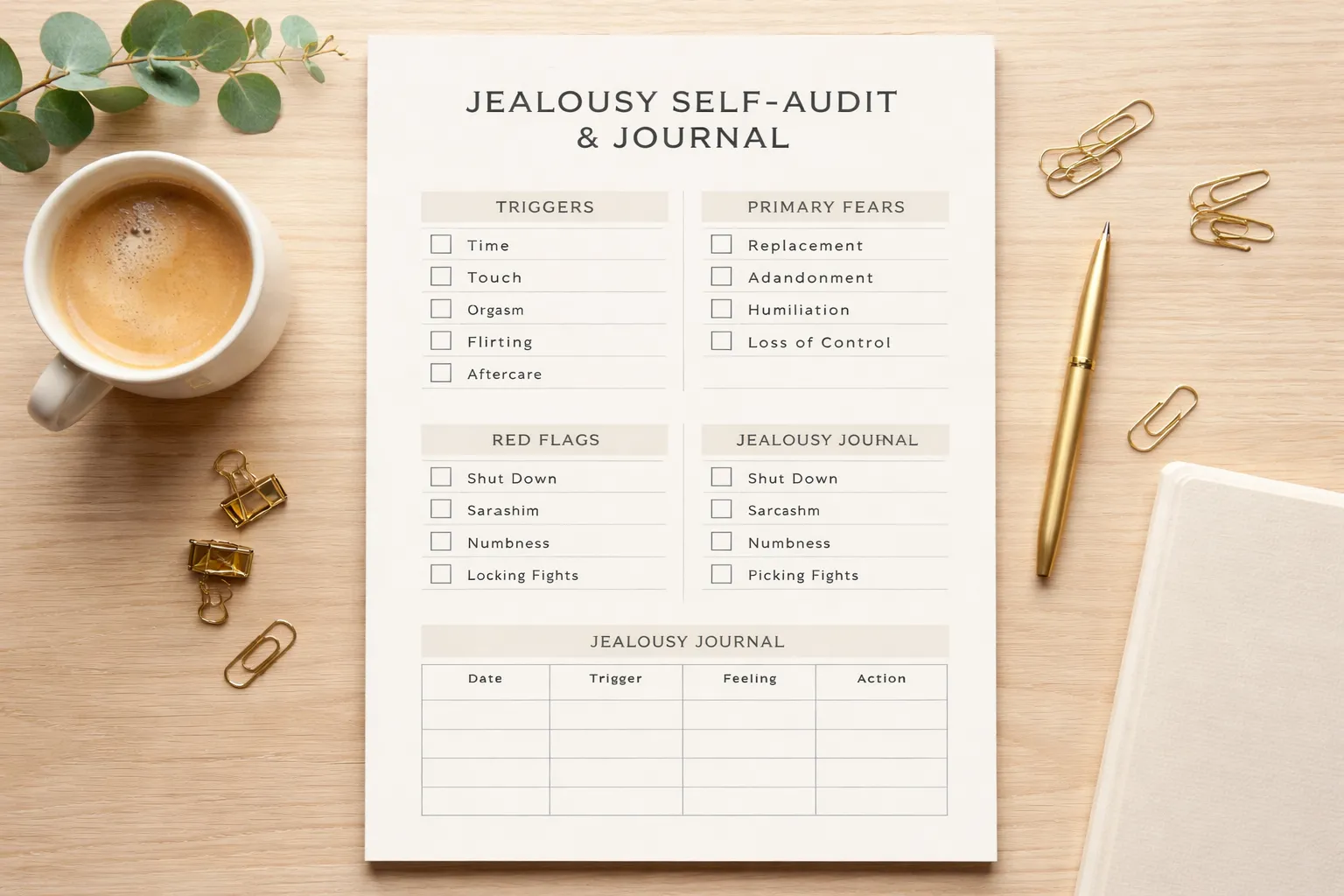
A quick self-audit, what specifically hurts
Jealousy rarely comes from “sex.” It spikes from a specific moment you did not expect or did not agree to. Get precise. Precision lowers conflict.
- Time: They stayed gone too long. You waited alone. You felt forgotten.
- Touch: Kissing felt too intimate. Cuddling felt like bonding. Hands lingered.
- Words: Pet names, praise, dirty talk, “I love that,” felt personal.
- Orgasm: They finished with them, not you. They chased their orgasm and left you behind.
- Flirting: The build-up felt like dating. Private jokes and eye contact felt exclusive.
- Aftercare: They gave care to the other person first. They came back cold. They skipped reconnection.
Pick the top two that hit you hardest. Write them down. You now have something you can plan for with clear boundaries and scripts. See Swinging Rules and Boundaries: Examples, Scripts, and Best Practices.
Identify your primary fear
Triggers sit on top. Fear sits underneath. Name the fear and you stop arguing about details.
- Replacement: “I am less desirable.” “They like them more.”
- Abandonment: “They will leave.” “I will end up alone.”
- Humiliation: “People will laugh.” “I look weak.” “I look unwanted.”
- Loss of control: “I cannot stop this.” “I cannot predict what happens next.”
Match your fear to one request you can make. Replacement, ask for words of reassurance. Abandonment, ask for a time check-in. Humiliation, ask for privacy rules. Loss of control, ask for clearer stop signals. If you need a full trust and boundaries reset, read Swinging While Married: How to Approach It With Trust and Boundaries.
Red flags you’re approaching overwhelm
You usually get a warning before you blow up the night. Learn your warning signs. Treat them as a cue to pause, not to push through.
- Shut down: You go quiet. You stop making eye contact. You stop responding.
- Sarcasm: You start “joking” sharp. You take small digs.
- Rushing: You try to end the scene fast. You push your partner to leave.
- Numbness: You feel blank. You disconnect from your body.
- Picking fights: You start policing. You search for a rule break.
Pre-agree on what happens when a red flag shows up. A short break. Water. Bathroom reset. A hand squeeze. A simple line like “pause with me.” Then you decide whether to continue or stop. Keep it clean and fast. Save the full talk for your debrief. See How to Debrief After Swinging With Your Partner (A Simple Framework).
Simple tracking tool, jealousy journal
Track patterns for two to four weeks. You will see repeat triggers. You will stop guessing. You will negotiate from data.
| Field | What to write |
|---|---|
| When | Date, time, and where you were in the night. |
| Where | Club, house party, hotel, texting at home, online chat. |
| Who | Partner, specific couple, new person, ex contact, group dynamic. |
| What happened | Concrete action only. “They kissed for two minutes.” “They left the room without telling me.” |
| What I felt | One to three words. Jealous, scared, angry, small, excluded. |
| What I needed | Reassurance, time check, touch, inclusion, a clear limit, aftercare. |
| Intensity | 0 to 10. |
| What helped | Signal used, break taken, partner check-in, leaving, debrief. |
After each entry, write one change for next time. Keep it specific. “Time check every 30 minutes.” “No pet names.” “Reconnect for five minutes after any play.” Then fold those changes into your boundaries and scripts.
Pre-Game Tools: Agreements, Boundaries, and a Plan You Can Actually Follow
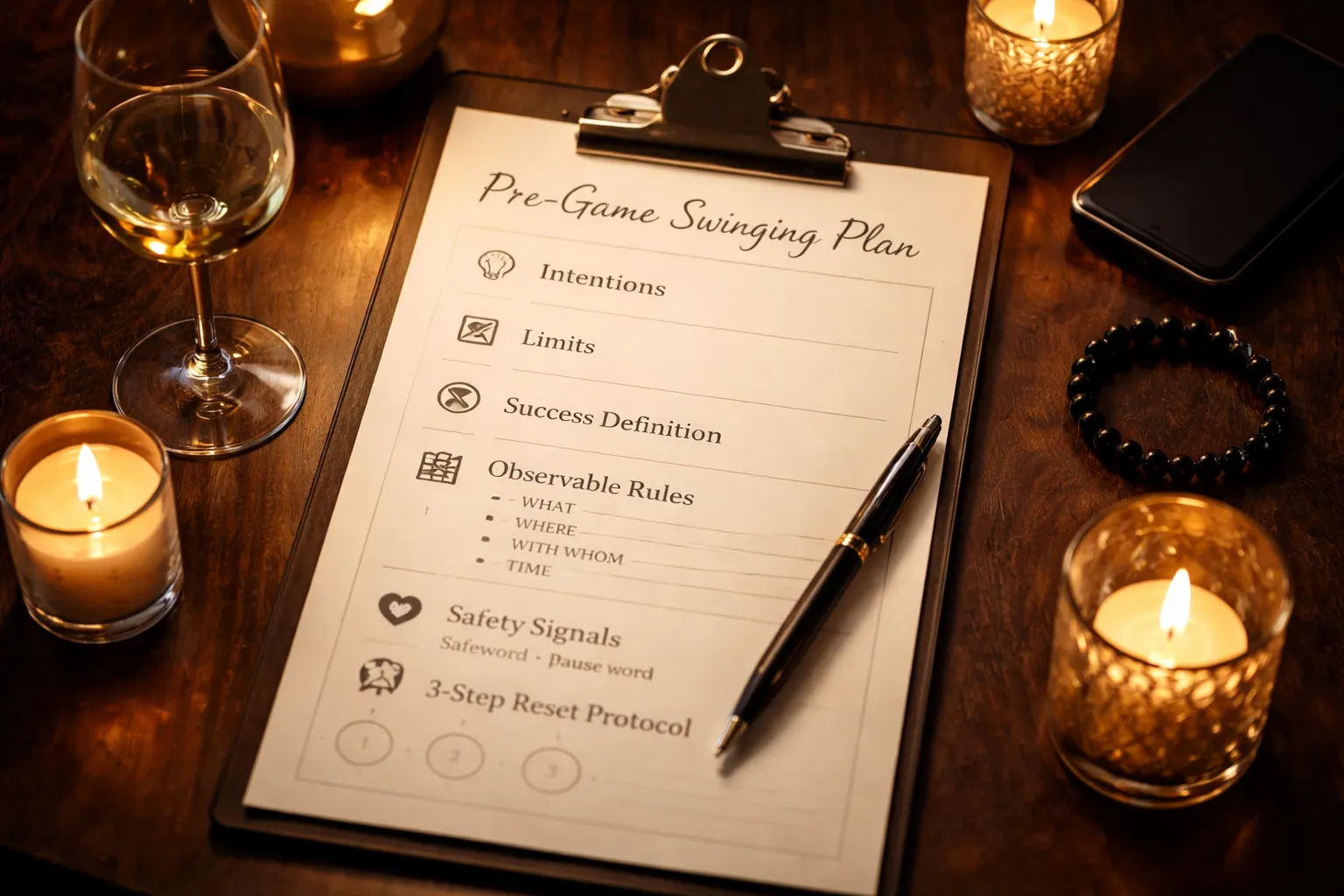
Pre-date check-in: intentions, limits, and what success looks like tonight
Do a check-in before you leave. Ten minutes. Phones down. One person speaks at a time.
Cover four points. Keep it concrete.
- Intentions: “We are here to flirt and see what clicks.” “We are here to play with one couple.” “We are here to watch and learn.”
- Jealousy risks: Name the top two triggers you already know, like seeing deep kissing, hearing pet names, long private talks.
- Limits: Hard no, soft no, yes. Use specific acts and situations.
- Success: Define a win you can measure, like “We leave connected,” “No one pushes past a soft no,” “We do one debrief before bed.”
Write your plan in one line. “Same room only, oral ok, no penetration, time check every 30 minutes, leave by 1 a.m.”
If you want a fuller pre-event flow, align it with your checklist in Swinging First Time Checklist: What to Do Before, During, and After.
Turn boundaries into observable rules
Good boundaries are visible. You can follow them in real time. “Be respectful” fails. “No pet names” works.
Use these categories and fill them in.
- What: kissing, oral, penetration, toys, condom rules, substance limits.
- Where: same room, same venue different area, separate rooms, off-site.
- With whom: couples only, singles ok, no friends, no coworkers, no repeats.
- For how long: time caps, check-in intervals, curfew, cooldown time before leaving.
- Aftercare: debrief time, reconnect routine, sleep plan, next-day check-in.
Convert each boundary into a rule you can observe.
- Instead of “Don’t ignore me,” use “Eye contact and hand touch every 10 minutes.”
- Instead of “Don’t go too far,” use “No penetration tonight.”
- Instead of “Stay close,” use “Same room only.”
- Instead of “Keep it equal,” use “No one plays unless both have a green light.”
Make rules short. Make them easy to repeat. If you cannot say it in one breath, it is not a rule yet.
Choose your safety signals: safeword, pause word, and reset protocol
You need three tools. Each has one job.
- Safeword: Full stop. You both disengage. You leave the interaction. No debate.
- Pause word: Slow down. Hands off for a moment. Quick check-in. Then continue or exit.
- Reset protocol: A scripted routine you run when jealousy spikes.
Pick words you will not say during play. Practice them out loud before you go.
Use a reset that takes under three minutes.
- Step back and create space.
- Hold hands or touch a shoulder.
- One sentence each. “I feel X.” “I need Y.”
- Choose one action. Continue, downgrade to lighter play, switch partners, take a break, leave.
Decide where resets happen. Bathroom, patio, hallway, car. Decide the default option if you cannot agree fast. “If we disagree, we take a ten-minute break.”
For deeper consent mechanics and clean communication, use Swinging Consent and Communication: Tips to Stay Safe and Aligned.
Handling common scenarios
Agree on these before the night starts. Most jealousy problems show up here.
- Split play: One partner plays while the other is nearby but not involved. Rule set: distance limit, time cap, and check-in schedule. Script: “We do 15 minutes, then a two-minute check-in.”
- Solo play in the same room: Each of you plays with someone else in the same space. Rule set: same room means same room, no disappearing behind curtains, no turning your body away for long stretches. Script: “If either of us wants eye contact, we pause and reconnect.”
- Separate rooms: This raises intensity fast. Treat it as an advanced option. Rule set: pre-approved acts only, door stays unlocked, timer on, mandatory check-in when leaving the room. Script: “We do 20 minutes, then meet at the bar.”
- Overnights: Overnights trigger attachment and comparison. Rule set: sleep arrangements, alcohol limits, morning boundaries, phone rules. Script: “If either of us feels off, we switch to a hotel or we go home.”
Set one default downgrade for any spike. Example. “If jealousy hits a 6, we drop to kissing only.” Make the downgrade automatic.
Consent and renegotiation: how to change the plan without blame
Plans change. You need a clean way to adjust without turning it into a fight.
Use a three-step renegotiation script.
- State: “I am at a 7. I am getting flooded.”
- Request: “I need a pause and a reset.” “I need same room only.” “I need to end play.”
- Confirm: “Can you agree now, yes or no.”
Drop the courtroom language. No cross-exams. No “You always.” No “You made me.” Stay in the present.
Make consent time-bound. If you say yes now, you can say no later. If you say no now, you can say yes later. Treat both as normal.
Keep one rule. Renegotiation always beats momentum. You can rebuild arousal. You cannot undo a boundary breach.
In-the-Moment Jealousy Toolkit: What to Do When the Green-Eyed Monster Shows Up
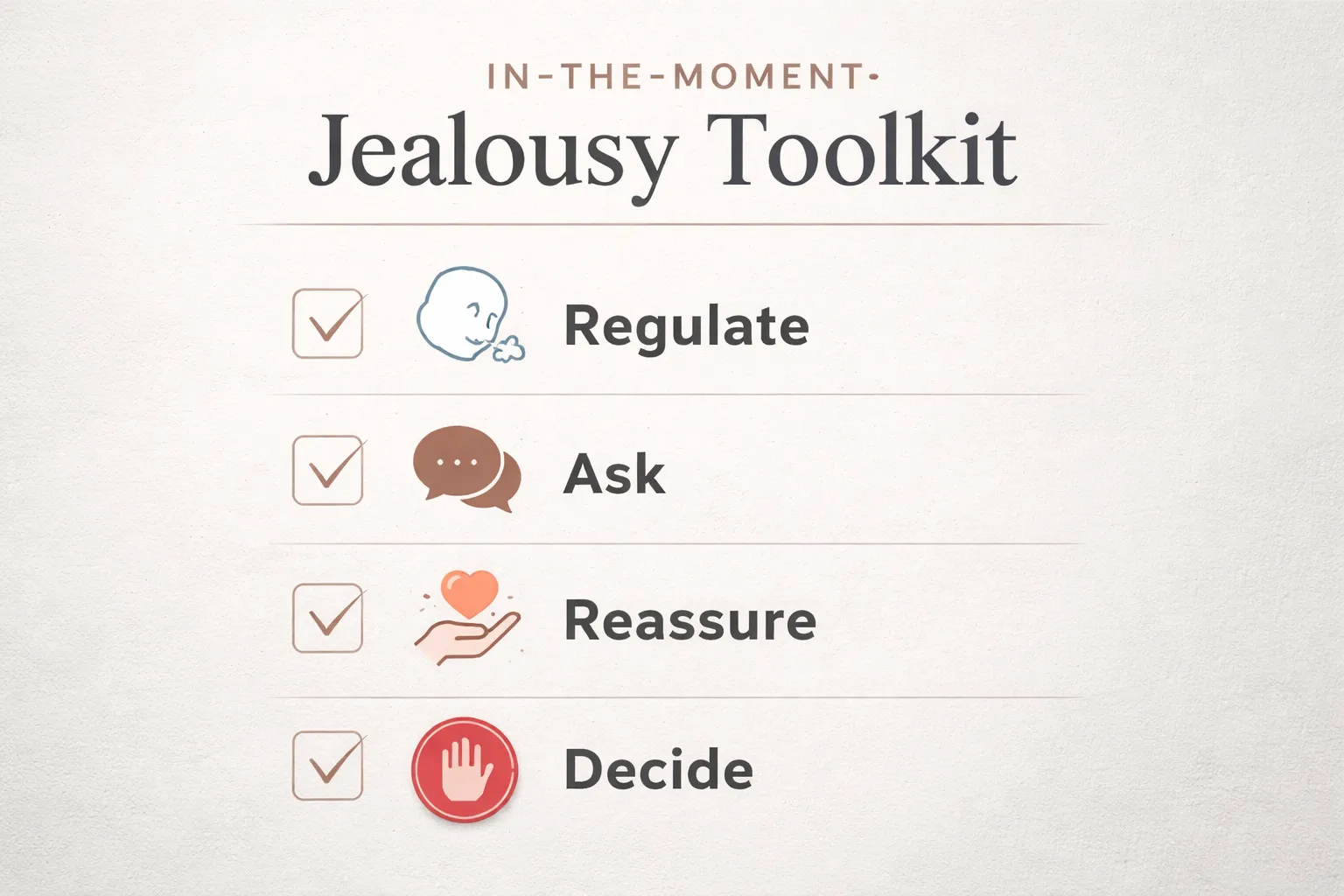
Regulate First, Stop the Spiral
Jealousy spikes fast. Your job is to slow your body down before you talk. If you talk while flooded, you will sound harsh or needy. Both push your partner away.
- Breathe: In through your nose for 4 seconds, out for 6 seconds. Do 6 rounds. Longer exhale drops arousal.
- Ground: Press both feet into the floor. Unclench your jaw. Drop your shoulders.
- Hydrate: Drink water. Low blood sugar and alcohol amplify threat response.
- Step out: Use a simple line, “I need two minutes.” Go to the bathroom, hallway, patio. Do not argue on the spot.
Pick one regulation move and use it every time. Repetition makes it faster. Speed matters in a live setting.
The 2-Minute Script to Ask for What You Need
Use the same structure every time. Keep it short. No blame. No history.
- 1. Name the state: “I’m feeling jealous and activated.”
- 2. Name the trigger in one sentence: “When I saw the kissing continue after our check-in time.”
- 3. Ask for one concrete need: “I need a 5-minute pause and eye contact.”
- 4. Set the time: “Then we can reassess.”
- 5. Confirm: “Can you do that now, yes or no.”
Needs that work in the moment: attention, reassurance, a pause, a quick check-in, a reposition in the room, switching activities, or leaving together for air.
Micro-Reassurance That Works
Small signals calm the nervous system. They also prevent you from chasing reassurance with bigger demands.
- Eye contact: 3 seconds. No talking needed.
- Touch: Hand squeeze, palm on shoulder, fingers linked. Keep it brief.
- Verbal anchor: “I’m with you.” “You’re my priority.” “We are good.” One sentence only.
- Reconnection cue: A pre-agreed word or gesture that means, “Come back to me for 30 seconds.”
- Positioning: Sit closer, knee-to-knee, or switch sides of the bed. Proximity lowers threat.
Agree on two anchors before you go out. One touch cue. One phrase. Make them routine.
Pause vs End the Date, Use a Decision Checklist
Pausing keeps you safe without killing the night. Ending the date protects trust when the conditions are wrong.
| Choose a pause when | End the date when |
| You can calm down within 10 minutes. | You cannot calm down after two regulation attempts. |
| Your partner responds with care and speed. | Your partner dismisses you or keeps pushing momentum. |
| The boundary issue is small and fixable right now. | A clear boundary was breached. |
| Alcohol is low and choices feel clear. | Alcohol is high and judgment is sliding. |
| You still want to be there after the check-in. | You feel dread, shutdown, or resentment. |
If you end it, keep it clean. “We’re done for tonight. We’re leaving together.” Save the full talk for later. Use aftercare when you get home, then debrief the next day.
- Aftercare: /aftercare-in-swinging-what-it-is-and-why-it-matters.html
- Debrief framework: /how-to-debrief-after-swinging-with-your-partner-a-simple-framework.html
Avoid These Coping Traps
These moves feel protective. They cause damage fast. They also make jealousy worse next time.
- Scorekeeping: “You got more than me.” That turns sex into debt. It kills generosity and play.
- Policing: Tracking minutes, positions, or who touched who. You stop relating and start monitoring.
- Silent tests: Withholding affection to see if your partner notices. You create distance, then call it proof.
- Drinking to numb: Alcohol reduces self-control and increases threat sensitivity. Set a drink cap before you arrive.
If you catch yourself doing any of these, stop and return to the toolkit. Regulate. Script. Micro-reassurance. Decide pause or end.
Aftercare and Repair: How to Rebuild Trust After a Jealousy Spike

Aftercare Starts Fast
Do not wait three days and call it “space.” Do aftercare within 2 hours. Then do a second debrief the next day.
Jealousy spikes leave threat signals in your body. Fast repair lowers the chance you rewrite the night as betrayal.
Post-Date Debrief Structure: Facts, Feelings, Needs, Requests
Keep the debrief short. Set a timer for 20 minutes. Take turns. No interruptions.
- Facts: What happened, in order. No mind-reading. No labels. “You kissed her for 2 minutes.”
- Feelings: One sentence each. Use body cues. “My chest tightened. I felt left out.”
- Needs: Name the need under the feeling. “I needed closeness and predictability.”
- Requests: Ask for one action next time. Make it specific. “If you move rooms, tell me first.”
If you get stuck in facts, you argue. If you skip facts, you invent stories. Use the order.
Repair vs Reassurance: What Each Partner Can Do
Reassurance reduces anxiety in the moment. Repair changes the pattern so the spike does not repeat.
- If you were the jealous partner: own your behavior. Say what you did. “I shut down and tested you.” Ask for one support action. Commit to one self-regulation action next time.
- If you were the triggering partner: own the impact. Do not debate intent. State what you will do differently. Ask what signal would have helped in the moment.
Both partners track one metric for the next date. Frequency of check-ins. Drink count. Time spent apart. Keep it measurable.
Apologies That Restore Safety, and What Does Not
A useful apology has four parts. Say them in this order.
- Name the behavior: “I left you alone without a heads-up.”
- Name the impact: “You felt unsafe and unimportant.”
- Own your choice: “I chose speed over teamwork.”
- Commit to a change: “Next time I will check in before I escalate.”
What does not rebuild safety.
- Conditional apologies: “I’m sorry you felt that way.”
- Defense first: “I didn’t mean it, but…”
- Scorekeeping: “You did it last time.”
- Global claims: “You always get jealous.”
If you want scripts and boundary language, use your shared rules document and update it after the debrief. Link it to your playbook at /swinging-rules-and-boundaries-examples-scripts-and-best-practices.html.
Adjust the Agreements: What Changes Next Time
Do not “power through” to prove you can handle it. Use baby steps. Use training wheels. Build tolerance on purpose.
- Baby steps: stay in the same room. Add touching first. Add kissing later.
- Training wheels: pre-set check-ins, hand signals, no closed doors, phones on.
- Time limits: cap solo time to 5 to 10 minutes. Use a visible timer.
- Escalation rules: no new sexual acts without a quick consent check with your partner.
- Alcohol rules: set a drink cap before you arrive, then follow it.
- Exit rules: either partner can end the night with one phrase, no debate until home.
Make one change at a time. Test it once. Then review. Too many new rules creates confusion and more spikes.
If you need a beginner structure for pacing and first nights, use /how-to-start-swinging-for-beginners-your-step-by-step-guide.html.
When Jealousy Points to Bigger Issues
Some spikes come from the date. Others come from the relationship. Do not use swinging to solve base problems.
- Low relationship satisfaction: you feel like roommates. Sex feels scarce. You chase novelty to avoid conflict. Fix the home connection first.
- Attachment wounds: you panic with distance. You read neutral actions as rejection. You need stronger repair rituals and clearer agreements.
- Mismatched motivations: one of you wants adventure. The other wants to keep the partner from leaving. That setup breeds jealousy and resentment.
- Unprocessed feelings for others: a crush or pair-bonding can intensify threat. Use a direct plan for managing ongoing contact. See /how-to-handle-feelings-for-another-couple-in-swinging.html.
If jealousy spikes keep happening after you adjust agreements twice, pause new partners. Focus on connection, communication, and consent skills. Then re-enter with tighter guardrails.
Long-Term Growth: Turning Jealousy Into Security (Without Forcing Compersion)
Long-Term Growth: Turning Jealousy Into Security (Without Forcing Compersion)
Jealousy does not need a cure. You need a system. Long-term security comes from repeatable habits, not big talks after a blowup. Track your triggers for 30 days. Use a simple scale, 0 to 10, before and after dates. Write down what helped. Keep the parts that work. Drop the rest.
Stop chasing compersion. Aim for calm neutrality. You can support your partner without feeling happy about every detail. Build safety with clear agreements, fast repair, and predictable aftercare. Treat jealousy like a signal, not a verdict. Tighten your boundaries, then test them in low-risk settings.
- Stability first: sleep, stress, alcohol limits, and timing.
- Skill reps: weekly check-ins and cleaner consent. See Swinging Consent and Communication.
- Better inputs: pre-date questions. Use these prompts.
- Contain crush risk: manage contact when feelings build. See this guide.
Read our detailed guide: Long-Term Growth: Turning Jealousy Into Security (Without Forcing Compersion) - How to Handle Jealousy in Swinging: Practical Tools That Work
FAQ: Handling Jealousy in Swinging
Is jealousy normal in swinging?
Yes. Treat it as data, not failure. Jealousy often points to unclear boundaries, weak reassurance, or unmet needs. Track when it hits, what triggered it, and what support you needed. Then adjust agreements and aftercare.
What should you do in the moment when jealousy spikes?
Use a pre-agreed pause plan. Take a break, hydrate, breathe, and name one need. Ask for a short check-in or reassurance. If you cannot regulate, end the scene. You can try again later. Protect trust first.
How do you bring up jealousy without blaming your partner?
Use clean statements. Say what you saw, what you felt, and what you need next time. Skip motives and character judgments. Keep it specific. Agree on one change you will test at the next event.
What if jealousy shows up after the date, not during?
Do aftercare the same night if possible. Then debrief within 24 to 72 hours. Use a simple structure and write down action items. See /aftercare-in-swinging-what-it-is-and-why-it-matters.html and /how-to-debrief-after-swinging-with-your-partner-a-simple-framework.html.
Should you stop swinging if you feel jealous?
Pause if jealousy stays high, repeats, and harms trust. Use the pause to rebuild safety, tighten agreements, and improve communication. Resume with lower intensity, smaller steps, and clearer limits. A short pause beats a long resentment cycle.
What boundaries reduce jealousy fastest?
Start with timing and attention rules. Examples include reconnect time before leaving, a check-in every hour, and a hard stop if either partner asks. Add clear limits on acts, locations, and who initiates. Write them down.
Does compersion fix jealousy?
No. Compersion can happen, but you cannot force it. Focus on security first. Build predictable reassurance, strong consent, and good aftercare. Jealousy often drops when your relationship feels stable and your agreements stay consistent.
How do you handle jealousy about texting and DMs?
Set a messaging policy. Define who can text, when, and what stays private. Agree on response times during couple time. If feelings build, reduce contact and review the connection. Contain crush risk early.
What if one partner gets more attention than the other?
Plan for imbalance. Rotate who leads, pick venues that fit both of you, and set a rule to pause if one partner stays sidelined. Debrief the next day and adjust your approach. Protect shared fun, not scorekeeping.
How do you deal with jealousy when your partner wants solo play?
Do not start with solo play if jealousy runs high. If you try it, use strict guardrails. Clear limits, location rules, time windows, and immediate aftercare. Treat the first attempts as experiments, then review.
What tools help you track progress over time?
Use a simple log. Rate jealousy 0 to 10 before, during, and after. Note triggers, what helped, and what you will change next time. Weekly check-ins turn random fights into planned improvements.
Can swinging strengthen your relationship even with jealousy?
Yes, if you use it to improve skills. Better communication, clearer consent, and stronger aftercare often carry into daily life. See /benefits-of-swinging-for-couples-why-some-relationships-thrive.html and /swinging-first-time-checklist-what-to-do-before-during-and-after.html.
When should you get outside help?
Get help if jealousy turns into control, threats, constant checking, or repeated boundary breaks. Also get help if you cannot calm down after events. Look for a sex-positive therapist or coach who understands non-monogamy.
Conclusion: A Practical Plan for Handling Jealousy in Swinging
Conclusion: A Practical Plan for Handling Jealousy in Swinging
Jealousy is a signal. Treat it like data. Use it to adjust your plan, not to punish your partner.
- Before: Set clear rules and boundaries. Write them down. Use simple scripts and stick to them. See /swinging-rules-and-boundaries-examples-scripts-and-best-practices.html.
- During: Use one check-in signal. Take short breaks. If you feel flooded, pause the play. Reconfirm consent. See /swinging-consent-and-communication-tips-to-stay-safe-and-aligned.html.
- After: Do aftercare the same night. Name what worked. Name one change for next time. Keep it short and specific. See /aftercare-in-swinging-what-it-is-and-why-it-matters.html.
- Between events: Track triggers and patterns. Sleep, alcohol, and stress matter. Adjust pace and intensity.
- If feelings shift: Address attachment early. Reset expectations. Tighten boundaries if needed. See /how-to-handle-feelings-for-another-couple-in-swinging.html.
- Get outside help: Get help if jealousy turns into control, threats, constant checking, or repeated boundary breaks. Also get help if you cannot calm down after events. Choose a sex-positive therapist or coach.
-
Swinging First Time Checklist: What to Do Before, During, and After
6 months ago -
How to Talk to Your Partner About Swinging (Without Pressure)
6 months ago -
Swinging Rules and Boundaries: Examples, Scripts, and Best Practices
6 months ago -
Aftercare in Swinging: What It Is and Why It Matters
6 months ago -
Questions Couples Should Ask Before Swinging (Boundaries, Safer Sex, Goals)
6 months ago
-
- Is jealousy normal in swinging?
- What should you do in the moment when jealousy spikes?
- How do you bring up jealousy without blaming your partner?
- What if jealousy shows up after the date, not during?
- Should you stop swinging if you feel jealous?
- What boundaries reduce jealousy fastest?
- Does compersion fix jealousy?
- How do you handle jealousy about texting and DMs?
- What if one partner gets more attention than the other?
- How do you deal with jealousy when your partner wants solo play?
- What tools help you track progress over time?
- Can swinging strengthen your relationship even with jealousy?
- When should you get outside help?
-
- Is jealousy normal in swinging?
- What should you do in the moment when jealousy spikes?
- How do you bring up jealousy without blaming your partner?
- What if jealousy shows up after the date, not during?
- Should you stop swinging if you feel jealous?
- What boundaries reduce jealousy fastest?
- Does compersion fix jealousy?
- How do you handle jealousy about texting and DMs?
- What if one partner gets more attention than the other?
- How do you deal with jealousy when your partner wants solo play?
- What tools help you track progress over time?
- Can swinging strengthen your relationship even with jealousy?
- When should you get outside help?
-
How to Debrief After Swinging: Break Jealousy Loops
6 months ago -
How to Repair Trust After a Boundary Is Broken
6 months ago -
How to Debrief After Swinging: Fix Resentment Early
6 months ago -
Aftercare & Support in Swinging: Red Flags and Resources
6 months ago -
Swinging Consent and Boundaries: Safer Sex & Comfort
6 months ago
-
Swinging First Time Checklist: What to Do Before, During, and After
6 months ago -
Swinging vs Open Relationship: Key Differences Explained
6 months ago -
How to Talk to Your Partner About Swinging (Without Pressure)
6 months ago -
Swingers Lifestyle Slang: Acronyms, Codes, and What They Mean
6 months ago -
Ethical Non‑Monogamy Terms: A Glossary of Common ENM Language
6 months ago